


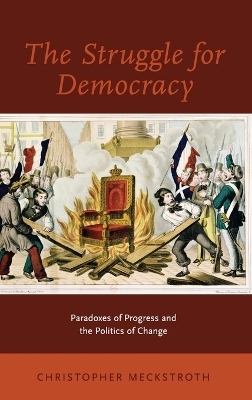
The Struggle for Democracy
Paradoxes of Progress and the Politics of Change
Seiten
2015
Oxford University Press Inc (Verlag)
978-0-19-021392-3 (ISBN)
Oxford University Press Inc (Verlag)
978-0-19-021392-3 (ISBN)
In The Struggle for Democracy, Christopher Meckstroth looks at history and context in the development of democratic theory to provide a principled way of sorting out deep conflicts over who has the right to speak for the democratic people. He tests this theory by applying it to contemporary debates over same-sex marriage, military intervention, and gun control.
Revolutionaries, counter-revolutionaries, and reformers the world over appeal to democracy to justify their actions. But when political factions compete over the right to act in "the people's" name, who is to decide? Although the problem is as old as the great revolutions of the seventeenth and eighteenth centuries, events from the Arab Spring to secession referendums suggest that today it is hardly any closer to being solved.
This book defends a new theory of democratic legitimacy and change that provides an answer. Christopher Meckstroth shows why familiar views that identify democracy with timeless principles or institutions fall into paradox when asked to make sense of democratic founding and change. Solving the problem, he argues, requires shifting focus to the historical conditions under which citizens work out what it will mean to govern themselves in a democratic way. The only way of sorting out disputes without faith in progress is to show, in Socratic fashion, that some parties' claims to speak for "the people" cannot hold up even on their own terms.
Meckstroth builds his argument on provocative and closely-argued interpretations of Plato, Kant, and Hegel, suggesting that familiar views of them as foundationalist metaphysicians misunderstand their debt to a method of radical doubt pioneered by Socrates. Recovering this tradition of antifoundational argument requires rethinking the place of German idealism in the history of political thought and opens new directions for contemporary democratic theory. The historical and Socratic theory of democracy the book defends makes possible an entirely new way of approaching struggles over contested notions of progress, popular sovereignty, political judgment and democratic change.
Revolutionaries, counter-revolutionaries, and reformers the world over appeal to democracy to justify their actions. But when political factions compete over the right to act in "the people's" name, who is to decide? Although the problem is as old as the great revolutions of the seventeenth and eighteenth centuries, events from the Arab Spring to secession referendums suggest that today it is hardly any closer to being solved.
This book defends a new theory of democratic legitimacy and change that provides an answer. Christopher Meckstroth shows why familiar views that identify democracy with timeless principles or institutions fall into paradox when asked to make sense of democratic founding and change. Solving the problem, he argues, requires shifting focus to the historical conditions under which citizens work out what it will mean to govern themselves in a democratic way. The only way of sorting out disputes without faith in progress is to show, in Socratic fashion, that some parties' claims to speak for "the people" cannot hold up even on their own terms.
Meckstroth builds his argument on provocative and closely-argued interpretations of Plato, Kant, and Hegel, suggesting that familiar views of them as foundationalist metaphysicians misunderstand their debt to a method of radical doubt pioneered by Socrates. Recovering this tradition of antifoundational argument requires rethinking the place of German idealism in the history of political thought and opens new directions for contemporary democratic theory. The historical and Socratic theory of democracy the book defends makes possible an entirely new way of approaching struggles over contested notions of progress, popular sovereignty, political judgment and democratic change.
Christopher Meckstroth is University Lecturer in the History of Political Thought at the University of Cambridge.
Acknowledgments ; Texts and Abbreviations ; Introduction: Democracy and the Politics of Change ; Chapter 1: An Historical and Socratic Theory of Democracy ; Part One ; Introduction to Part One ; Chapter 2: The Socratic Elenchus ; Chapter 3: Kant's Critique of Morality ; Chapter 4: Kant on Politics ; Chapter 5: Hegel on History ; Part Two ; Introduction to Part Two ; Chapter 6: The Four Conditions of Principle (II)* ; Chapter 7: Cases ; Conclusion ; Appendix ; Works Cited
| Erscheint lt. Verlag | 10.9.2015 |
|---|---|
| Verlagsort | New York |
| Sprache | englisch |
| Maße | 236 x 163 mm |
| Gewicht | 516 g |
| Themenwelt | Geisteswissenschaften ► Philosophie |
| Sozialwissenschaften ► Politik / Verwaltung ► Politische Systeme | |
| Sozialwissenschaften ► Politik / Verwaltung ► Politische Theorie | |
| ISBN-10 | 0-19-021392-2 / 0190213922 |
| ISBN-13 | 978-0-19-021392-3 / 9780190213923 |
| Zustand | Neuware |
| Informationen gemäß Produktsicherheitsverordnung (GPSR) | |
| Haben Sie eine Frage zum Produkt? |
Mehr entdecken
aus dem Bereich


aus dem Bereich
Das politische System der USA und die Zukunft der Demokratie
Buch | Hardcover (2025)
C.H.Beck (Verlag)
CHF 39,20
Russland, Europa, Amerika
Buch | Softcover (2025)
C.H.Beck (Verlag)
CHF 25,20


