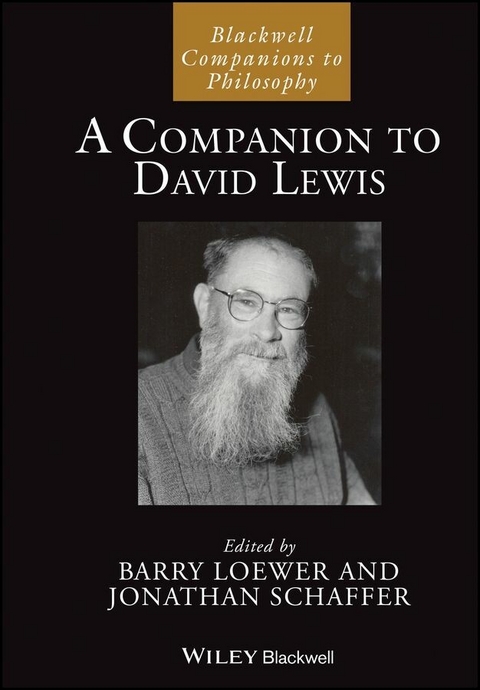
A Companion to David Lewis (eBook)
John Wiley & Sons (Verlag)
978-1-118-60761-9 (ISBN)
In A Companion to David Lewis, Barry Loewer and Jonathan Schaffer bring together top philosophers to explain, discuss, and critically extend Lewis's seminal work in original ways. Students and scholars will discover the underlying themes and complex interconnections woven through the diverse range of his work in metaphysics, philosophy of language, logic, epistemology, philosophy of science, philosophy of mind, ethics, and aesthetics.
- The first and only comprehensive study of the work of David Lewis, one of the most systematic and influential philosophers of the latter half of the 20th century
- Contributions shed light on the underlying themes and complex interconnections woven through Lewis's work across his enormous range of influence, including metaphysics, language, logic, epistemology, science, mind, ethics, and aesthetics
- Outstanding Lewis scholars and leading philosophers working in the fields Lewis influenced explain, discuss, and critically extend Lewis's work in original ways
- An essential resource for students and researchers across analytic philosophy that covers the major themes of Lewis's work
Barry Loewer is a Professor of Philosophy at Rutgers University and director of the Rutgers Center for Philosophy and the Sciences. He works mainly on philosophy of science, focusing on issues in philosophy of physics and metaphysics. His publications include 'Counterfactuals and the Second Law,' 'David Lewis's Humean Theory of Objective Chance,' and 'Why is There Anything Except Physics?'.
Jonathan Schaffer is Professor of Philosophy at Rutgers University. His research centers on metaphysics, epistemology, and language, and his publications include 'Monism: The Priority of the Whole,' 'On What Grounds What,' and 'Knowing the Answer.'
Barry Loewer is a Professor of Philosophy at Rutgers University and director of the Rutgers Center for Philosophy and the Sciences. He works mainly on philosophy of science, focusing on issues in philosophy of physics and metaphysics. His publications include Counterfactuals and the Second Law, David Lewis's Humean Theory of Objective Chance, and Why is There Anything Except Physics?. Jonathan Schaffer is Professor of Philosophy at Rutgers University. His research centers on metaphysics, epistemology, and language, and his publications include Monism: The Priority of the Whole, On What Grounds What, and Knowing the Answer.
Notes on Contributors ix
Part I Biography and New Work 1
1 Intellectual Biography of David Lewis (1941-2001): Early Influences 3
Stephanie R. Lewis
2 Counterparts of States of Affairs 15
David Lewis
3 Reply to Dana Scott, "Is There Life on Possible Worlds?" 18
David Lewis
Part II Methodology and Context 23
4 Lewis's Philosophical Method 25
Daniel Nolan
5 On Metaphysical Analysis 40
David Braddon-Mitchell and Kristie Miller
6 A Lewisian History of Philosophy 60
Robert Pasnau
7 David Lewis's Place in Analytic Philosophy 80
Scott Soames
Part III Metaphysics and Science 99
8 Humean Supervenience 101
Brian Weatherson
9 No Work for a Theory of Universals 116
M. Eddon and C.J.G. Meacham
10 Hume's Dictum and Metaphysical Modality: Lewis's Combinatorialism 138
Jessica Wilson
11 Truthmaking: With and Without Counterpart Theory 159
Phillip Bricker
12 How to Be Humean 188
Jenann Ismael
13 Where (in Logical Space) Is God? 206
Stephanie R. Lewis
14 De Re Modality, Essentialism, and Lewis's Humeanism 220
Helen Beebee and Fraser MacBride
15 David Lewis on Persistence 237
Katherine Hawley
16 "Perfectly Understood, Unproblematic, and Certain": Lewis on Mereology 250
Karen Bennett
17 Humean Reductionism about Laws of Nature 262
Ned Hall
18 Why Lewisians Should Love Deterministic Chance 278
Rachael Briggs
19 Lewis on Causation 295
Christopher Hitchcock
Part IV Language and Logic 313
20 David Lewis on Convention 315
Ernie Lepore and Matthew Stone
21 Asking What a Meaning Does: David Lewis's Contributions to Semantics 328
Barbara H. Partee
22 Accommodation in a Language Game 345
Craige Roberts
23 Lewis on Reference and Eligibility 367
J.R.G. Williams
24 On the Nature of Certain Philosophical Entities: Set Theoretic Constructionalism in the Metaphysics of David Lewis 382
Gideon Rosen
25 Primitive Self-Ascription: Lewis on the De Se 399
Richard Holton
26 Counterfactuals and Humean Reduction 411
Robert Stalnaker
27 On the Plurality of Lewis's Triviality Results 425
Alan Hájek
28 Decision Theory after Lewis 446
John Collins
29 Lewis on Mereology and Set Theory 459
John P. Burgess
Part V Epistemology and Mind 471
30 Lewis on Knowledge Ascriptions 473
Jonathan Schaffer
31 Humility and Coexistence in Kant and Lewis: Two Modal Themes, with Variations 491
Rae Langton
32 Analytic Functionalism 504
Wolfgang Schwarz
33 Lewis on Materialism and Experience 519
Daniel Stoljar
Part VI Ethics and Politics 533
34 Lewis on Value and Valuing 535
Peter Railton
35 David Lewis's Social and Political Philosophy 549
Simon Keller
Bibliography of the Work of David Lewis 562
Index 572
Notes on Contributors
Helen Beebee is Samuel Hall Professor of Philosophy at the University of Manchester. Her research focuses on issues surrounding Humeanism and its rivals. She is the author of Hume on Causation (Routledge 2006) and Free Will: An Introduction (Palgrave 2013).
Karen Bennett is Associate Professor of Philosophy at Cornell University. She is the co-editor of Oxford Studies in Metaphysics, and the author of many articles in metaphysics and philosophy of mind. Her book Making Things Up is forthcoming with Oxford University Press.
David Braddon-Mitchell is Professor of Philosophy at the University of Sydney; he works in the philosophy of mind, metaphysics, and metaethics, and has published in these areas in various journals including Mind, The Journal of Philosophy, Noûs, Philosophical Studies, Erkenntnis, and Synthese.
Phillip Bricker is Professor of Philosophy at the University of Massachusetts-Amherst. He wrote his doctoral dissertation at Princeton University under the direction of David Lewis. He works primarily in metaphysics, especially issues in modality and ontology.
Rachael Briggs splits her time as a research fellow between the Australian National University and Griffith University. Her research interests include formal epistemology, metaphysics (particularly the metaphysics of chance), and preference-satisfaction theories of wellbeing.
John P. Burgess is the John N. Woodhull Professor of Philosophy at Princeton University, where he has taught since 1975. He is author or co-author of eight books and scores of papers and reviews in logic and related areas of philosophy.
John Collins completed a PhD at Princeton under David Lewis's supervision. He is Associate Professor of Philosophy at Columbia University. His current research centers on the nature of simple belief, the role of modal principles in epistemology, the foundations of causal decision theory, and the metaphysics of dispositions.
M. Eddon is an Assistant Professor of Philosophy at the University of Massachusetts-Amherst. Her primary area of research is metaphysics, with interests in fundamentality, quantity, mereology, and intrinsicality.
Alan Hájek is Professor of Philosophy at the Australian National University (since 2005). He works mainly in formal epistemology, the philosophical foundations of probability, decision theory, philosophy of science, metaphilosophy, philosophical logic, and philosophy of religion. He received his PhD at Princeton University, and worked for 12 years at Caltech.
Ned Hall teaches philosophy at Harvard University, and works primarily on topics in metaphysics and epistemology that overlap with philosophy of science (causation, laws of nature, objective chance and its relation to credence – all the fun stuff, in other words).
Katherine Hawley is Professor of Philosophy at the University of St Andrews, Scotland. She is the author of How Things Persist (Oxford University Press 2001) and of Trust: A Very Short Introduction (Oxford University Press 2012), as well as numerous papers within metaphysics and beyond.
Christopher Hitchcock is Professor of Philosophy at the California Institute of Technology. He has published extensively on the topic of causation, including articles in most of the leading philosophy journals, as well as venues in computer science, law, and psychology. He is also the co-editor of the Oxford Handbook of Causation.
Richard Holton is Professor of Philosophy at the University of Cambridge and a fellow of Peterhouse. He works in many different fields, and is the author of Willing, Wanting, Waiting.
Jenann Ismael is a Professor of Philosophy at the University of Arizona. She has published two books and numerous articles. Her research focuses on issues related to philosophy of physics including the nature of space and time, what quantum phenomena are telling us about the world, how fundamental ontology relates to higher level structures, and how we ourselves fit into the natural order.
Simon Keller is Professor of Philosophy at Victoria University of Wellington. He has published widely on topics in ethics and political philosophy. He is the author of The Limits of Loyalty and Partiality.
Rae Langton is Professor of Philosophy at the University of Cambridge. She works in ethics, metaphysics, feminist philosophy, and a range of other areas. She is author of Kantian Humility: Our Ignorance of Things in Themselves (Oxford University Press 1998) and Sexual Solipsism: Philosophical Essays on Pornography and Objectification (Oxford University Press 2009).
Ernie Lepore is Professor of Philosophy and Cognitive Science at Rutgers University. He has published in philosophy of language and philosophy of mind.
Stephanie R. Lewis taught philosophy from 1971 until 1984. When she realized that a tenured job was a complete impossibility, she went to Wharton and got an MBA. She has worked in public finance since then; nonetheless she is a philosopher first and last.
Fraser MacBride is Professor of Logic & Rhetoric at Glasgow University. He works on metaphysics and the philosophy of mathematics and is writing a book on the history of analytic philosophy. His recent publications include “How Involved Do You Want to Be in a Non-Symmetric Relationship?,” Australasian Journal of Philosophy.
C.J.G. Meacham is an Associate Professor of Philosophy at the University of Massachusetts-Amherst. His main interests are in formal epistemology, decision theory, and the philosophy of physics.
Kristie Miller is an Associate Professor of Philosophy in the Department of Philosophy at the University of Sydney, Australia. She works primarily in metaphysics, in particular on the nature of time and persistence. Her most recent work focuses on the intersection of agency and timelessness.
Daniel Nolan is Professor of Philosophy at the Australian National University. He is the author of Topics in the Philosophy of Possible Worlds (Routledge) and David Lewis (Acumen/McGill-Queens), and articles in journals including Noûs, Philosophy and Phenomenological Research, Philosophical Studies, and Analysis. He works primarily in metaphysics.
Barbara H. Partee is Distinguished University Professor Emerita of Linguistics and Philosophy at the University of Massachusetts-Amherst. Her research centers on formal semantics; she is writing a book on the history of formal semantics. She also teaches semantics in Moscow and has worked with Russian colleagues on Slavic semantics.
Robert Pasnau is Professor of Philosophy at the University of Colorado. He works in the areas of metaphysics and knowledge, and especially the history of these subjects. He is the editor of Oxford Studies in Medieval Philosophy.
Peter Railton is Perrin Professor of Philosophy at the University of Michigan. David Lewis was his thesis supervisor. Railton's primary research has been in the philosophy of science, moral philosophy, and aesthetics. Facts, Values, and Norms (Cambridge University Press 2003) collects some of his papers in ethics and metaethics.
Craige Roberts is Professor of Linguistics and Adjunct Professor of Philosophy at the Ohio State University. Her work in formal semantics and pragmatics focuses on the nature of the context of utterance and the pragmatics of questions, presupposition, modals and attitude predicates, anaphora and reference, and their interactions in discourse.
Gideon Rosen is Stuart Professor of Philosophy and chair of the Council of the Humanities at Princeton University. He is the author (with John P. Burgess) of A Subject with No Object (Oxford 1997) and co-editor of the forthcoming Norton Introduction to Philosophy.
Jonathan Schaffer is Professor of Philosophy at Rutgers University. His research centers on metaphysics, epistemology, and language, and his publications include “Monism: The Priority of the Whole,” “On What Grounds What,” and “Knowing the Answer.”
Wolfgang Schwarz is a postdoctoral research fellow at the Australian National University in Canberra. He works on topics in epistemology, metaphysics, philosophy of language, and logic.
Scott Soames is Distinguished Professor and Director of the School of Philosophy at USC. His recent books (from Princeton University Press) include What Is Meaning?, Philosophy of Language, The Analytic Tradition in Philosophy Vol. 1, and Analytic Philosophy in America and Other Essays. Rethinking Language, Mind, and Meaning is forthcoming.
Robert Stalnaker is Laurance S. Rockefeller Professor of Philosophy at MIT. He is the author of Inquiry...
| Erscheint lt. Verlag | 10.2.2015 |
|---|---|
| Reihe/Serie | Blackwell Companions to Philosophy |
| Blackwell Companions to Philosophy | Blackwell Companions to Philosophy |
| Sprache | englisch |
| Themenwelt | Geisteswissenschaften ► Philosophie ► Allgemeines / Lexika |
| Geisteswissenschaften ► Philosophie ► Geschichte der Philosophie | |
| Geisteswissenschaften ► Philosophie ► Logik | |
| Geisteswissenschaften ► Philosophie ► Philosophie der Neuzeit | |
| Schlagworte | Analytic philosophy • Analytische Philosophie • game theory, social conventions, prisoner's dilemma, Co-ordination problems, possible worlds, modal realism, common knowledge, principal principle, Philosophy, Analytic, Western, Logic, Language, Metaphysics, Epistemology, Ethics • Lewis, David • Philosophical Logic • Philosophie • Philosophische Logik • Philosophy • Philosophy of Language • Sprachphilosophie |
| ISBN-10 | 1-118-60761-9 / 1118607619 |
| ISBN-13 | 978-1-118-60761-9 / 9781118607619 |
| Informationen gemäß Produktsicherheitsverordnung (GPSR) | |
| Haben Sie eine Frage zum Produkt? |
 EPUB (Adobe DRM)
Kopierschutz: Adobe-DRM
Adobe-DRM ist ein Kopierschutz, der das eBook vor Mißbrauch schützen soll. Dabei wird das eBook bereits beim Download auf Ihre persönliche Adobe-ID autorisiert. Lesen können Sie das eBook dann nur auf den Geräten, welche ebenfalls auf Ihre Adobe-ID registriert sind.
Details zum Adobe-DRM
Dateiformat: EPUB (Electronic Publication)
EPUB ist ein offener Standard für eBooks und eignet sich besonders zur Darstellung von Belletristik und Sachbüchern. Der Fließtext wird dynamisch an die Display- und Schriftgröße angepasst. Auch für mobile Lesegeräte ist EPUB daher gut geeignet.
Systemvoraussetzungen:
PC/Mac: Mit einem PC oder Mac können Sie dieses eBook lesen. Sie benötigen eine
eReader: Dieses eBook kann mit (fast) allen eBook-Readern gelesen werden. Mit dem amazon-Kindle ist es aber nicht kompatibel.
Smartphone/Tablet: Egal ob Apple oder Android, dieses eBook können Sie lesen. Sie benötigen eine
Geräteliste und zusätzliche Hinweise
Buying eBooks from abroad
For tax law reasons we can sell eBooks just within Germany and Switzerland. Regrettably we cannot fulfill eBook-orders from other countries.
aus dem Bereich