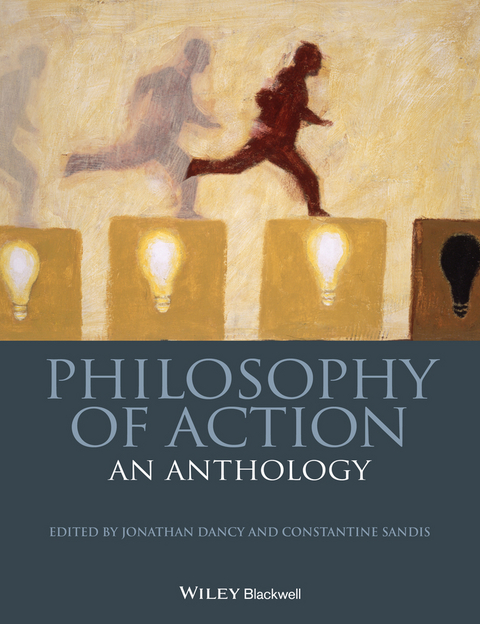
Philosophy of Action (eBook)
John Wiley & Sons (Verlag)
978-1-118-87924-5 (ISBN)
The Philosophy of Action: An Anthology is an authoritative collection of key work by top scholars, arranged thematically and accompanied by expert introductions written by the editors. This unique collection brings together a selection of the most influential essays from the 1960s to the present day.
- An invaluable collection that brings together a selection of the most important classic and contemporary articles in philosophy of action, from the 1960's to the present day
- No other broad-ranging and detailed coverage of this kind currently exists in the field
- Each themed section opens with a synoptic introduction and includes a comprehensive further reading list to guide students
- Includes sections on action and agency, willing and trying, intention and intentional action, acting for a reason, the explanation of action, and free agency and responsibility
- Written and organised in a style that allows it to be used as a primary teaching resource in its own right
Jonathan Dancy is Professor of Philosophy at the University of Texas at Austin and at the University of Reading, UK. An internationally known specialist in ethics, epistemology, and early modern philosophy, Professor Dancy is author of five books: An Introduction to Contemporary Epistemology (Blackwell, 1985), Berkeley: an Introduction (Blackwell, 1987), Moral Reasons (Blackwell, 1993), Practical Reality (2000), and Ethics Without Principles (2004).
Constantine Sandis is Professor in Philosophy at Oxford Brookes University. He is the author of The Things We Do and Why We Do Them (2012) and the editor or co-editor of New Essays on Action Explanation (2009), A Companion to the Philosophy of Action (Wiley-Blackwell, 2010), Hegel on Action (2010), and Human Nature (2012).
Jonathan Dancy is Professor of Philosophy at the University of Texas at Austin and at the University of Reading, UK. An internationally known specialist in ethics, epistemology, and early modern philosophy, Professor Dancy is author of five books: An Introduction to Contemporary Epistemology (Blackwell, 1985), Berkeley: an Introduction (Blackwell, 1987), Moral Reasons (Blackwell, 1993), Practical Reality (2000), and Ethics Without Principles (2004). Constantine Sandis is Professor in Philosophy at Oxford Brookes University. He is the author of The Things We Do and Why We Do Them (2012) and the editor or co-editor of New Essays on Action Explanation (2009), A Companion to the Philosophy of Action (Wiley-Blackwell, 2010), Hegel on Action (2010), and Human Nature (2012).
Preface x
Source Acknowledgments xi
1 Philosophical Investigations §§611-628 1
Ludwig Wittgenstein
Part I Action and Agency 3
Introduction to Part I 5
2 Agency 10
Donald Davidson
3 Shooting, Killing and Dying 21
Jonathan Bennett
4 The Problem of Action 26
Harry G. Frankfurt
5 Agents and their Actions 33
Maria Alvarez and John Hyman
6 Agency and Actions 48
Jennifer Hornsby
Part II Willing and Trying 63
Introduction to Part II 65
7 Acting, Willing, Desiring 69
H. A. Prichard
8 The Will 76
Gilbert Ryle
9 Acting and Trying to Act 83
Jennifer Hornsby
10 Action and Volition 91
E. J. Lowe
Part III Intention and Intentional Action 101
Introduction to Part III 103
11 Intention §§1-9 107
G. E. M. Anscombe
12 Knowing What I Am Doing 113
Keith S. Donnellan
13 Intending 119
Donald Davidson
14 Two Faces of Intention 130
Michael Bratman
15 Acting As One Intends 145
John McDowell
16 Intentional Action and Side Effects in Ordinary Language 158
Joshua Knobe
17 The Toxin Puzzle 161
Gregory S. Kavka
18 The Ontology of Social Agency 164
Frederick Stoutland
Part IV Acting for a Reason 177
Introduction to Part IV 179
19 Actions, Reasons, and Causes 183
Donald Davidson
20 How to Act for a Good Reason 193
Jonathan Dancy
21 Acting for a Reason 206
Christine Korsgaard
22 Arational Actions 222
Rosalind Hursthouse
23 Agency, Reason, and the Good 230
Joseph Raz
24 Skepticism About Weakness of Will 245
Gary Watson
Part V The Explanation of Action 257
Introduction to Part V 259
25 Explanation in Science and in History §§1-3 263
Carl G. Hempel
26 The Rationale of Actions 270
William Dray
27 Explanation in Science and in History §§4-7 280
Carl G. Hempel
28 The Explanatory Role of Being Rational 289
Michael Smith
29 The Conceivability of Mechanism 303
Norman Malcolm
30 Action, Causality, and Teleological Explanation 315
Arthur W. Collins
31 Psychological vs. Biological Explanations of Behavior 333
Fred Dretske
Part VI Free Agency and Responsibility 341
Introduction to Part VI 343
32 Human Freedom and the Self 347
Roderick Chisholm
33 Alternate Possibilities and Moral Responsibility 353
Harry G. Frankfurt
34 Responsibility, Control, and Omissions 360
John Martin Fischer
35 The Impossibility of Ultimate Responsibility? 373
Galen Strawson
36 Moral Responsibility and the Concept of Agency 382
Helen Steward
37 Free Will and Science 393
Alfred R. Mele
Introduction to Part I
1.
Although accounts of action have been central to most philosophical systems from Plato to Kant, it is only in recent years (following the writings of Wittgenstein and Anscombe, Chapters 1 and 11) that philosophy of action has come to be seen as a subject in its own right. We begin this volume with enquiries into what we might call the most basic question in this area of study: what is action?
One obvious suggestion is that action is bodily motion. But not all bodily motion is action; when you jog my arm, the motion of my arm is not an action of mine – I haven’t moved my arm – and it isn’t an action of yours, either. So what is the difference between those bodily motions that are actions and those that are not? The most popular strategy is to adopt a causal theory, whereby the distinction between actions and other forms of behavior lies in their causal origins; a sneeze, for instance, is typically not going to count as an action, because it has the wrong sort of cause. So which causes are of the right sort? Davidson’s influential answer to this question identifies the causes of action with (the onset of) beliefs and pro-attitudes (such as desires, preferences, and values) that rationalize the action, that is, show how the action that is their effect made sense to the agent, and so can be thought of as the agent’s reasons for doing what he did (see Chapter 19). Most sneezes are not actions, because they are not caused by rationalizing beliefs and desires, but by such things as tickles. Davidson saw this account as an improvement on earlier views which identified the causes in question with inner acts of will. His view is a form of event-causalism (since the action is an event and its causes are events, too), and due to its prominence in the literature is frequently also referred to as ‘the standard view’.
Event-causalism faces two general challenges. The first, recognized by Davidson himself, is that the right sort of cause (viz. a ‘rationalizing’ one) can bring about an action in the wrong sort of way (i.e. not in virtue of its rationalizing power). So we don’t just need things of the right sort to do the causing, we need them to do their causing in the right sort of way. Davidson (Chapter 2) gives the now famous example of a climber who wants to rid himself of the weight and danger of holding another man on a rope, and who knows that the way to do this is to let go of the rope; but if this belief and desire together so unnerve him that his grip relaxes and the rope slips through his fingers, the loosening of the grip is something that happens to him rather than something that he does; so it is not an action of his even though it is caused by a rationalizing belief-desire combination (Davidson 1973). This has come to be known as the problem of deviant causes (addressed by Smith in Chapter 28).
The second challenge to event-causalism relates to the lack of any causal role played by agents themselves in all this. If actions are events caused by (the onset of) prior mental states and/or neural processes, we arguably lose sight of what, if any, role we play in all this. If we are not ourselves actively involved, are we really the agents of our own actions or are we mere vehicles for them? It seems insufficient for agency that the causes in question occur inside us. Our digestive processes, for example, are alien to our agency in a way in which our actions had better not be. This worry has come to be known as the problem of ‘the disappearing agent’; it affects any account that, like Davidson’s, understands actions as a species of events, viz. ones with a cause that is not identified with the agent. This problem is the focus of Hornsby’s contribution in this part (Chapter 6). (There are other challenges to the details of Davidson’s view, which are discussed in Parts IV and V.)
So an alternative strategy that is not event-causalist – and is sometimes even misleadingly described as non-causalist – identifies the cause with the agent himself (Chisholm 1964; Reid 1969; O’Connor 2000) rather than with some event. This idea, known as agent-causation, is thought to avoid the two problems discussed above. Agent-causalists disagree over whether the agent causes her action or whether the action consists in her causing a certain result (the latter is argued by Alvarez and Hyman in Chapter 5). But either way, there is the further question of whether an agent’s causing something should itself be understood as an event, and if so, what, if anything, brings about that event. (Ruben 2003 denies that there are such events as the causing of things by agents; O’Connor 2000 denies that they need further causes.)
Not everybody agrees that action is bodily motion with a particular kind of cause. For instance Frankfurt (Chapter 4) defends the non-causalist view that what makes a bodily motion of yours an action is that you are embracing it as your own and that it occurs under your guidance. On this account there can be actions that do not involve the causation of bodily motion at all, so long they are embraced by the agent in the relevant way. Examples of such actions might be pressing one’s hand against a door to keep it closed, refraining from apologizing, and omitting to send a card. In addition, some ‘volitionist’ philosophers identify actions not with bodily motions, however caused, but with the inner causes of those motions, which they take to be acts of will or volitions. Other volitionists take actions to be complex events composed of volitions followed (causally or otherwise) by bodily movements; on this view neither the volition nor the bodily motion is itself an action. These and other related views will be considered in more detail in the introduction to Part II.
Whatever the causes of action may be, most of the above views seem to identify actions themselves with events of some sort. But some thinkers identify actions with processes rather than events. The precise difference between the two characterizations is contentious, but it is generally agreed that – unlike events – processes need not occur throughout or across a temporal stretch (Mourelatos 1978). Dretske (1988) argues that an action is the causal process of a mental/neural event causing a bodily event. More recent process-theorists inspired by Aristotle (e.g. Stout 1997) prefer to think of actions as non-causal processes. These are teleological processes defined by an end or goal that need not be achieved in order for it to be true that the process has taken place. One may, for example, be in the process of baking a cake without ever succeeding in baking one, or crossing the road without ever making it to the other side. So understood, there can be cake-baking or road-crossing processes without there having been a cake-baking or road-crossing event.
Whether actions are events or processes, it may seem that they are at least occurrences or happenings. In Anscombe’s terms, “I do what happens … there is no distinction between my doing and the things happening” (1957: §29). On this outlook, the problem of action we have been dealing with is that of offering a way of distinguishing the doings of an agent from what ‘merely’ happens to him (see the chapter by Frankfurt in this part). But even this framework can be, and has been, rejected. Some philosophers take actions to be instances of relations (e.g. Hyman 2001). Others remind us that to act is to do something (e.g. bring about x) and then proceed to distinguish between the thing done (the deed?) and the event of one’s doing it (Macmurray 1938; Hornsby 1980; Ricœur 1986). This distinction is often compared to that between the thing thought and one’s thinking it, or between the thing said and one’s saying it.
2.
The term ‘basic action’ was first introduced by Danto, in his 1963 paper “What We Can Do.” Danto’s goal was to identify the point at which agency begins (and arguably freedom and moral responsibility with it, but see the discussion of these issues in our introduction to Part VI). Danto’s governing thought is that no matter how complex the action I am doing, there must always be a basic element to it, viz. something by doing which I do everything else that I am doing. But the notion of the basic needs careful handing everywhere in philosophy, not least in the case of basic action. Baier (1971) has raised the worry that there are at least eight kinds of basicness, some of which are a matter of degree rather than kind: causally basic, instrumentally basic, conventionally basic, ontologically basic, logically basic, genetically basic, ease basic, and isolation basic. If so, we need to be sure which one of these we are talking about. Danto’s own example of a paradigmatic basic action is that of moving an arm “without having to do anything to cause it to move” (so pushing it with the other arm won’t count). Volitionists, by contrast, maintain that such an action as moving one’s arm is the effect of a volition; this volition is the basic action and its effect, the moving of the arm, is another action (done by means of the basic action of willing).
Chisholm has offered an alternative, teleological, definition of basic action intended to be neutral on these issues of causality: “‘A is performed by the agent as...
| Erscheint lt. Verlag | 23.2.2015 |
|---|---|
| Reihe/Serie | Blackwell Philosophy Anthologies |
| Blackwell Philosophy Anthologies | Blackwell Philosophy Anthologies |
| Sprache | englisch |
| Themenwelt | Literatur ► Historische Romane |
| Literatur ► Märchen / Sagen | |
| Geisteswissenschaften ► Philosophie ► Allgemeines / Lexika | |
| Geisteswissenschaften ► Philosophie ► Metaphysik / Ontologie | |
| Schlagworte | action • Anthology • Articles • Best • best previously • College • concise • CONSPECTUS • Epistemology • Erkenntnistheorie • Excellent • introductions • Last • Metaphysics • Metaphysik • Minimal • Offers • overlap • Philosophie • Philosophy • publishedpapers • Reader • reader deftly • selection • thirtyseven • topic • UK |
| ISBN-10 | 1-118-87924-4 / 1118879244 |
| ISBN-13 | 978-1-118-87924-5 / 9781118879245 |
| Informationen gemäß Produktsicherheitsverordnung (GPSR) | |
| Haben Sie eine Frage zum Produkt? |
 EPUB (Adobe DRM)
Kopierschutz: Adobe-DRM
Adobe-DRM ist ein Kopierschutz, der das eBook vor Mißbrauch schützen soll. Dabei wird das eBook bereits beim Download auf Ihre persönliche Adobe-ID autorisiert. Lesen können Sie das eBook dann nur auf den Geräten, welche ebenfalls auf Ihre Adobe-ID registriert sind.
Details zum Adobe-DRM
Dateiformat: EPUB (Electronic Publication)
EPUB ist ein offener Standard für eBooks und eignet sich besonders zur Darstellung von Belletristik und Sachbüchern. Der Fließtext wird dynamisch an die Display- und Schriftgröße angepasst. Auch für mobile Lesegeräte ist EPUB daher gut geeignet.
Systemvoraussetzungen:
PC/Mac: Mit einem PC oder Mac können Sie dieses eBook lesen. Sie benötigen eine
eReader: Dieses eBook kann mit (fast) allen eBook-Readern gelesen werden. Mit dem amazon-Kindle ist es aber nicht kompatibel.
Smartphone/Tablet: Egal ob Apple oder Android, dieses eBook können Sie lesen. Sie benötigen eine
Geräteliste und zusätzliche Hinweise
Buying eBooks from abroad
For tax law reasons we can sell eBooks just within Germany and Switzerland. Regrettably we cannot fulfill eBook-orders from other countries.
aus dem Bereich