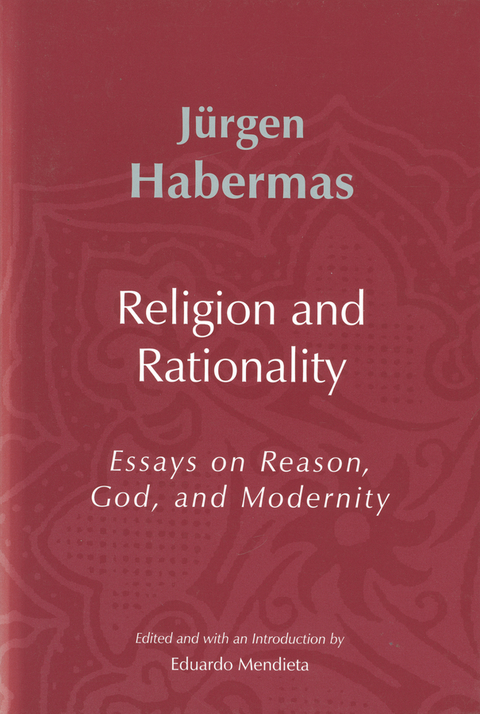
Religion and Rationality (eBook)
John Wiley & Sons (Verlag)
978-0-7456-9441-2 (ISBN)
In a new introduction written especially for this volume, EduardoMendieta places Habermas' engagement with religion in the contextof his work as a whole. Mendieta also discusses Habermas' writingsin relation to Jewish Messianism and the Frankfurt School, showinghow the essays in Religion and Rationality, one of which istranslated into English for the first time, foreground animportant, yet often neglected, dimension of critical theory. Thevolume concludes with an original extended interview, also inEnglish for the first time, in which Habermas develops his currentviews on religion in modern society.
This book will be of great interest to students and scholars intheology, religious studies and philosophy, as well as to all thosealready familiar with Habermas' work.
Jürgen Habermas is Professor of Philosophy Emeritus atthe University of Frankfurt.
This important new volume brings together Habermas' key writing on religion and religious belief. Habermas explores the relations between Christian and Jewish thought, on the one hand, and the Western philosophical tradition on the other. In so doing, he examines a range of important figures, including Benjamin, Heidegger, Johann Baptist Metz and Gershom Scholem. In a new introduction written especially for this volume, Eduardo Mendieta places Habermas' engagement with religion in the context of his work as a whole. Mendieta also discusses Habermas' writings in relation to Jewish Messianism and the Frankfurt School, showing how the essays in Religion and Rationality, one of which is translated into English for the first time, foreground an important, yet often neglected, dimension of critical theory. The volume concludes with an original extended interview, also in English for the first time, in which Habermas develops his current views on religion in modern society. This book will be of great interest to students and scholars in theology, religious studies and philosophy, as well as to all those already familiar with Habermas' work.
Jürgen Habermas is Professor of Philosophy Emeritus at the University of Frankfurt.
Acknowledgments.
Introduction.
Chapter 1: The German Idealism of the Jewish Philosophers.
Chapter 2: On the Difficulty of Saying No.
Chapter 3: Transcendence from Within, Transcendence in this
World.
Chapter 4: To Seek to Salvage an Unconditional Meaning Without
God is a Futile Undertaking: Reflections on a Remark of Max
Horkheimer.
Chapter 5: Communicative Freedom and Negative Theology:
Questions for Michael Theunissen.
Chapter 6 Israel or Athens: Where does Anamnestic Reason Belong?
Johannes Baptist Metz on Unity amidst Multicultural Plurality.
Chapter 7: Tracing the Other of History in History: Gershom
Scholem's Sabbati Sevi.
Chapter 8: A Conversation About God and the World: Interview
with Eduardo Mendieta.
Index
1
The German Idealism of the Jewish Philosophers
“The Jew can play a creative role in nothing at all that concerns German life, neither in what is good nor in what is evil.” This statement by Ernst Jünger has outlived the anti-Semitism of the conservative revolutionaries in whose name it was written more than a generation ago. I heard the identical assertion just a few years ago in the philosophy department of one of our great universities. As this version had it, Jews at best attain stardom of the second rank. At that time, when I was a student, I did not give it a second thought; I must have been occupied with reading Husserl, Wittgenstein, Scheler, and Simmel without realizing the descent of these scholars. However, the well-known philosophy professor who gainsaid the productivity of his Jewish colleagues did know of their origins. The stubbornness of the components of an ideology whose discrepancies could be conveyed by any lexicon is remarkable. If it were a matter of dissecting into pieces a form of the spirit such as that of German philosophy in the twentieth century, separating it out according to its parts, and putting it on the scales, then we would find in the domain supposedly reserved for German profundity a preponderance of those the same prejudice wants to assign to the outer court as merely critical talents.
It is not my intention here to offer another proof of what has long since been demonstrated. There is another situation much more in need of clarification: It remains astonishing how productively central motifs of the philosophy of German Idealism shaped so essentially by Protestantism can be developed in terms of the experience of the Jewish tradition. Because the legacy of the Kabbalah already flowed into and was absorbed by Idealism, its light seems to refract all the more richly in the spectrum of a spirit in which something of the spirit of Jewish mysticism lives on, in however hidden a way.
The abysmal and yet fertile relationship of the Jews with German philosophy shares in the social fate that once forced open the gates of the ghettos, for assimilation or reception of the Jews into bourgeois society became a reality only for the minority of Jewish intellectuals. Despite a century and a half of progressive emancipation, the broad mass of the Jewish people had not gotten beyond the formal aspects of equal rights. On the other hand, even the courtly Jews, like their successors, the Jewish bankers of the state of the nineteenth century, never became fully acceptable socially. Indeed, they had not striven so seriously to break down the barriers of their invisible ghetto; a universal emancipation would have threatened what privileges they possessed. Assimilation stretched only a thin protective layer around the permanently foreign body of Jewry. Its medium was a culture gained academically, its seal a baptism often socially coerced. If these cultivated Jews would give back to the culture intellectually as much as they owed to it, their social standing remained so ambivalent right into the 1920s that Ernst Jünger could not only deprecate their productivity as the “feuilleton prattle of civilization” but also put in question the process of assimilation: “To the same extent that the German will gains in sharpness and shape, it becomes increasingly impossible for the Jews to entertain even the slightest delusion that they can be Germans in Germany; they are faced with their final alternatives, which are, in Germany, either to be Jewish or not to be.” This was in 1930, when those who could not adapt to a dubious politics of apartheid were already being offered the menacing promise that was so gruesomely kept in the concentration camps.
And so, precisely out of the marginal strata that had been assimilated most successfully, there emerged the spokesmen for a turning back of the German Jews to the origins of their own tradition. This movement found its political expression in Zionism and its philosophic expression in the (as it were, anticipated) existentialism of Martin Buber, who fastened onto the last phase of Jewish mysticism. The Polish and Ukrainian Hassidism of the eighteenth century had drawn its ideas from kabbalist writings, but the doctrine had retreated so far behind the personality of the Hassidic holy men that the traditionally idealized figure of the learned rabbi was pushed out by that of the folkish Zaddik, whose existence was the Torah become entirely and utterly living. In Buber's zeal against the rationalistically stultified teaching of the rabbis and his appropriation of the religion of the people, which was full of mythic legends and mystical faces, a new pathos of existential philosophizing was enflamed:
With the destruction of the Jewish communal spirit the fruitfulness of the spiritual conflict became weakened. Spiritual force is mustered henceforth on behalf of the preservation of the people against outside influences; the strict enclosure of one's own realm, to protect against penetration by alien tendencies; the codification of values in order to fend off every shift in values; the unmistakable, unreinterpretable, hence consistently rational formulation of religion. In place of the God-filled, demanding, creative element there entered the ever more rigid, merely preserving, merely continuing, merely defensive element of official Judaism; indeed, it was directed ever more against the creative element, which seemed to endanger the status quo of the people by its audacity and freedom; it became its persecutor and life-enemy.
The Hassidic impulse first found a philosophical language in the work of Franz Rosenzweig. Rosenzweig, who with Buber translated the Bible into German, had worked on Hegel's philosophy of state as a student of Friedrich Meinecke. In his own great project he attempted – as the title of the three-volume work, Star of Redemption, announced from afar – an interpretation of Idealist thought out of the depths of Jewish mysticism. Not only was he one of the first to establish links with Kierkegaard; he also took up motifs of the so-called late Idealism, especially from Schelling's last philosophy; thus he divulged the lineage of existentialist philosophy decades before it was painstakingly rediscovered by the official history of philosophy. The basic question on which the Idealist self-confidence in the power of the concept shatters is this: “How can the world be contingent, although it still has to be thought of as necessary?” Thought labors in vain on the impenetrable fact that things are so and not otherwise, that the historical existence of human beings is so profoundly bathed in enigmatic arbitrariness:
Inasmuch as philosophy … denies this opaque presupposition of all life; that is, inasmuch as it does not let it hold good as something real but makes it into nothing, it conjures up for itself the illusion of presuppositionlessness. … If philosophy wanted not to stop up its ears in the face of the cry of anguished humanity, it would have to start from this: that the nothingness of death is a something; that each new nothingness of death, as a new newly fruitful something, is not to be talked or written away. … Nothingness is not nothing, it is something. … We do not want a philosophy that deceives us by the all-or-nothing tone of its dance about the lasting domination of death. We want no deception.
The deception that has been seen through leads to the insight that the world, in which there is still laughter and crying, is itself caught up in becoming – the appearances still seek their essence. In the visible happening of nature is disclosed the growth of an invisible realm in which God himself looks forward to his redemption: “God, in the redemption of the world by human beings and of human beings in relation to the world, redeems himself.”
Idealism only entered into competition with the theology of creation; still in bondage to Greek philosophy, it did not look upon the unreconciled world from the standpoint of possible redemption. Its logic remained in the grips of the past: “True lastingness is constantly in the future. Not what always was is lasting; not what gets renewed at all times, but solely what is to come: the kingdom.” The meaning of this, of course, is only disclosed to a logic that does not, like that of Idealism, deny its linguistic body; it has to open itself up to the underlying logic deposited in the language – a resonance from the ancient kabbalist idea that language reaches God because it is sent out from God. Idealism condemned language as the instrument of knowledge and elevated a divinized art as its substitute. A Jew actually anticipated Heidegger, the philosophicus teutonicus, in this peculiarly heightened awareness.
Toward the end of World War I, Rosenzweig sent home the manuscript of Star of Redemption by mail from the field of battle. The way he conceived of the messianic vocation of Jewish exile during his time on the Balkan front is documented by a passage from one of his letters: “Because the Jewish people already stands beyond the opposition that forms the authentically dynamic power in the life of the nations, beyond the polarity of particularity and world history, of home and faith, of earth and heaven, so, too, it does not know war.”
Another Jewish philosopher, Hermann Cohen, had on Christmas Day 1914 testified in the same sense to the students withdrawing from their studies to the field of battle that the political expression of the messianic idea is eternal peace: “Since the prophets as international politicians...
| Erscheint lt. Verlag | 15.10.2014 |
|---|---|
| Sprache | englisch |
| Themenwelt | Geisteswissenschaften ► Philosophie ► Allgemeines / Lexika |
| Geisteswissenschaften ► Philosophie ► Logik | |
| Geisteswissenschaften ► Religion / Theologie | |
| Schlagworte | Benjamin • Brings • ConText • Continental Philosophy • Eduardo Mendieta • Engagement • Habermas • Hand • important • Introduction • Key • Kontinentalphilosophie • Mendieta • New • new volume • Philosophie • Philosophy • Philosophy of Religion • Places • Range • Religion • Religion & Theology • Religionsphilosophie • Religion u. Theologie • Religious • Volume • western philosophical tradition • whole • Work |
| ISBN-10 | 0-7456-9441-1 / 0745694411 |
| ISBN-13 | 978-0-7456-9441-2 / 9780745694412 |
| Informationen gemäß Produktsicherheitsverordnung (GPSR) | |
| Haben Sie eine Frage zum Produkt? |
 EPUB (Adobe DRM)
Kopierschutz: Adobe-DRM
Adobe-DRM ist ein Kopierschutz, der das eBook vor Mißbrauch schützen soll. Dabei wird das eBook bereits beim Download auf Ihre persönliche Adobe-ID autorisiert. Lesen können Sie das eBook dann nur auf den Geräten, welche ebenfalls auf Ihre Adobe-ID registriert sind.
Details zum Adobe-DRM
Dateiformat: EPUB (Electronic Publication)
EPUB ist ein offener Standard für eBooks und eignet sich besonders zur Darstellung von Belletristik und Sachbüchern. Der Fließtext wird dynamisch an die Display- und Schriftgröße angepasst. Auch für mobile Lesegeräte ist EPUB daher gut geeignet.
Systemvoraussetzungen:
PC/Mac: Mit einem PC oder Mac können Sie dieses eBook lesen. Sie benötigen eine
eReader: Dieses eBook kann mit (fast) allen eBook-Readern gelesen werden. Mit dem amazon-Kindle ist es aber nicht kompatibel.
Smartphone/Tablet: Egal ob Apple oder Android, dieses eBook können Sie lesen. Sie benötigen eine
Geräteliste und zusätzliche Hinweise
Buying eBooks from abroad
For tax law reasons we can sell eBooks just within Germany and Switzerland. Regrettably we cannot fulfill eBook-orders from other countries.
aus dem Bereich