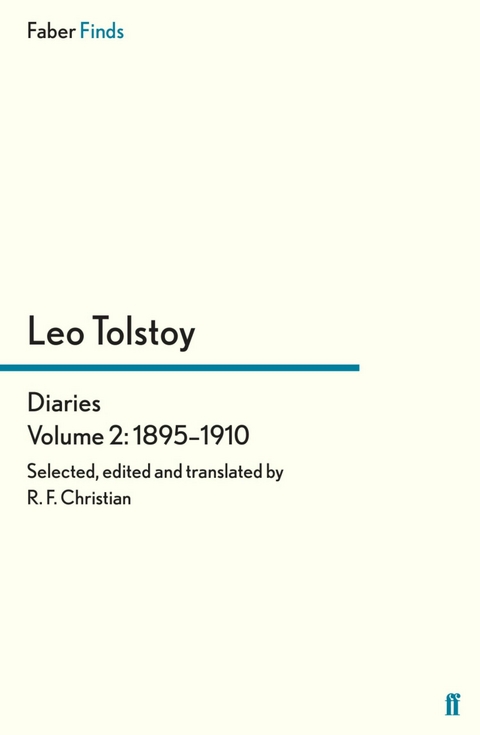
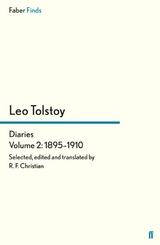
Tolstoy's Diaries Volume 2: 1895-1910 (eBook)
366 Seiten
Faber & Faber (Verlag)
978-0-571-32406-4 (ISBN)
Professor R. F. Christian is one of the major scholars of Russian literature of the last one hundred years. Most especially he is associated with Tolstoy being accorded the highest praise from authors and critics like A. N. Wilson, Jay Parini and George Steiner. Among his publications are Tolstoy: A Critical Introduction, Tolstoy's 'War and Peace': A Study and his definitive editions of Tolstoy's Letters and Diaries (both in two volumes). The Letters and Diaries as well as his 'War and Peace' book have been reissued in Faber Finds. Professor Christian was born in Liverpool, graduated from Oxford University with a first-class honours degree in Russian, joined the Foreign Office and was Attache at the British Embassy in Moscow. His academic career began at the University of Liverpool. At the University of Birmingham he became Chair of Russian Language and Literature. He moved to the University of St. Andrews from where he retired as Head of the Russian Department. A man of many interests beyond the academic, it has been said of him that 'he has always welcomed change if it led to improvements in standards of teaching and research, but one who has always resisted the idea of change for change's sake.'
An important and long-overdue contribution to our knowledge of Tolstoy.' D. M. Thomas, Sunday TimesVolume 2 of Tolstoy's Diaries covers the years 1895-1910. These Diaries were meticulously edited by R.F. Christian so as to reflect Tolstoy's preoccupations as a writer (his views on his own work and that of others), his development as a person and as a thinker, and his attitudes to contemporary social problems, rural life, industrialisation, education, and later, to religious and spiritual questions. Christian introduces each period with a brief and informative summary of the main biographical details of Tolstoy's life. The result is a unique portrait of a great writer in the variegation of his everyday existence. 'As a picture of the turbulent Russian world which Tolstoy inhabited these diaries are incomparable - the raw stuff not yet processed into art.' Anthony Burgess'A model of scholarship, one of the most important books to be published in recent years.' A. N. Wilson, Spectator
23 January, Moscow Haven’t written my diary for exactly a month. During this time I’ve written a letter on patriotism1 and a letter to Crosby, and for about two weeks now I’ve been writing a drama.2 I’ve written three acts very badly. I’m thinking of sketching it out in rough, to give it a charpente [framework]. Haven’t much hope of success. The Chertkovs and Kenworthy left on the 7th. Sonya has gone to Tver to see Andryushka. Nagornov died today. I’m rather unwell again. Noted down during this time:
(1) A true work of art – an infectious one – is only produced when the artist seeks and strives towards a goal. This passion in poetry for depicting what is, stems from the fact that the artist hopes that by seeing clearly and pinning down what is, he will understand the meaning of what is.
(2) In every art there are two aberrations: triviality and artificiality. Between the two there is only a narrow path. And this narrow path is defined by inner drive. Given inner drive and direction, you avoid both dangers. Of the two, the more terrible is artificiality.
(3) It’s impossible to force the mind to understand and comprehend what the heart doesn’t want.
(4) It’s bad when the mind wants to attribute virtuous significance to egotistical strivings.
Kudinenko3 was here, a remarkable man. Suller took the oath and is serving.4 A letter from Makovitsky with an article about the Nazarenes.5
25 January, Moscow The main event of the last two days was the death of Nagornov – death is always new and significant. Thought: they represent death in the theatre. Does it make one ten-thousandth of the impression which the proximity of real death makes?
I’m continuing to write the drama. I’ve written the fourth act. It’s all bad. But it’s beginning to resemble something real.
26 January, Moscow I.I.A I’m alive, but not living. Strakhov. Heard the news of his death today. They buried Nagornov today – and now this news. I lay down to sleep, but couldn’t sleep, and a clear picture came to me of an understanding of life whereby we might feel ourselves to be travellers. Ahead of us lies one and the same station in one and the same, familiar conditions. How can we travel past that station otherwise than eagerly and joyfully, in a friendly and cooperative spirit, without lamenting the fact that we ourselves are going, or that others are going ahead of us, to the place where we shall all be together again, even more so than before?
Today I wrote a post-script to the letter to Crosby. A good letter from Kenworthy. Unpleasantness with Manson.6 He’s a journalist.
[13 February] Haven’t written my diary for almost a month. Today is 13 February, Moscow. Wanted to go to the Olsufyevs’. Sonya wasn’t pleased. I stayed here. There’s a lot of fuss here, and it takes up a lot of time. I settle down late to work and so don’t write much. Managed somehow to finish the fifth act of the drama and took up Resurrection again. I’ve got eleven chapters done and am making a bit of progress. Revised the letter to Crosby. An important event was Strakhov’s death, and as well as that – Davydov’s conversation with the Tsar.7 To my shame I feel glad about this. Ertel’s article about the usefulness of flirting with liberalism and Spielhagen’s letter about the same thing irritate me.8 But I shouldn’t and musn’t write – there’s no time. Letters from Sopotsko and Zdziechowski about Orthodoxy and Catholicism irritate me from a different aspect, but I probably won’t write.9 And then yesterday there was a letter from Grinevich’s mother about the religious education of children.10 Something must be done about it. At least, I must make every effort to do something. A great deal of music – useless. The girls – especially Masha – are weak. Will she manage to get over it somehow? I don’t give them enough guidance. They need to be helped. The boys are alien to me. With regard to religion, I’ve been very cold all this time. Thought during this time:
[…]
(3) The possibility of killing oneself is a freedom given to people. God didn’t want slaves in this life, but free workers. If you stay on in this life, it means that conditions are favourable for you. If they are favourable – then work. But if you want to escape from the conditions here and kill yourself, you will be offered the same conditions again in the next life. So there is nowhere to escape to. It would be good to write a story about the experiences in this life of a man who had killed himself in a previous one: how, when running up against the same demands made on him in the other life, he comes to the realisation that he must fulfil them. And in this life he would be more intelligent than other people, remembering the lesson he had had. […]
Today is 27 February, Nikolskoye I’m getting on with the drama. It’s going very sluggishly. I don’t even know whether I’m making any progress. Some moderately discontented letters from Sonya in Moscow. But I feel very well here – the main thing is the quietness. I’ve been reading Trilby11 – poor. Wrote letters to Chertkov, Schmitt and Kenworthy. Read Corneille.12 Edifying. I’ve been thinking:
(1) I once noted that there are two kinds of art. I’ve been thinking about it now and can find no clear way of expressing my idea. At that time I used to think that there is an art, as it has rightly been defined, which derives from play, from the need of every creature to play. The play of a calf is jumping, the play of a man – a symphony, picture, poem or novel. This is one kind of art – the art of playing and inventing new games, performing old ones and making up new ones. This is a good, useful and valuable thing because it increases the joys of man. But understandably one can only engage in play when one is well fed. Likewise society can only engage in art when all its members are well fed. And until its members are well fed, there can be no real art. But there will be an art of the overfed, a misshapen one, and an art of the hungry – crude and pitiful – as is the case now. And so with this first kind of art – play – only that art is valuable which is accessible to all, and increases the joys of all. If this is so, it is not a bad thing, especially if it does not require an increase of the labour of the oppressed, as happens now. (This could and should be better expressed.)13
But there is another kind of art also which evokes in people better and higher feelings.
I’ve just written what I’ve said many times, and I think it’s not true.
There is only one kind of art, and it consists in increasing innocent joys, common and accessible to all – the good of man. A fine building, a gay picture, a song or a story produces a little good; the awakening of a religious feeling of love of the good brought about by a drama, a painting or singing produces a great good.
(2) What I also thought about art is that nowhere else is conservatism so harmful as in art.
Art is one of the manifestations of man’s spiritual life, and so, just as if an animal is alive, it breathes and secretes the products of its breathing, so, if mankind is alive, it manifests the activity of art. And so at any given moment it must be contemporary – art of our time. One only needs to know whereabouts it is (it isn’t in the music, poetry and novels of the Decadents). But it must be sought not in the past, but in the present. People who wish to show themselves to be connoisseurs of art and who therefore praise the art of the past – classical art – and abuse the contemporary, only show by this that they have no feeling for art. […]
(7) Today at dinner there was talk about a boy with vicious inclinations who had been expelled from school, and about how good it would be to commit him to a reformatory. This is exactly what a man does who has lived a bad life, injurious to his health, and who, when sickness overtakes him, turns to a doctor to be cured, never thinking that his sickness is a beneficial indication to him that his whole life is bad and that he ought to change it. It’s the same with the sickness of our society. All the sick members of this society fail to remind us that the whole life of our society is wrong and ought to be changed, but we think that for every such sick member, there is or ought to be an institution ridding us of this member or even reforming him. Nothing hinders the progress of mankind so much as this false belief. The more sick society is, the more institutions there are for treating the symptoms, and the less concern for changing its entire life. […]
Today is 2 May, Yasnaya Polyana Haven’t written my diary for nearly two months. I was living in Moscow all that time. Important events: a closer acquaintance with the scribe Novikov14 who changed his life as a result of my books which his brother, a man-servant, received from his mistress abroad. A spirited young man. Then his other brother, a worker, asked for What I Believe, and Tanya sent it to Kholevinskaya. Kholevinskaya was taken to prison. The prosecutor said they ought to have laid hands on...
| Erscheint lt. Verlag | 19.2.2015 |
|---|---|
| Reihe/Serie | Leo Tolstoy, Diaries and Letters | Leo Tolstoy, Diaries and Letters |
| Einführung | Rosamund Bartlett |
| Verlagsort | London |
| Sprache | englisch |
| Themenwelt | Literatur ► Biografien / Erfahrungsberichte |
| Literatur ► Briefe / Tagebücher | |
| Literatur ► Essays / Feuilleton | |
| Literatur ► Romane / Erzählungen | |
| Geisteswissenschaften ► Sprach- / Literaturwissenschaft ► Literaturwissenschaft | |
| Schlagworte | Diaries • Faber Finds • Industry • Letters • Social History • writers |
| ISBN-10 | 0-571-32406-1 / 0571324061 |
| ISBN-13 | 978-0-571-32406-4 / 9780571324064 |
| Informationen gemäß Produktsicherheitsverordnung (GPSR) | |
| Haben Sie eine Frage zum Produkt? |
 EPUB (Adobe DRM)
Kopierschutz: Adobe-DRM
Adobe-DRM ist ein Kopierschutz, der das eBook vor Mißbrauch schützen soll. Dabei wird das eBook bereits beim Download auf Ihre persönliche Adobe-ID autorisiert. Lesen können Sie das eBook dann nur auf den Geräten, welche ebenfalls auf Ihre Adobe-ID registriert sind.
Details zum Adobe-DRM
Dateiformat: EPUB (Electronic Publication)
EPUB ist ein offener Standard für eBooks und eignet sich besonders zur Darstellung von Belletristik und Sachbüchern. Der Fließtext wird dynamisch an die Display- und Schriftgröße angepasst. Auch für mobile Lesegeräte ist EPUB daher gut geeignet.
Systemvoraussetzungen:
PC/Mac: Mit einem PC oder Mac können Sie dieses eBook lesen. Sie benötigen eine
eReader: Dieses eBook kann mit (fast) allen eBook-Readern gelesen werden. Mit dem amazon-Kindle ist es aber nicht kompatibel.
Smartphone/Tablet: Egal ob Apple oder Android, dieses eBook können Sie lesen. Sie benötigen eine
Geräteliste und zusätzliche Hinweise
Buying eBooks from abroad
For tax law reasons we can sell eBooks just within Germany and Switzerland. Regrettably we cannot fulfill eBook-orders from other countries.
aus dem Bereich