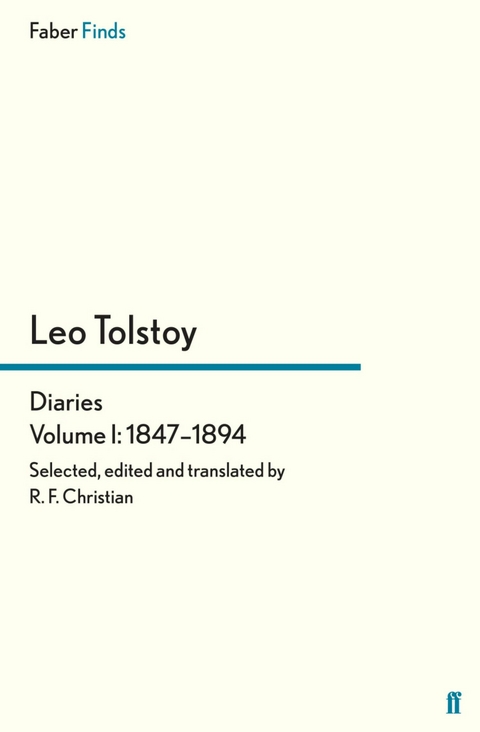
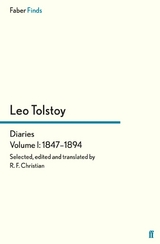
Tolstoy's Diaries Volume 1: 1847-1894 (eBook)
412 Seiten
Faber & Faber (Verlag)
978-0-571-32404-0 (ISBN)
Professor R. F. Christian is one of the major scholars of Russian literature of the last one hundred years. Most especially he is associated with Tolstoy being accorded the highest praise from authors and critics like A. N. Wilson, Jay Parini and George Steiner. Among his publications are Tolstoy: A Critical Introduction, Tolstoy's 'War and Peace': A Study and his definitive editions of Tolstoy's Letters and Diaries (both in two volumes). The Letters and Diaries as well as his 'War and Peace' book have been reissued in Faber Finds. Professor Christian was born in Liverpool, graduated from Oxford University with a first-class honours degree in Russian, joined the Foreign Office and was Attache at the British Embassy in Moscow. His academic career began at the University of Liverpool. At the University of Birmingham he became Chair of Russian Language and Literature. He moved to the University of St. Andrews from where he retired as Head of the Russian Department. A man of many interests beyond the academic, it has been said of him that 'he has always welcomed change if it led to improvements in standards of teaching and research, but one who has always resisted the idea of change for change's sake.'
'An important and long-overdue contribution to our knowledge of Tolstoy.' D. M. Thomas, Sunday TimesVolume 1 of Tolstoy's Diaries covers the years 1847-1894 and was meticulously edited by R.F. Christian so as to reflect Tolstoy's preoccupations as a writer (his views on his own work and that of others), his development as a person and as a thinker, and his attitudes to contemporary social problems, rural life, industrialisation, education, and later, to religious and spiritual questions. Christian introduces each period with a brief and informative summary of the main biographical details of Tolstoy's life. The result is a unique portrait of a great writer in the variegation of his everyday existence. 'As a picture of the turbulent Russian world which Tolstoy inhabited these diaries are incomparable - the raw stuff not yet processed into art.' Anthony Burgess'A model of scholarship, one of the most important books to be published in recent years.' A. N. Wilson, Spectator
17 March, Kazan It’s now six days since I entered the clinic,1 and for six days now I’ve been almost satisfied with myself. Les petites causes produisent de grands effets. I caught gonorrhoea where one usually catches it from of course; and this trivial circumstance gave me a jolt which made me mount the step which I had put my foot on long ago, but had been quite unable to heave my body on to (probably because, withing thinking, I put my left foot on instead of my right). Here I’m completely alone, nobody disturbs me, I haven’t any servants here, nobody helps me – consequently nothing extraneous has any influence on my reason or memory, and my work must necessarily make progress. But the chief advantage is that I’ve come to see clearly that the disorderly life which the majority of fashionable people take to be a consequence of youth is nothing other than a consequence of the early corruption of the soul.
Solitude is just as good for a man who lives in society, as social intercourse is for a man who doesn’t. Let a man withdraw from society, let him retreat into himself, and his reason will soon cast aside the spectacles which showed him everything in a distorted form, and his view of things will become so clear that he will be quite unable to understand how he had not seen it all before. Let reason do its work and it will indicate to you your destiny, and will give you rules with which you can confidently enter society. Everything that is in accord with man’s primary faculty – reason – will likewise be in accord with everything that exists; an individual’s reason is a part of everything that exists, and a part cannot upset the organisation of the whole. But the whole can destroy the part. Therefore educate your reason so that it will be in accord with the whole, with the source of everything, and not with the part, with human society; then your reason will merge into one with the whole, and then society, as the part, will have no influence over you. It’s easier to write ten volumes of philosophy than to put one single principle into practice.
18 March I’ve been reading Catherine’s Instructions,2 and since I’ve generally made it a rule when reading any serious work to think about it and copy out any remarkable thoughts from it, I’ll write down my opinion here about the first six chapters of this remarkable work. […]
Chapter I comprises a proof of the fact that Russia is a European power. Chapter II contains proofs of the necessity for autocracy, which are the more convincing in that she speaks about the Monarch in the abstract. However great a woman’s mind may be, you will always find in its manifestations a certain pettiness and inconsistency, and so Catherine includes as one of her proofs of the necessity for absolute power: ‘Another reason is that it is better to obey the laws under one master than to be subject to the wills of many’; or ‘The intention and end of absolute government is the glory of the citizens, the state and the sovereign’. […]
Chapter V, On the Condition of all People in Civil Society, begins with the philosophical idea that a happy man is a man whose will, though under the influence of external circumstances, can subdue his passions. When I read this, I thought Catherine would deduce from this proposition the notion of the law as an external circumstance influencing the will and making man happy through being subject to the law; but she passes on to the notion of the possibility of equality within the state, i.e. the subjection of all men to the same laws. Her notions of freedom under monarchical rule are as follows: freedom, she says, is man’s ability to do everything he ought to do, and not to be compelled to do what he ought not to do. I would like to know what she understands by the words ought and ought not; if she means by the words what he ought to do the natural law, it clearly follows from this that freedom can only exist in a state in whose legislation natural law is in no way different from positive law – an idea which is perfectly correct. Further, in support of her opinion, Catherine adduces an extremely ingenious proof: freedom is the right to act in accordance with the laws. But if a citizen acts illegally, he thereby gives others the right to act likewise, and so freedom is violated. […]
19 March A passion for the sciences is beginning to manifest itself in me; but although it is the noblest of all man’s passions, I shall never surrender myself to it in a one-sided manner, i.e. completely destroy feeling, not concern myself with application, and only endeavour to educate my mind and fill my memory with facts. Onesidedness is the main cause of man’s unhappiness.
I’ll now continue my analysis of Catherine’s Instructions. […] She goes on to say that people can be governed by moderation, not severity (I would add to that: ‘in monarchies’). She then says that punishments ought to be derived from the nature of the crime itself. I would again add: ‘in monarchies’. For history shows us that the laws of Draco and Lycurgus, which were very harsh and incompatible with the nature of the crime, were tolerated; for in a republic, as Montesquieu rightly observes, the people are at once both the subordinate and the absolute power, and therefore since laws in such a case are the expression of the will of the people, they are tolerated by the people, and since the people governs itself there is no need for punishments to be derived from the nature of the crime, for in republics the will of the citizens serves as the standard of punishment. Catherine goes on to divide crimes into crimes against religion, against morals, against law and order and against the security of the citizens, and in indicating what sort of punishments ought to be applied to each class of crime, arrives at a completely false conclusion by deriving each punishment from the essence of the crime. Actually with regard to the last class of crime she says that the punishments for such crimes should be banishment, a life for a life, or a monetary fine where property has been alienated; but she also says that since for the most part those who attempt to appropriate the property of others do not own any themselves, the fine should be replaced by the death penalty. This idea is unworthy of the great Catherine. For how can an injured party be compensated for theft by the death of the other party? Surely the state can both compensate the injured party for his loss and retain a member of society who might still be useful to it. The whole of the next chapter serves to refute this false idea. Here she argues quite correctly for the need for moderation with regard to punishments, then speaks about the mistakes sometimes made by a legislator, saying that a legislator often employs severity in order to eradicate a particular evil, but that when the main evil has been eliminated there still remains the abuse created by this severity. Further on she completely contradicts herself when she says that it is highly unjust to punish murderers and robbers in like manner, and then says that punishments which disfigure the human body should be abolished. But how can one accept the death penalty without accepting disfigurement? The chief disfigurement of the body is its separation from the soul. […]
Chapter IX contains some rules for judicial procedure in general. […] The idea that major criminals might choose the judges for their own trials shows Catherine’s endeavour to justify monarchical rule and to contend that freedom exists in obeying laws which emanate from the monarch, but she forgets that freedom to obey laws which do not emanate from the people is not freedom. […]
21 March In Chapter X the basic principles and the most dangerous errors connected with criminal legal procedure are expounded.
At the beginning of this chapter she asks herself a question. ‘Whence do punishments derive, and whence the right to punish?’ To the first question she replies: ‘Punishments derive from the need to safeguard the laws.’ To the second question she also replies very ingeniously. She says: ‘The right to punish belongs to the laws alone, but only the monarch as the representative of the state as a whole can make laws.’ Throughout the Instructions we are constantly presented with two heterogeneous elements which Catherine has constantly sought to reconcile, namely the recognition of the need for constitutional rule, and self-love, i.e. her desire to be the absolute sovereign of Russia. For example, while saying that under monarchical rule only the monarch can have legislative power, she accepts the existence of such power as axiomatic without referring to its origin. A subordinate government cannot impose punishments because it is a part of the whole, but a monarch has this right because he is the representative of all the citizens, Catherine says. But is the representation of the people by the sovereign in absolute monarchies the expression of the sum total of the free, individual wills of the citizens? No, the expression of the general will in absolute monarchies amounts to the following: I tolerate a lesser evil, because if I didn’t tolerate it, I would be subjected to a greater evil.
A second question concerns the proper measures necessary for keeping an accused person in custody and for detecting a crime. In trying to solve the first part of this...
| Erscheint lt. Verlag | 29.1.2015 |
|---|---|
| Reihe/Serie | Leo Tolstoy, Diaries and Letters | Leo Tolstoy, Diaries and Letters |
| Einführung | Rosamund Bartlett |
| Verlagsort | London |
| Sprache | englisch |
| Themenwelt | Literatur ► Biografien / Erfahrungsberichte |
| Literatur ► Briefe / Tagebücher | |
| Literatur ► Essays / Feuilleton | |
| Literatur ► Romane / Erzählungen | |
| Geisteswissenschaften ► Sprach- / Literaturwissenschaft ► Literaturwissenschaft | |
| Schlagworte | Diaries • Faber Finds • Industry • Letters • Religion • Social History • Society |
| ISBN-10 | 0-571-32404-5 / 0571324045 |
| ISBN-13 | 978-0-571-32404-0 / 9780571324040 |
| Informationen gemäß Produktsicherheitsverordnung (GPSR) | |
| Haben Sie eine Frage zum Produkt? |
 EPUB (Adobe DRM)
Kopierschutz: Adobe-DRM
Adobe-DRM ist ein Kopierschutz, der das eBook vor Mißbrauch schützen soll. Dabei wird das eBook bereits beim Download auf Ihre persönliche Adobe-ID autorisiert. Lesen können Sie das eBook dann nur auf den Geräten, welche ebenfalls auf Ihre Adobe-ID registriert sind.
Details zum Adobe-DRM
Dateiformat: EPUB (Electronic Publication)
EPUB ist ein offener Standard für eBooks und eignet sich besonders zur Darstellung von Belletristik und Sachbüchern. Der Fließtext wird dynamisch an die Display- und Schriftgröße angepasst. Auch für mobile Lesegeräte ist EPUB daher gut geeignet.
Systemvoraussetzungen:
PC/Mac: Mit einem PC oder Mac können Sie dieses eBook lesen. Sie benötigen eine
eReader: Dieses eBook kann mit (fast) allen eBook-Readern gelesen werden. Mit dem amazon-Kindle ist es aber nicht kompatibel.
Smartphone/Tablet: Egal ob Apple oder Android, dieses eBook können Sie lesen. Sie benötigen eine
Geräteliste und zusätzliche Hinweise
Buying eBooks from abroad
For tax law reasons we can sell eBooks just within Germany and Switzerland. Regrettably we cannot fulfill eBook-orders from other countries.
aus dem Bereich