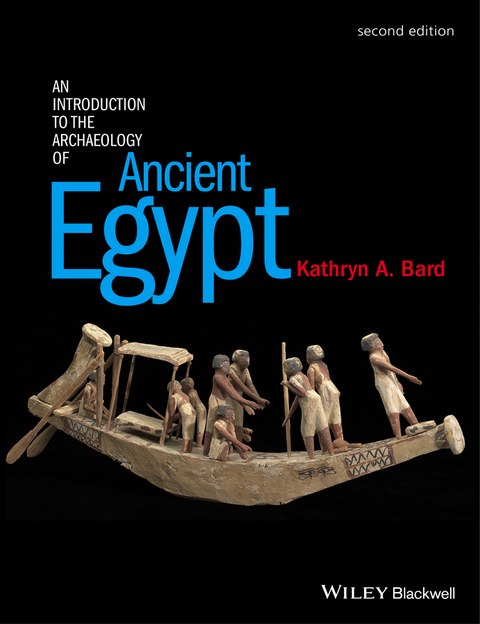
An Introduction to the Archaeology of Ancient Egypt (eBook)
John Wiley & Sons (Verlag)
9781118896112 (ISBN)
• Superbly illustrated with photographs, maps, and site plans, with additional illustrations in this new edition
• Organized into 11 chapters, covering: the history of Egyptology and Egyptian archaeology; prehistoric and pharaonic chronology and the ancient Egyptian language; geography, resources, and environment; and seven chapters organized chronologically and devoted to specific archaeological sites and evidence
• Includes sections on salient topics such as the constructing the Great Pyramid at Giza and the process of mummification
Kathryn A. Bard is Professor of Archaeology at Boston University. A fellow of the American Academy of Arts and Sciences, she has directed excavations in Egypt and northern Ethiopia since 1989, and in 1998 was given the Chairman's Award of the National Geographic Society's Committee for Research and Exploration. She is the author of From Farmers to Pharaohs: Mortuary Evidence for the Rise of Complex Society in Egypt (1994), the editor of The Archaeology of Ancient Egypt: An Encyclopedia (1999), and is on the editorial board of The Journal of Egyptian Archaeology published by the Egypt Exploration Society. Professor Bard is co-director of excavations at the pharaonic harbor at Mersa-Wadi Gawasis on the Red Sea, which has uncovered evidence of ancient Egyptian ships used in seafaring expeditions to the land of Punt, probably located in what is now eastern Sudan and Eritrea.
Kathryn A. Bard is Professor of Archaeology at Boston University. A fellow of the American Academy of Arts and Sciences, she has directed excavations in Egypt and northern Ethiopia since 1989, and in 1998 was given the Chairman's Award of the National Geographic Society's Committee for Research and Exploration. She is the author of From Farmers to Pharaohs: Mortuary Evidence for the Rise of Complex Society in Egypt (1994), the editor of The Archaeology of Ancient Egypt: An Encyclopedia (1999), and is on the editorial board of The Journal of Egyptian Archaeology published by the Egypt Exploration Society. Professor Bard is co-director of excavations at the pharaonic harbor at Mersa-Wadi Gawasis on the Red Sea, which has uncovered evidence of ancient Egyptian ships used in seafaring expeditions to the land of Punt, probably located in what is now eastern Sudan and Eritrea.
"Kathryn Bard's thorough and very up to date
revision of her excellent Introduction assimilates
impressively the continuing flood of research in Egyptian
archaeology and of new discoveries. Reworked major chapters
highlight issues that are important for the archaeology of all
early states."
John Baines, Oxford University
"This is a history of ancient Egypt as seen through the lens
of archaeological discoveries. Well written and approachable, this
volume will engage students and scholars alike."
Ronald Leprohon, University of Toronto
"A comprehensive approach to the archaeology of one of the
world's great ancient societies, this important resource is
now admirably updated to keep abreast of the latest developments in
Egyptology."
Peter Der Manuelian, Harvard University
List of Figures
| 1.1 | The Rosetta Stone |
| 1.2 | Set for the opera, The Magic Flute |
| 1.3 | Giovanni Battista Belzoni (1778–1823) |
| 1.4 | British archaeologist Sir William Matthew Flinders Petrie (1853–1942) |
| 1.5 | Quickbird and WorldView-1 satellite image of Tanis, Egypt |
| 1.6 | Wheeler excavation squares at a site |
| 1.7 | Tell el-Balamun, magnetic map of the temple enclosure |
| 1.8 | Vivien Leigh as Cleopatra (VII) with Claude Rains as Julius Caesar, in the 1945 film of the George Bernard Shaw play Caesar and Cleopatra |
| 2.1 | Stages of the Egyptian language |
| 2.2 | Fragmentary papyrus in hieratic about the Battle of Qadesh, fought by Rameses II in the 19th Dynasty |
| 2.3 | Limestone ostracon, with Coptic inscriptions on both sides |
| 2.4 | Jean-François Champollion (1790–1832) |
| 2.5 | Sety I’s king list from his Abydos temple |
| 3.1 | Wooden model of a bakery/brewery, from the 12th-Dynasty tomb of Meketra, Deir el-Bahri |
| 3.2 | Fishing scene (from a papyrus boat), from the 6th-Dynasty tomb of Mereruka, Saqqara |
| 4.1 | Handax |
| 4.2 | Steps in the making of a Levallois flake |
| 4.3 | Middle Paleolithic flake tools |
| 4.4 | Late Predynastic ripple-flaked knife produced by pressure flaking |
| 4.5 | Figures of wild cattle at the Late Paleolothic rock art site of Qurta I, locality 1 |
| 4.6 | Late Neolithic stone alignment at Nabta Playa |
| 5.1 | Subterranean house structure at Ma’adi |
| 5.2 | Sequence Dating chart showing Petrie’s Predynastic pottery classes |
| 5.3 | Plan of the Naqada cemeteries excavated by Petrie |
| 5.4 | Wall scene from Tomb 100, Hierakonpolis |
| 5.5 | Egypt: Predynastic (Naqada culture) burial from Naga el-Deir |
| 5.6 | Narmer Palette, reverse and obverse |
| 5.7 | Tags from Tomb U-j, Abydos |
| 5.8 | Plan of the Early Dynastic Royal Cemetery at Abydos |
| 5.9 | 1st-Dynasty limestone stela of King Djet from his tomb at Abydos |
| 5.10 | Plan of the three funerary enclosures from Aḥa’s reign, Abydos |
| 5.11 | Section of the 1st-Dynasty Tomb 3357 at North Saqqara |
| 5.12 | Carved disk from Hemaka’s tomb, North Saqqara |
| 5.13 | Location of the “Main Deposit,” Hierakonpolis |
| 6.1 | Cartouche of Khufu |
| 6.2 | Djoser’s Step Pyramid complex, Saqqara |
| 6.3 | Relief of Djoser running the sed-festival race, from the so-called “South Tomb” at his Step Pyramid complex, Saqqara |
| 6.4 | Aerial photo of the Step Pyramid complex and three unfinished rectangular pyramid complexes at Saqqara |
| 6.5 | Cross-section plan of Sneferu’s Maidum pyramid |
| 6.6 | Plan of Khufu’s Great Pyramid at Giza |
| 6.7 | Disassembled boat, investigated in 1987 and still in a boat pit next to Khufu’s Great Pyramid, Giza |
| 6.8 | Khafra statue from the valley temple of his pyramid complex at Giza |
| 6.9 | Plan of Shepseskaf’s tomb at Zawiyet el-Aryan |
| 6.10 | Plan of the funerary cult town of Queen Khentkawes, Giza |
| 6.11 | 4th-Dynasty pyramid town at Giza |
| 6.12 | “Reserve head” from a mastaba tomb to the west of Khufu’s Giza pyramid |
| 6.13 | Restored furniture found in the Giza tomb or ritual deposit of Queen Hetepheres I |
| 6.14 | Plan of Nyussera’s sun temple complex at Abu Ghurob |
| 6.15 | Plan of Pepy II’s pyramid complex at Saqqara |
| 6.16 | Painted relief with scenes of boat construction from the 5th-Dynasty tomb of Ti, Saqqara |
| 6.17 | Relief scene of hunting in the desert, from the 6th-Dynasty tomb of Mereruka, Saqqara |
| 6.18 | Funerary stela of a priestess of Hathor, Setnet-Inheret, from Naga el-Deir |
| 7.1 | Plan of Mentuhotep II’s tomb complex at Deir el-Bahri |
| 7.2 | View into the small chamber of Meketra’s 12th-Dynasty tomb at Deir el-Bahri |
| 7.3 | Plans of the Montu temple at Medamud, dating from the Old Kingdom to the Greco-Roman Period |
| 7.4 | Plan of the rock-cut tomb of Senusret III at Abydos |
| 7.5 | Plan of Senusret I’s pyramid at Lisht |
| 7.6 | Planks excavated at the Lisht pyramid of Senusret I, reconstructed into a cross-section of a freight boat |
| 7.7 | Plan of Amenemhat III’s pyramid at Dahshur |
| 7.8 | Plan of the pyramid town of Kahun |
| 7.9 | Descriptive scheme of images painted on a birth brick from South Abydos, Building A |
| 7.10 | Scene of moving a large statue from the tomb of Djehuty-hotep, Deir el-Bersha |
| 7.11 | Reconstruction of the 12th-Dynasty fort of Buhen |
| 7.12 | Plan of the site of Tell el-Dab’a, dating to the 12th–13th Dynasties and later the 15th-Dynasty Hyksos capital of Avaris |
| 7.13 | Plan of the royal tomb K X and the funerary temple K XI excavated by George Reisner at Kerma |
| 7.14 | 12th-Dynasty statue of Lady Sennuwy found in a royal burial (K III) at Kerma |
| 7.15 | Plan of the central city of Kerma |
| 7.16 | View of the Western Deffufa temple at Kerma |
| 7.17 | Pan-Grave excavated at Abydos |
| 8.1 | The Colossi of Memnon |
| 8.2 | Plan of Hatshepsut’s mortuary temple at Deir el-Bahri |
| 8.3 | Plan of Amenhotep III’s Malkata palace complex |
| 8.4 | Plan of the city of Akhetaten (the site of Tell el-Amarna) |
| 8.5 | Plan of the central city of Akhetaten |
| 8.6 | Fragmented relief of Akhenaten with Nefertiti on his lap holding two princesses |
| 8.7 | Howard Carter and Lord Carnarvon in Tutankhamen’s tomb |
| 8.8 | View of the antechamber of Tutankhamen’s tomb, taken in 1922 |
| 8.9 | Plan of Tutankhamen’s tomb (KV 62), overlain by part of the tomb of Rameses VI (KV 9) |
| 8.10 | Plan of Tutankhamen’s burial chamber, with four shrines, sarcophagus, and coffins |
| 8.11 | Abydos, plan of the Temple of Sety I/Rameses II |
| 8.12 | Plan of the Temple of Luxor |
| 8.13 | Plan of the Temple of Karnak |
| 8.14 | Map/location of the (royal) mortuary temples of western Thebes |
| 8.15 | The Ramesseum with fallen colossus of Rameses II |
| 8.16 | Plan of the temple complex at Medinet Habu |
| 8.17 | Theban Mapping Project plans of tombs in Valley of the... |
| Erscheint lt. Verlag | 7.1.2015 |
|---|---|
| Sprache | englisch |
| Themenwelt | Geisteswissenschaften ► Archäologie |
| Geschichte ► Allgemeine Geschichte ► Vor- und Frühgeschichte | |
| Geschichte ► Allgemeine Geschichte ► Altertum / Antike | |
| Technik | |
| Schlagworte | Ägypten /Alte Geschichte • Ãgypten /Alte Geschichte • Ancient Egyptian History • Archäologie • Archäologie Ãgyptens, Ãgyptologie • archaeology • Archaeology of Egypt / Egyptology • Archäologie • Archäologie Ägyptens, Ägyptologie • Classical Studies • Egyptology, ancient Egypt, archaeology, anthropology, history, early civilizations, pharaonic period, pharaonic dynasties, Near-Eastern archaeology, Near-Eastern civilizations, ancient monuments, pyramids, ancient cultures, mummies, mummification, Tutankhamun • Geschichte des ägyptischen Altertums • Geschichte des ägyptischen Altertums • Humanistische Studien |
| ISBN-13 | 9781118896112 / 9781118896112 |
| Informationen gemäß Produktsicherheitsverordnung (GPSR) | |
| Haben Sie eine Frage zum Produkt? |
 EPUB (Adobe DRM)
Kopierschutz: Adobe-DRM
Adobe-DRM ist ein Kopierschutz, der das eBook vor Mißbrauch schützen soll. Dabei wird das eBook bereits beim Download auf Ihre persönliche Adobe-ID autorisiert. Lesen können Sie das eBook dann nur auf den Geräten, welche ebenfalls auf Ihre Adobe-ID registriert sind.
Details zum Adobe-DRM
Dateiformat: EPUB (Electronic Publication)
EPUB ist ein offener Standard für eBooks und eignet sich besonders zur Darstellung von Belletristik und Sachbüchern. Der Fließtext wird dynamisch an die Display- und Schriftgröße angepasst. Auch für mobile Lesegeräte ist EPUB daher gut geeignet.
Systemvoraussetzungen:
PC/Mac: Mit einem PC oder Mac können Sie dieses eBook lesen. Sie benötigen eine
eReader: Dieses eBook kann mit (fast) allen eBook-Readern gelesen werden. Mit dem amazon-Kindle ist es aber nicht kompatibel.
Smartphone/Tablet: Egal ob Apple oder Android, dieses eBook können Sie lesen. Sie benötigen eine
Geräteliste und zusätzliche Hinweise
Buying eBooks from abroad
For tax law reasons we can sell eBooks just within Germany and Switzerland. Regrettably we cannot fulfill eBook-orders from other countries.
aus dem Bereich