


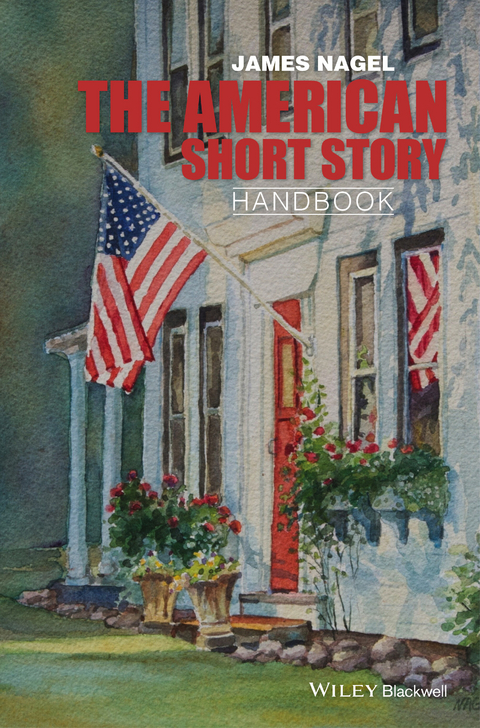
The American Short Story Handbook (eBook)
328 Seiten
Wiley-Blackwell (Verlag)
978-1-118-90213-4 (ISBN)
This is a concise yet comprehensive treatment of the American short story that includes an historical overview of the topic as well as discussion of notable American authors and individual stories, from Benjamin Franklin’s “The Speech of Miss Polly Baker” in 1747 to “The Joy Luck Club”.
- Includes a selection of writers chosen not only for their contributions of individual stories but for bodies of work that advanced the boundaries of short fiction, including Washington Irving, Sarah Orne Jewett, Stephen Crane, Jamaica Kincaid, and Tim O’Brien
- Addresses the ways in which American oral storytelling and other narrative traditions were integral to the formation and flourishing of the short story genre
- Written in accessible and engaging prose for students at all levels by a renowned literary scholar to illuminate an important genre that has received short shrift in scholarly literature of the last century
- Includes a glossary defining the most common terms used in literary history and in critical discussions of fiction, and a bibliography of works for further study
James Nagel is the Eidson Distinguished Professor Emeritus at the University of Georgia and a Visiting Scholar at Dartmouth College, USA. He is President of the Society for the Study of the American Short Story and Former President of the International Ernest Hemingway Society. Early in his career he founded the scholarly journal Studies in American Fiction and the widely influential series Critical Essays on American Literature, which published 156 volumes of scholarship. Among his twenty-three books are Stephen Crane and Literary Impressionism (1980), Hemingway in Love and War (1989, which was made into a Hollywood film starring Sandra Bullock), The Contemporary American Short-Story Cycle (2001), Anthology of The American Short Story (2007), The Blackwell Companion to the American Short Story (Wiley Blackwell, 2010), and Race and Culture in Stories of New Orleans (2014). He has been a Fulbright Professor as well as a Rockefeller Fellow. He has published some eighty articles in the field and lectured on American literature in fifteen countries.
James Nagel is the Eidson Distinguished Professor Emeritus at the University of Georgia and a Visiting Scholar at Dartmouth College, USA. He is President of the Society for the Study of the American Short Story and Former President of the International Ernest Hemingway Society. Early in his career he founded the scholarly journal Studies in American Fiction and the widely influential series Critical Essays on American Literature, which published 156 volumes of scholarship. Among his twenty-three books are Stephen Crane and Literary Impressionism (1980), Hemingway in Love and War (1989, which was made into a Hollywood film starring Sandra Bullock), The Contemporary American Short-Story Cycle (2001), Anthology of The American Short Story (2007), The Blackwell Companion to the American Short Story (Wiley Blackwell, 2010), and Race and Culture in Stories of New Orleans (2014). He has been a Fulbright Professor as well as a Rockefeller Fellow. He has published some eighty articles in the field and lectured on American literature in fifteen countries.
Preface vii
Part 1 Introduction 1
Part 2 Historical Overview of the American Short Story 9
The American Story to Washington Irving 12
The Age of Romanticism 20
Realism and Naturalism 26
American Modernism 39
The Contemporary American Short Story 46
Part 3 Notable Authors of American Short Stories 55
Washington Irving 57
Edgar Allan Poe 62
Nathaniel Hawthorne 67
Herman Melville 71
Mark Twain 76
Bret Harte 82
Henry James 86
Kate Chopin 91
Stephen Crane 96
O. Henry 101
Sarah Orne Jewett 105
Charles W. Chesnutt 109
Willa Cather 115
F. Scott Fitzgerald 120
Ernest Hemingway 126
John Steinbeck 132
William Faulkner 139
Jamaica Kincaid 144
Tim O'Brien 150
Louise Erdrich 156
Part 4 Great American Short Stories 163
Benjamin Franklin, "The Speech of Polly Baker" 165
Ruri Colla, "The Story of the Captain's Wife and an Aged Woman" 168
Washington Irving, "Rip Van Winkle" 172
Nathaniel Hawthorne, "Young Goodman Brown" 177
Edgar Allan Poe, "The Cask of Amontillado" 180
Herman Melville, "Bartleby, the Scrivener" 184
Frances Ellen Watkins Harper, "The Two Offers" 189
Hamlin Garland, "Under the Lion's Paw" 192
Charlotte Perkins Gilman, "The Yellow Wallpaper" 196
Henry James, "The Real Thing" 202
Kate Chopin, "Désirée's Baby" 206
Ambrose Bierce, "An Occurrence at Owl Creek Bridge" 210
Stephen Crane, "The Blue Hotel" 214
Frank Norris, "A Deal in Wheat" 218
Edith Wharton, "The Other Two" 222
Willa Cather, "A Wagner Matinée" 226
Jack London, "To Build a Fire" 230
Jean Toomer, "Blood-Burning Moon" 233
F. Scott Fitzgerald, "Babylon Revisited" 236
Ernest Hemingway, "Indian Camp" 241
John Steinbeck, "The Chrysanthemums" 245
Eudora Welty, "Petrified Man" 249
William Faulkner, "Barn Burning" 253
Flannery O'Connor, "The River" 257
Tillie Olsen, "Help Her to Believe" ["I Stand Here Ironing"] 261
Raymond Carver, "Cathedral" 265
Louise Erdrich, "The Red Convertible" 269
Susan Minot, "Hiding" 273
Amy Tan, "The Joy Luck Club" 277
Tim O'Brien, "Sweetheart of the Song Tra Bong" 281
Jamaica Kincaid, "Columbus in Chains" 285
Judith Cofer, "Nada" 289
A Glossary for the Study of the American Short Story 293
Selected Books for Further Study of the American Short Story 303
Index 307
"A stunning contribution by an acknowledged master of the
study of the genre. With a superb introduction, choice of
stories, and scholarly support, Nagel's new volume will the first
choice for any reader. This is the definitive collection and
handbook on the American short story."--Jeanne Reesman,
University of Texas at San Antonio
"This new Handbook offers a valuable overview of the
American short story with attention to individual authors and
masterpieces as well as to the historical development of the
form. There is no scholar who knows more about the short
story in the United States than James Nagel, and students will find
this book to be reliable, informative, and
illuminating."--Alfred Bendixen, Princeton
University
"A brilliant chronological mapping of the largely ignored
genre of the American short story, by one of the master scholars of
American literature. Generous in its historical inclusiveness
and rich contextualization, this is far more than a
"Handbook." It will stand for some time as the
definitive work in the field as it establishes the emerging
tradition and the canon of the American short
story."--Gloria Cronin, Brigham Young
University
Part 1
Introduction
I am delighted that this book has appeared in the series of volumes published by Wiley- Blackwell covering the entire sweep of American letters, from the earliest colonial period to the most recent contemporary literature. My book can claim a special significance because although scores of studies of the novel of the United States have appeared over the past century, many of them distinguished works of serious scholarship, relatively few full-length histories have been written about the short story since Fred Lewis Pattee published The Development of the American Short Story: An Historical Survey in 1923. It is difficult to explain this curious lacuna in literary investigation, but some of the neglect of the genre has been because of the general assumption that the story is a minor fictional partner in a field dominated by the more important “novel.”
Many recent developments have begun to challenge the validity of that premise, including the establishment of the Society for the Study of the American Short Story, a vibrant organization of scholars that I am pleased to serve as president. That group functions within the American Literature Association, directed by the masterful leadership of Alfred Bendixen. The professional students of literature within that society have produced an enormous body of serious scholarship on short fiction, and the genre has at last begun to receive the attention it deserves. The form of the story is much older than that of the novel, reaching back before the birth of Christ, and it played an important role in cultural expression and preservation for centuries before the first “novel” appeared, and for that reason, and many others, it deserves a seminal place in the study of American literature. This book is also important in that it is the first study of the genre to take into consideration the hundreds of examples of short fiction that appeared in America in the eighteenth century. These early stories addressed many of the most salient issues of the day, including the abolition of slavery, the status of Native Americans, the role of women in the formation of a new country, and the definition of an “American,” what values and standards are to be associated with such a person. These vastly important matters in the early story have not received serious attention in any previous literary history.
From the beginning of human history, even the earliest records of emerging civilizations demonstrate the importance of narrative tales in charting the background of a given cultural group, presenting the myths that offer explanations for the origin of the universe, preserve fundamental values, and explain the meaning of life. A story is a window on a society, and before it pass the people of that culture, speaking in their own dialect, discussing the issues of the day, and struggling with the human conflicts central to that period of history. Looking through that window is entertaining and instructive, though it is not always easy to understand the meaning of what is going on. Cultures are complex entities, with assumptions deeply embedded below the surface. A story presents an opportunity to examine things more closely, to think about what values and traditions rest behind the actions of the characters, to weigh the wisdom of accepted standards of behavior and decorum.
The earliest forms of narrative seem to have been extremely important and reach as far back as to primitive societies. The “myth,” for example, evolved as an important ancient convention because it could explain the ways of the gods and the reasons for natural events. Myths could also build cultural pride by recording the glorious accomplishments of ancestral figures, accounts that also emphasized central values exemplified in the life of the hero. A related narrative form is the “legend,” which was less speculative and supernatural than the myth and more closely tied to cultural history. As a new country, America was free to establish a fresh catalog of legends based on historical personages who could plausibly be said to have exhibited some form of virtue or initiative. The account of George Washington, who, unable to tell a lie, once threw a coin across the Potomac River, is among the early national legends.
“Parables” are an ancient form of storytelling, reaching back to early Greek rhetoricians, that illustrated some religious virtue a society wished to preserve in the young. The Christian Bible contains many such narratives, the most famous being the parable of the prodigal son. This tradition is patently didactic in substance, teaching and sustaining modes of thought and behavior that a given society wishes to emphasize. They are thus closely related to the “fable,” from which the parables were differentiated in that the former features anthropomorphic animals as characters. Told in either prose or verse, they entertained children and instructed them about the dangers of the world and the rewards of virtue. Aesop recorded his famous collection sometime around 600 B.C., and other fables were popular in medieval English literature as well, as the works of Geoffrey Chaucer make clear. The emphasis on animal characters links the fable to Native American tales, which animated and gave voice to nature in all of its forms.
Until the development of written languages, these early “stories” were not recorded in any precise manner but passed on from one generation to the next verbally, no doubt changing style and substance somewhat with each successive telling. These oral traditions are important in the formation of the genre of the “story” because they gave shape to how a tale could be told, how someone had to give voice to the account, how the events recited would be presented in a certain order and would somehow conclude in a satisfying way. Vocal recitations are perhaps a more important consideration in American literature than in most of the countries of the world because although some cultures established a means of written, or carved, recorded history several thousand years before the birth of Christ, Native American cultures were still essentially vocal when Europeans arrived in North America, and the indigenous spoken accounts quickly merged into the written languages the new settlers brought with them, especially Spanish, French, and British immigrants. What is unique about the history of the short story in English is that it constitutes a blending of narrative traditions from a broad spectrum of sources and languages and a means of presenting characters, action, and speech inherited from virtually every country of the world.
Perhaps for this reason, the story flourished in America as it had nowhere else in the world, and its earliest manifestations were linked to the oral tradition. A “yarn,” even when it was written, implied that it was spoken by a narrator to an immediate audience that who could interact with the teller, sometimes interrupting with extraneous or even insulting remarks. The emphasis was not so much on the tale as on the person talking, on the personality of the speaker, who might be sincere or have tongue in cheek, who might not believe the truth of what he is saying. This manner of recitation is captured in American literary history as part of the early humor traditions and, at least for a few years, as part of the Local Color method of storytelling. Mark Twain's most famous tale, “The Celebrated Jumping Frog of Calaveras County,” exemplifies how this early vocal method could be successfully adapted into a written literature. Yarns were generally told not by a learned Eastern sophisticate but by an old codger who spoke a regional dialect that was entertaining in itself. Most of them are essentially humorous in tone, and nearly all are brief and conclude with some kind of “snapper” that evokes laughter from the gathered folk.
Another early form was the “anecdote,” which is a very brief narrative account of something that actually happened to a real person or, occasionally, an exchange of comments between two characters. Such presentations have the feel of being oral in origin and of capturing an action or a personality. Reaching back in history, perhaps the earliest published collection of anecdotes was Plutarch's Lives of the Noble Greeks and Romans, which schoolchildren were obliged to read for many generations. In America, local events provided more than sufficient material for the anecdotes that ran in the newspapers and magazines in virtually every issue in the eighteenth and nineteenth centuries. As part of the pre-story continuum, anecdotes contributed unified plots with a concentrated focus on one event, which perhaps led to the controlled structure of the American form after Edgar Allan Poe. They also captured the vernacular in print decades before tales in regional dialects became a popular fictional form.
In the mid-nineteenth century, the role of the yarn quickly gave way to the “tale,” a longer narrative that retained the emphasis on the manner of telling. Tales were longer than yarns and put more stress on plots, on events that often seemed improbable but were thrilling to hear about, backwoods hunters killing huge grizzly bears, for example. Tales strain credulity, and the more tenuous the hold on reality, the better. By the middle of the nineteenth century, magazines ran them in virtually every issue, and the nation found them entertaining, although most often they were not instructive. By the end of the century, however, the popularity of the form had run...
| Erscheint lt. Verlag | 8.12.2014 |
|---|---|
| Reihe/Serie | Blackwell Literature Handbooks |
| Blackwell Literature Handbooks | Wiley Blackwell Literature Handbooks |
| Sprache | englisch |
| Themenwelt | Geisteswissenschaften ► Sprach- / Literaturwissenschaft ► Anglistik / Amerikanistik |
| Geisteswissenschaften ► Sprach- / Literaturwissenschaft ► Literaturgeschichte | |
| Geisteswissenschaften ► Sprach- / Literaturwissenschaft ► Literaturwissenschaft | |
| Schlagworte | American Literature • American Studies • Amerikanische Literatur • Amerikanistik • Cultural Studies • Kulturwissenschaften • Kurzgeschichte • Literary Criticism & History • Literature • Literaturkritik • Literaturkritik u. -geschichte • Literaturwissenschaft • <p>American fiction, American story, US short stories, Washington Irving, Hawthorne, Poe, Melville, Twain, Henry James, O Henry, Sarah Orne Jewett, Stephen Crane, Jamaica Kincaid , Jack London, Willa Cather, Hemingway, Steinbeck, Faulkner, Tim O’Brien, Cask of Amontillado, Yellow Wallpaper, Benjamin Franklin, The Speech of Miss Polly Baker, Amy Tan, The Joy Luck Club, American oral storytelling, Blackwell Literature Handbooks</p> • USA /Literatur, Literaturgeschichte |
| ISBN-10 | 1-118-90213-0 / 1118902130 |
| ISBN-13 | 978-1-118-90213-4 / 9781118902134 |
| Informationen gemäß Produktsicherheitsverordnung (GPSR) | |
| Haben Sie eine Frage zum Produkt? |
 EPUB (Adobe DRM)
Kopierschutz: Adobe-DRM
Adobe-DRM ist ein Kopierschutz, der das eBook vor Mißbrauch schützen soll. Dabei wird das eBook bereits beim Download auf Ihre persönliche Adobe-ID autorisiert. Lesen können Sie das eBook dann nur auf den Geräten, welche ebenfalls auf Ihre Adobe-ID registriert sind.
Details zum Adobe-DRM
Dateiformat: EPUB (Electronic Publication)
EPUB ist ein offener Standard für eBooks und eignet sich besonders zur Darstellung von Belletristik und Sachbüchern. Der Fließtext wird dynamisch an die Display- und Schriftgröße angepasst. Auch für mobile Lesegeräte ist EPUB daher gut geeignet.
Systemvoraussetzungen:
PC/Mac: Mit einem PC oder Mac können Sie dieses eBook lesen. Sie benötigen eine
eReader: Dieses eBook kann mit (fast) allen eBook-Readern gelesen werden. Mit dem amazon-Kindle ist es aber nicht kompatibel.
Smartphone/Tablet: Egal ob Apple oder Android, dieses eBook können Sie lesen. Sie benötigen eine
Geräteliste und zusätzliche Hinweise
Buying eBooks from abroad
For tax law reasons we can sell eBooks just within Germany and Switzerland. Regrettably we cannot fulfill eBook-orders from other countries.
aus dem Bereich


