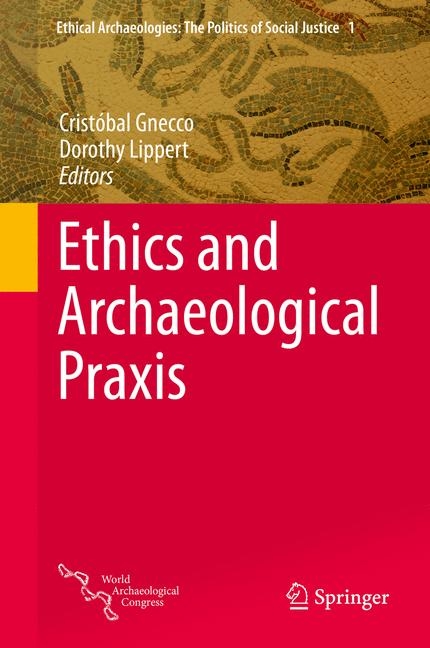
Ethics and Archaeological Praxis (eBook)
258 Seiten
Springer New York (Verlag)
978-1-4939-1646-7 (ISBN)
Restoring the historicity and plurality of archaeological ethics is a task to which this book is devoted; its emphasis on praxis mends the historical condition of ethics. In doing so, it shows that nowadays a multicultural (sometimes also called “public”) ethic looms large in the discipline. By engaging communities “differently,” archaeology has explicitly adopted an ethical outlook, purportedly striving to overcome its colonial ontology and metaphysics. In this new scenario, respect for other historical systems/worldviews and social accountability appear to be prominent. Being ethical in archaeological terms in the multicultural context has become mandatory, so much that most professional, international and national archaeological associations have ethical principles as guiding forces behind their openness towards social sectors traditionally ignored or marginalized by their practices. This powerful new ethics—its newness is based, to a large extent, in that it is the first time that archaeological ethics is explicitly stated, as if it didn’t exist before—emanates from metropolitan centers, only to be adopted elsewhere. In this regard, it is worth probing the very nature of the dominant multicultural ethics in disciplinary practices because (a) it is at least suspicious that at the same time archaeology has tuned up with postmodern capitalist/market needs, and (b) the discipline (along with its ethical principles) is contested worldwide by grass-roots organizations and social movements. Can archaeology have socially committed ethical principles at the same time that it strengthens its relationship with the market and capitalism? Is this coincidence just merely haphazard or does it obey more structural rules? The papers in this book try to answer these two questions by examining praxis-based contexts in which archaeological ethics unfolds.
Restoring the historicity and plurality of archaeological ethics is a task to which this book is devoted; its emphasis on praxis mends the historical condition of ethics. In doing so, it shows that nowadays a multicultural (sometimes also called "e;public"e;) ethic looms large in the discipline. By engaging communities "e;differently,"e; archaeology has explicitly adopted an ethical outlook, purportedly striving to overcome its colonial ontology and metaphysics. In this new scenario, respect for other historical systems/worldviews and social accountability appear to be prominent. Being ethical in archaeological terms in the multicultural context has become mandatory, so much that most professional, international and national archaeological associations have ethical principles as guiding forces behind their openness towards social sectors traditionally ignored or marginalized by their practices. This powerful new ethics-its newness is based, to a large extent, in that it is the first time that archaeological ethics is explicitly stated, as if it didn't exist before-emanates from metropolitan centers, only to be adopted elsewhere. In this regard, it is worth probing the very nature of the dominant multicultural ethics in disciplinary practices because (a) it is at least suspicious that at the same time archaeology has tuned up with postmodern capitalist/market needs, and (b) the discipline (along with its ethical principles) is contested worldwide by grass-roots organizations and social movements. Can archaeology have socially committed ethical principles at the same time that it strengthens its relationship with the market and capitalism? Is this coincidence just merely haphazard or does it obey more structural rules? The papers in this book try to answer these two questions by examining praxis-based contexts in which archaeological ethics unfolds.
Cristóbal Gnecco is Professor in the Department of Anthropology at the University of Cauca (Colombia), where he works on the political economy of archaeology, the geopolitics of knowledge, and the discourses on alterity. He currently serves as Chair of the Ph.D. Program in Anthropology at his university and as a co-editor of the journals Archaeologies and Arqueología Suramericana.Dorothy Lippert, National Museum of Natural History, Washington, DC.
Chapter 1: An entanglement of sorts: archaeology, ethics, praxis, multiculturalism.-Section 1: Is there a global archaeological ethics? Canonical conditions for discursive legitimacy and local responses.- Chapter 2: An Indigenous anthropologist’s perspective on archaeological ethics.- Chapter 3: Both sides of the ditch: the ethics of narrating the past in the present.- Chapter 4: Against global archaeological ethics: critical views from South America.- Chapter 5: Archaeology and ethics. The case of Central-Eastern Europe.- Chapter 6: Europe: beyond the canon.- Chapter 7: New worlds: ethics in contemporary North American archaeological practice.- Section 2: Archaeological ethics in the global arena: emergences, transformations, accommodations.- Chapter 8: Chapter Archaeology and capitalist development: lines of complicity.- Chapter 9: Archaeology and capitalism: successful relationship or economic and ethical alienation?.-Chapter 10: Trading archaeology is not just a matter of antiquities. Archaeological practice as a commodity.- Chapter 11: The differing forms of public archaeology: where we have been, where we are now, and thoughts for the future.- Chapter 12: Ethics in the publishing of archaeology.- Chapter 13: Patrimonial ethics and the field of heritage production.- Chapter 14: Archeologies of intellectual heritage?.- Chapter 15: Just methods, no madness: historical archaeology on the Piikani First Nation.
| Erscheint lt. Verlag | 10.11.2014 |
|---|---|
| Reihe/Serie | Ethical Archaeologies: The Politics of Social Justice | Ethical Archaeologies: The Politics of Social Justice |
| Zusatzinfo | XVII, 258 p. 10 illus., 6 illus. in color. |
| Verlagsort | New York |
| Sprache | englisch |
| Themenwelt | Geisteswissenschaften ► Archäologie |
| Geschichte ► Allgemeine Geschichte ► Vor- und Frühgeschichte | |
| Geschichte ► Allgemeine Geschichte ► Altertum / Antike | |
| Geisteswissenschaften ► Philosophie ► Ethik | |
| Schlagworte | archaeological practice and ethics • capitalism and archaeology • community archaeology • ethical principles of archaeology • ethics of public archaeology • indigenous viewpoints on the practice of archaeology • local archaeology • market archaeology • multiculturalism and archaeology • social accountability and archaeology • social accountability of archaeoogy |
| ISBN-10 | 1-4939-1646-7 / 1493916467 |
| ISBN-13 | 978-1-4939-1646-7 / 9781493916467 |
| Informationen gemäß Produktsicherheitsverordnung (GPSR) | |
| Haben Sie eine Frage zum Produkt? |
 PDF (Wasserzeichen)
Größe: 3,8 MB
DRM: Digitales Wasserzeichen
Dieses eBook enthält ein digitales Wasserzeichen und ist damit für Sie personalisiert. Bei einer missbräuchlichen Weitergabe des eBooks an Dritte ist eine Rückverfolgung an die Quelle möglich.
Dateiformat: PDF (Portable Document Format)
Mit einem festen Seitenlayout eignet sich die PDF besonders für Fachbücher mit Spalten, Tabellen und Abbildungen. Eine PDF kann auf fast allen Geräten angezeigt werden, ist aber für kleine Displays (Smartphone, eReader) nur eingeschränkt geeignet.
Systemvoraussetzungen:
PC/Mac: Mit einem PC oder Mac können Sie dieses eBook lesen. Sie benötigen dafür einen PDF-Viewer - z.B. den Adobe Reader oder Adobe Digital Editions.
eReader: Dieses eBook kann mit (fast) allen eBook-Readern gelesen werden. Mit dem amazon-Kindle ist es aber nicht kompatibel.
Smartphone/Tablet: Egal ob Apple oder Android, dieses eBook können Sie lesen. Sie benötigen dafür einen PDF-Viewer - z.B. die kostenlose Adobe Digital Editions-App.
Buying eBooks from abroad
For tax law reasons we can sell eBooks just within Germany and Switzerland. Regrettably we cannot fulfill eBook-orders from other countries.
aus dem Bereich