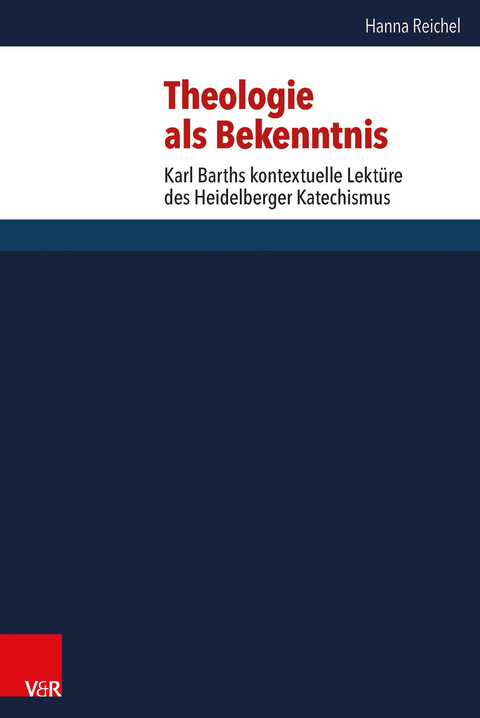
Theologie als Bekenntnis
Vandenhoeck & Ruprecht (Verlag)
978-3-525-56446-2 (ISBN)
In this volume Hanna Reichel explains Karl Barth´s expositions of the Heidelberg Catechism between the common reference to Jesus Christ as the basic text of theology and the contemporary contexts to which he referred. In this volume Hanna Reichel explains the links between Karl Barth and the Heidelberg Catechism, which served Barth as an important cornerstone of his theology. From the common emphasis on Christology he used the Heidelberg Catechism as his theological "friend" and an important resource for his dogmatics and his own belief. Barth is shown to have been a contextual thinker who increasingly came to use the Christology of the Heidelberg Catechism to gain theological texture, and who employed confessional texts as counterparts to his situation.
Dr. theol. Hanna Reichel ist als Wissenschaftliche Mitarbeiterin am Institut für Systematische Theologie, Praktische Theologie und Religionswissenschaft an der Martin-Luther-Universität Halle-Wittenberg tätig.
Karl Barth was a confessing theologian. He was passionately involved in theology, and pas-sionately, he took part in the political and historic developments of his time. His work with texts of tradition laid the groundwork for both aspects. Understanding the word of God as the founding text of theology, Hanna Reichel describes how Barth repeatedly interpreted confessional texts within his own situation as a form of contextual theology. No confessional statement drew Barth's attention as much as the Heidelberg Catechism. Through the course of his theological career, Barth interpreted the Heidelberg Catechism many times in academic and as well as non-academic settings, and at quite distinguished moments. The Heidelberg Catechism inspired his own confessing witness as much as the structure of his dogmatic thought. Reichel scrutinizes Barth's interpretations of the Heidelberg Catechism, which for the most part remain unpublished until today. She shows how his understanding of the Heidelberg Catechism changes from a skeptical and even scornful attitude to holding it in high esteem. This becomes possible by the continuity in his criterion of evaluation: the relation to Jesus Christ. Gaining texture from Christology and drawing from the Heidelberg Catechism as a counter-text to his respective situations, Barth develops a profile as a contextual theologian, giving his interpretations of confession a confessional stance in themselves. The differentiation from neoprotestantism in the Göttingen years shows this tendency as much as his use of the Heidelberg Catechism as a theological resource in the Barmen Theological Declaration or in the reconstruction after the war and even in the architecture of theology in the Church Dogmatics. Repeatedly beginning from the beginning, Barth's re-interpretations form a catechesis viatorum in faithful exegesis of the text. This study reveals how Karl Barth's manner of drawing from a spiritual tradition by engaging a confessional text enables a non-denominational confessional self-understanding and a critical and constructive form of contextual theology.
| Erscheint lt. Verlag | 22.4.2015 |
|---|---|
| Reihe/Serie | Forschungen zur systematischen und ökumenischen Theologie ; Band 149 |
| Verlagsort | Göttingen |
| Sprache | deutsch |
| Maße | 160 x 237 mm |
| Gewicht | 610 g |
| Themenwelt | Religion / Theologie ► Christentum ► Kirchengeschichte |
| Schlagworte | Barth • Barth, Karl • Evangelische Theologie • Evangelische Theologiegeschichte • Heidelberger Katechismus • Karl • Systematische Theologie |
| ISBN-10 | 3-525-56446-5 / 3525564465 |
| ISBN-13 | 978-3-525-56446-2 / 9783525564462 |
| Zustand | Neuware |
| Informationen gemäß Produktsicherheitsverordnung (GPSR) | |
| Haben Sie eine Frage zum Produkt? |
aus dem Bereich