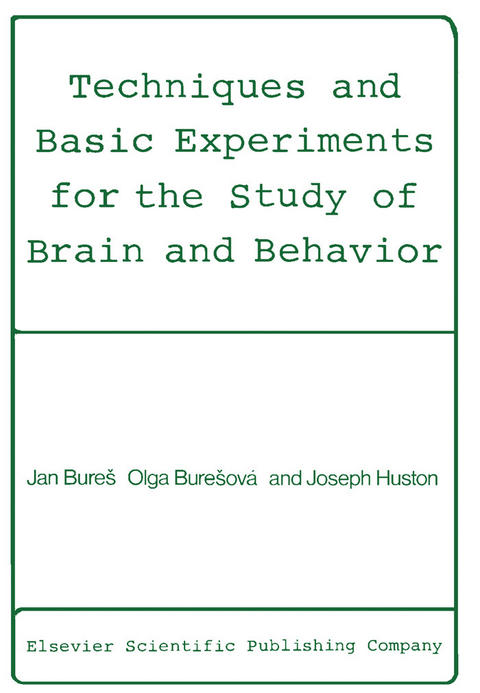
Techniques and Basic Experiments for the Study of Brain and Behavior (eBook)
290 Seiten
Elsevier Science (Verlag)
978-1-4831-6377-2 (ISBN)
Techniques and Basic Experiments for the Study of Brain and Behavior emphasizes the practical aspects of conducting behavioral experiments, illustrates the various fundamental methods with characteristic examples, and provides a thorough description of the techniques. This text aims to teach the basic skills of behavioral research by providing a wide range of reproducible experiments. Most of the experiments can be completed within a few hours, which makes them suitable for classroom demonstrations and laboratory courses for students. Although this book is organized into systematically arranged sections, the reader can commence with any of the experiments without studying the preceding chapters. A general knowledge of physiological psychology, along the lines outlined in Chapter 1, however, is indispensable. This book is intended for students and scientists (physiologists, psychologists, pharmacologists, biologists, and biophysicists) interested in physiological psychology.
Front Cover 1
Techniques and Basic Experiments for the Study of Brain and Behavior 4
Copyright Page 5
Table of Contents 10
Preface 6
Acknowledgements 8
Chapter 1. PHYSIOLOGICAL PSYCHOLOGY RESEARCH 14
1.1. BASIC CONCEPTS 14
1.2. PLANNING OF EXPERIMENTS 17
1.3. ANIMAL CARE 19
1.4. MORPHOLOGICAL TECHNIQUES 21
1.5. ELECTRONIC APPARATUS 26
REFERENCES 47
Chapter 2.
50
2.1. NEUROLOGICAL TESTS IN RATS 50
2.2. BEHAVIORAL PATTERNS 58
2.3. MEASUREMENT OF ACTIVITY 61
2.4. DEPTH AVOIDANCE 65
2.5. OPEN FIELD 67
2.6. ELECTROCUTANEOUS SHOCK 70
2.7. AGGRESSION 72
2.8. FEEDING AND DRINKING 80
2.9. SEXUAL BEHAVIOR 87
2.10. FILIAL BEHAVIOR 91
2.11. MEASURING DRIVE (REINFORCEMENT) INTENSITY 93
REFERENCES 98
Chapter 3.
104
3.1. CLASSICAL CONDITIONING 104
3.2. AVOIDANCE CONDITIONING 118
3.3. OPERANT CONDITIONING 148
3.4. DISCRIMINATION LEARNING 158
3.5. MEMORY 174
REFERENCES 178
Chapter 4. ABLATION AND STIMULATION OF THE BRAIN 184
4.1. BRAIN LESIONS 184
4.2. ELECTRICAL BRAIN STIMULATION 208
4.3. CHEMICALLY ELICITED CONSUMMATORY BEHAVIOR 221
REFERENCES 226
Chapter 5. ELECTROPHYSIOLOGICAL CORRELATES
232
INTRODUCTION 232
5.1. SPONTANEOUS EEG 232
5.2. FOCAL EPILEPTIC ACTIVITY 243
5.3. EVOKED RESPONSES 250
5.4. UNIT ACTIVITY 255
REFERENCES 261
Chapter 6.
264
INTRODUCTION 264
6.1. AUDIOGENIC SEIZURES 264
6.2. ELECTROCONVULSIVE SHOCK 269
6.3. ANIMAL HYPNOSIS 271
6.4. PATHOLOGICAL TURNING 274
REFERENCES 277
SUBJECT INDEX 280
| Erscheint lt. Verlag | 27.10.2016 |
|---|---|
| Sprache | englisch |
| Themenwelt | Geisteswissenschaften ► Psychologie ► Biopsychologie / Neurowissenschaften |
| Sozialwissenschaften ► Ethnologie | |
| Sozialwissenschaften ► Politik / Verwaltung | |
| Sozialwissenschaften ► Soziologie | |
| ISBN-10 | 1-4831-6377-6 / 1483163776 |
| ISBN-13 | 978-1-4831-6377-2 / 9781483163772 |
| Informationen gemäß Produktsicherheitsverordnung (GPSR) | |
| Haben Sie eine Frage zum Produkt? |
 PDF (Adobe DRM)
Kopierschutz: Adobe-DRM
Adobe-DRM ist ein Kopierschutz, der das eBook vor Mißbrauch schützen soll. Dabei wird das eBook bereits beim Download auf Ihre persönliche Adobe-ID autorisiert. Lesen können Sie das eBook dann nur auf den Geräten, welche ebenfalls auf Ihre Adobe-ID registriert sind.
Details zum Adobe-DRM
Dateiformat: PDF (Portable Document Format)
Mit einem festen Seitenlayout eignet sich die PDF besonders für Fachbücher mit Spalten, Tabellen und Abbildungen. Eine PDF kann auf fast allen Geräten angezeigt werden, ist aber für kleine Displays (Smartphone, eReader) nur eingeschränkt geeignet.
Systemvoraussetzungen:
PC/Mac: Mit einem PC oder Mac können Sie dieses eBook lesen. Sie benötigen eine
eReader: Dieses eBook kann mit (fast) allen eBook-Readern gelesen werden. Mit dem amazon-Kindle ist es aber nicht kompatibel.
Smartphone/Tablet: Egal ob Apple oder Android, dieses eBook können Sie lesen. Sie benötigen eine
Geräteliste und zusätzliche Hinweise
Buying eBooks from abroad
For tax law reasons we can sell eBooks just within Germany and Switzerland. Regrettably we cannot fulfill eBook-orders from other countries.
aus dem Bereich