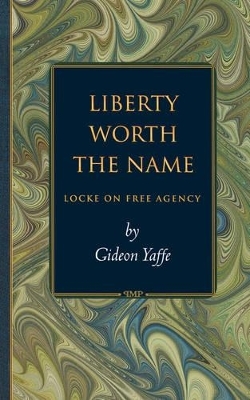
Liberty Worth the Name
Princeton University Press (Verlag)
978-0-691-05706-4 (ISBN)
This is the first comprehensive interpretation of John Locke's solution to one of philosophy's most enduring problems: free will and the nature of human agency. Many assume that Locke defines freedom as merely the dependency of conduct on our wills. And much contemporary philosophical literature on free agency regards freedom as a form of self-expression in action. Here, Gideon Yaffe shows us that Locke conceived free agency not just as the freedom to express oneself, but as including also the freedom to transcend oneself and act in accordance with "the good." For Locke, exercising liberty involves making choices guided by what is good, valuable, and important. Thus, Locke's view is part of a tradition that finds freedom in the imitation of God's agency. Locke's free agent is the ideal agent. Yaffe also examines Locke's understanding of volition and voluntary action. For Locke, choices always involve self-consciousness. The kind of self-consciousness to which Locke appeals is intertwined with his conception of personal identity.
And it is precisely this connection between the will and personal identity that reveals the special sense in which our voluntary actions can be attributed to us and the special sense in which we are active with respect to them. Deftly written and tightly focused, Liberty Worth the Name will find readers far beyond Locke studies and early modern British philosophy, including scholars interested in free will, action theory, and ethics.
Gideon Yaffe is Assistant Professor of Philosophy at the University of Southern California.
Acknowledgments xi Introduction 3 Chapter 1: A Second Perfection 12 Freedom of Action 13 Freedom of Will: The Negative Views 21 Free Wills 22 Free Violitions 27 The Elusive Something and Freedom of Will: The Positive Views 31 The First Edition 32 The Second and Later Editions 42 Some Consequences of the Second Edition Account 61 Freedom of Will and The Natural Law Theory 65 Conclusion 71 Chapter 2: Violition and Voluntary Action 75 Act~ion and Active Powers 78 Passion and Proper Action 79 Active and Passive Power 82 Two Degrees of Attributability 85 What are Volitions; 88 A Quick Look Back 98 Voluntary Action 99 The Necessity of Causation by Volition for Voluntarines 100 The (Non)Sufficency of Causation by Volition for Voluntarines 104 An Alternative Interpretation 107 The Power to Act Voluntarily 112 The Special Atyributability of Vnlnntrary Action 112 Conclusion 117 Chapter 3: Free Agency and Personal Identity 118 Choice and Personal Identity 119 Contemplation of (Temporally) Absent Pleasure and Pain 134 Conclusion 139 Notes 141 Bibliography 161 General Index 169 Index Locorum 175
| Erscheint lt. Verlag | 22.10.2000 |
|---|---|
| Reihe/Serie | Princeton Monographs in Philosophy |
| Verlagsort | New Jersey |
| Sprache | englisch |
| Maße | 140 x 216 mm |
| Gewicht | 198 g |
| Themenwelt | Geisteswissenschaften ► Philosophie ► Erkenntnistheorie / Wissenschaftstheorie |
| ISBN-10 | 0-691-05706-0 / 0691057060 |
| ISBN-13 | 978-0-691-05706-4 / 9780691057064 |
| Zustand | Neuware |
| Informationen gemäß Produktsicherheitsverordnung (GPSR) | |
| Haben Sie eine Frage zum Produkt? |
aus dem Bereich