


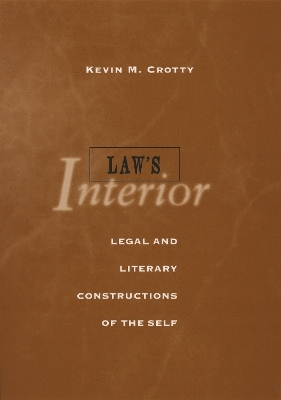
Law's Interior
Legal and Literary Constructions of the Self
Seiten
2001
Cornell University Press (Verlag)
978-0-8014-3856-1 (ISBN)
Cornell University Press (Verlag)
978-0-8014-3856-1 (ISBN)
In Law's Interior, Kevin M. Crotty draws on several important literary works to offer a new model of the relationship between citizens and their laws, one that emphasizes the power of law to shape citizens and to foster—or discourage—their autonomy...
In Law's Interior, Kevin M. Crotty draws on several important literary works to offer a new model of the relationship between citizens and their laws, one that emphasizes the power of law to shape citizens and to foster—or discourage—their autonomy. Crotty maintains that citizens are "inside" the law—they are the law's interior. Literature, he finds, can be relevant to law by emphasizing the connections between law and the world around it—a stance that corrects the tendency of legal theory to treat law as a separate, autonomous entity.The texts Crotty examines—Aeschylus' Oresteia, St. Augustine's Confessions, and the poetry of Wallace Stevens—question the rationalist optimism that Crotty regards as distorting much recent theorizing about law. Further, he asserts that the inability of courts to state clearly the principles animating their decisions demonstrates the stranglehold the positivist model has on us and our legal imaginations.Crotty sketches a model of the relation between citizens and laws that supplements the more familiar idea of law as something deliberated and enacted by rational, inherently autonomous citizens. The most important legal decisions of the past fifty years, Crotty says, rest on the perception that the state, far from merely respecting the "innate" autonomy of its citizens, actively shapes that autonomy. Law's Interior should contribute to a better understanding of the real principles underlying some landmark decisions by the Supreme Court.
In Law's Interior, Kevin M. Crotty draws on several important literary works to offer a new model of the relationship between citizens and their laws, one that emphasizes the power of law to shape citizens and to foster—or discourage—their autonomy. Crotty maintains that citizens are "inside" the law—they are the law's interior. Literature, he finds, can be relevant to law by emphasizing the connections between law and the world around it—a stance that corrects the tendency of legal theory to treat law as a separate, autonomous entity.The texts Crotty examines—Aeschylus' Oresteia, St. Augustine's Confessions, and the poetry of Wallace Stevens—question the rationalist optimism that Crotty regards as distorting much recent theorizing about law. Further, he asserts that the inability of courts to state clearly the principles animating their decisions demonstrates the stranglehold the positivist model has on us and our legal imaginations.Crotty sketches a model of the relation between citizens and laws that supplements the more familiar idea of law as something deliberated and enacted by rational, inherently autonomous citizens. The most important legal decisions of the past fifty years, Crotty says, rest on the perception that the state, far from merely respecting the "innate" autonomy of its citizens, actively shapes that autonomy. Law's Interior should contribute to a better understanding of the real principles underlying some landmark decisions by the Supreme Court.
Kevin M. Crotty is Professor of Classics and Law at Washington and Lee University. His previous books include The Poetics of Supplication: Homer's "Iliad"and "Odyssey", also from Cornell.
| Erscheint lt. Verlag | 3.4.2001 |
|---|---|
| Verlagsort | Ithaca |
| Sprache | englisch |
| Maße | 152 x 229 mm |
| Gewicht | 907 g |
| Themenwelt | Geisteswissenschaften ► Sprach- / Literaturwissenschaft ► Anglistik / Amerikanistik |
| Geisteswissenschaften ► Sprach- / Literaturwissenschaft ► Literaturwissenschaft | |
| ISBN-10 | 0-8014-3856-X / 080143856X |
| ISBN-13 | 978-0-8014-3856-1 / 9780801438561 |
| Zustand | Neuware |
| Informationen gemäß Produktsicherheitsverordnung (GPSR) | |
| Haben Sie eine Frage zum Produkt? |
Mehr entdecken
aus dem Bereich



aus dem Bereich
Poetik eines sozialen Urteils
Buch | Hardcover (2023)
De Gruyter (Verlag)
CHF 83,90


