Helicopter Pilot's Companion (eBook)
128 Seiten
Crowood (Verlag)
978-1-84797-922-3 (ISBN)
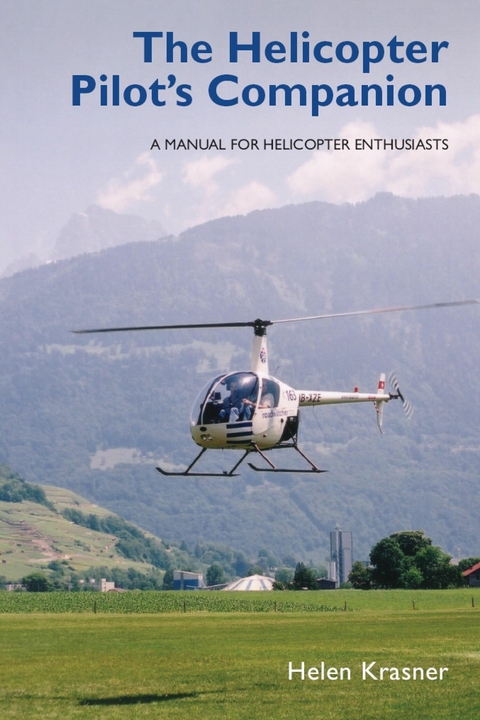
The Helicopter Pilot's Companion is essential reading for those who are considering training to be a helicopter pilot, those currently undertaking training and those who have recently gained their Private Pilot's Licence for helicopters. Written in a clear, no-nonsense style, it covers a whole range of subjects concerning rotary aviation including common myths about flying helicopters, choosing a flying school and an instructor, the basics of rotary aerodynamics, and all practical aspects of learning to fly helicopters. Issues are examined that are important when the new helicopter pilot has gained his, or her, licence and is able to fly alone, including flying with passengers, coping with challenging weather and dealing with emergencies. In addition, the author provides useful advice to those readers who are considering becoming professional helicopter pilots. Illustrated with 28 colour photographs.
1 SO YOU WANT TO FLY A HELICOPTER?
HELICOPTER MYTHS
‘I wouldn’t fly a helicopter, ever. For a start, I’d never manage it; they’re really, really difficult to fly. And they’re incredibly expensive. Besides, the small ones aren’t any good in strong winds; they’re too fragile. And helicopters are dangerous, you only have to look at the accident rates to realize that – they’re far higher than for other types of aircraft.’
While I have never actually heard quite so many mistaken assumptions about helicopters stated in so few words by one person, I might well have done. Despite the fact that many people find helicopters intriguing, they also have some pretty strange ideas about them. This applies even to some fixed-wing pilots (who, I always think, ought to know better). It seems to be the case that these ‘helicopter myths’ are repeated so often that people come to believe that they must be true. So let’s take a look at each of these ideas in turn.
Myth Number One: helicopters are really difficult to fly. No, actually, they are not. You will probably be pleased to hear that most people can learn to fly a helicopter. If you can drive a car, ride a bike, or do anything else requiring a fair degree of co-ordination, then you could probably learn to fly a rotary aircraft. PPL(H) students take about the same amount of time to get their licences as their fixed-wing counterparts. The national average is around sixty to seventy hours, although a few real ‘naturals’ manage to qualify in the legal minimum of forty-five flying hours.
It is true that some helicopter manoeuvres are quite difficult. Hovering takes many students quite a while to master and, as it is such a central part of helicopter flying, this often means they cannot move on until they have managed it. But the same type of thing applies during fixed-wing training. Many students struggle when it comes to learning to land a fixed-wing aircraft; in contrast, the approach and landing in a helicopter is comparatively easy. In company with many other helicopter pilots, I’ve always preferred being able to slow down before I land, rather than the other way round.
I’ve always preferred being able to slow down before I land.
Admittedly, navigation is more difficult in a small helicopter as you need to keep your hands on the controls all the time – you can’t trim the aircraft and then concentrate on studying your map, as you can in a small aeroplane. But this whole issue comes down to cockpit organization rather than anything else. In addition, a helicopter’s ability to slow down as much as the pilot wants it to without stalling means that you can always reduce the speed to give yourself time to think, to work out where you are, or to decide what to do. This is particularly useful when approaching an unfamiliar airfield, for example. So it is swings and roundabouts really, in respect of the relative difficulties associated with each type of flying machine. Some helicopter pilots would like everyone to think that they are quite unlike the rest of the human race, but that’s not really the case.
Myth Number Two: helicopters are incredibly expensive. It is indeed true that the training costs are about double those for fixed-wing flying, and the same is true of self-fly hire charges once you’ve got a PPL(H). Also, buying a helicopter is far more expensive than buying an aeroplane at the cheaper end of the scale. But this is by no means the whole story. In a helicopter, a lot less time is wasted. By that I mean that you can start up, take off into wind, go to your destination and land, without spending expensive time in a queue for the departure runway or doing an overhead join at your destination airfield. A few years ago, I was trying to leave a fly-in at about the same time as around a dozen other aircraft. I’ll never forget the envious glances as I called up on the radio and asked to depart directly into wind, effectively avoiding about ten minutes of queuing time … and money-burning time.
If you have a specific destination that is off-airfield, a helicopter can act as door-to-door transport, since it does not need a runway. This can save on taxi fares and, of course, is far more convenient. And if you’re just wanting to get airborne and ‘play’ rather than actually go anywhere for a reason, there’s so much more you can do in a helicopter. A flight doesn’t have to be to another airfield, and the nearest one could be maybe an hour away. Instead, you can visit friends and land in their gardens, or simply hover and have fun at low level. The feeling of boredom and sameness about local flying that can often set in after someone has had a PPL (A) for a year or so, necessitating longer and more expensive flights, doesn’t tend to happen with a helicopter licence because there is such a variety of things that you can try. It is more expensive to fly helicopters, but, once everything is taken into account, the difference is not as great as it might first appear.
Myth Number Three: small helicopters are fragile and can’t cope with strong winds. Well, it is true that helicopters do vibrate quite a lot, but they cope with weather conditions at least as well as, and often better than, fixed-wing aircraft of an equivalent size. After all, wind strength as such is rarely a problem in any aircraft, unless it gets to a point at which the machine is about to be blown apart. It is more usually the case that either the wind makes things uncomfortable for the passengers, or it makes it difficult for the pilot to fly. When it comes to passenger comfort, small helicopters actually ride the wind surprisingly well. Students in a trial lesson are often surprised at how stable a helicopter can feel in a fairly strong wind. The type of turbulence that affects the wings of an aeroplane and leads to the feeling of being flung around the sky may affect the helicopter’s rotors in a similar fashion, but this is often not transmitted to the fuselage below. When it comes to pilot handling, in many respects helicopters are easier to manage in windy conditions than aeroplanes. There is no equivalent to the fixed-wing crosswind landing, in terms of difficulty for the pilot. In a helicopter, you simply land into wind, or, if absolutely compelled to use a runway, you turn into wind at the last moment as you come to a hover. Hovering in a strong wind may be quite challenging, but, again, you can turn into wind and hover-taxi sideways if conditions warrant it.
Myth Number Four: helicopters are dangerous, and you only have to look at the accident records to prove it. Actually, if you do take a look at the accident reports you will find that very few helicopter accidents are caused by engine failure, other mechanical failure, or anything else to do with the actual machine. The primary reasons for accidents are the same as for fixed-wing aircraft. Controlled flight into terrain generally tops the list, as do other factors associated with flying in bad weather. Wire strikes figure quite frequently, since so many helicopter landings are off-airfield, and wires are a common hazard. Most other causes also seem to be associated with human error rather than anything else. When failures do happen, they are, again, similar to those in aeroplanes; for example, carburettor icing is the most common cause of engine failure. Other emergencies, such as engine fires, electrical fires, unexplained vibrations, and so on, are very rare. When they do happen, the helicopter pilot has one big advantage in that he can simply make a precautionary landing on any flat area available – and that flat area does not need to be very big. The fixed-wing pilot would probably have to divert to the nearest airfield, or at least look for a very large, flat field … from which he’d probably have great difficulty in departing again, should the aircraft turn out to be flyable after all.
I hope I’ve now proved to you that helicopters are not as difficult, expensive, impractical and dangerous as they are often portrayed, and that flying them is relatively easy, not outrageously expensive, and fairly comfortable and safe. In fact, piloting a helicopter is probably within the reach of most people, if they really want to try it.
However, before you go out and book a rotary trial lesson, I should offer a word of warning. There is a fifth helicopter myth – that rotary flying is hopelessly addictive, and that having a go just once is never enough. In this case, the ‘myth’ is true. Once you’ve tried flying a helicopter – particularly when you’ve mastered hovering, even if only for a few seconds – you probably won’t be able to stop. You will want to do more, and more, and more. Most of us did not set out to be helicopter pilots. We planned just to try it, but somehow we kept going back. The same could happen to you. You have been warned!
MAKING THE MOST OF THE TRIAL LESSON
So you’ve now decided to give it a go! You really want to fly a helicopter, and you’re ready to book a taster flight, or what is generally known as a trial lesson/air experience flight. Virtually all helicopter training schools can offer these. Most of them also sell trial lesson gift vouchers, so you might be able to persuade someone to buy you the best birthday or Christmas present you’ll probably ever have.
First, though, especially if you might be considering a gift voucher, let me offer a word of warning. You can also buy trial lesson vouchers from various organizations which act as middlemen; they are not flying schools themselves, but a large number of flying schools are affiliated to them. The advantage of this is that they sell vouchers...
| Erscheint lt. Verlag | 30.9.2014 |
|---|---|
| Verlagsort | London |
| Sprache | englisch |
| Themenwelt | Natur / Technik ► Fahrzeuge / Flugzeuge / Schiffe ► Luftfahrt / Raumfahrt |
| Sachbuch/Ratgeber ► Sport ► Motor- / Rad- / Flugsport | |
| Geisteswissenschaften ► Psychologie | |
| Technik ► Fahrzeugbau / Schiffbau | |
| Technik ► Luft- / Raumfahrttechnik | |
| ISBN-10 | 1-84797-922-X / 184797922X |
| ISBN-13 | 978-1-84797-922-3 / 9781847979223 |
| Informationen gemäß Produktsicherheitsverordnung (GPSR) | |
| Haben Sie eine Frage zum Produkt? |
 EPUB (Wasserzeichen)
DRM: Digitales Wasserzeichen
Dieses eBook enthält ein digitales Wasserzeichen und ist damit für Sie personalisiert. Bei einer missbräuchlichen Weitergabe des eBooks an Dritte ist eine Rückverfolgung an die Quelle möglich.
Dateiformat: EPUB (Electronic Publication)
EPUB ist ein offener Standard für eBooks und eignet sich besonders zur Darstellung von Belletristik und Sachbüchern. Der Fließtext wird dynamisch an die Display- und Schriftgröße angepasst. Auch für mobile Lesegeräte ist EPUB daher gut geeignet.
Systemvoraussetzungen:
PC/Mac: Mit einem PC oder Mac können Sie dieses eBook lesen. Sie benötigen dafür die kostenlose Software Adobe Digital Editions.
eReader: Dieses eBook kann mit (fast) allen eBook-Readern gelesen werden. Mit dem amazon-Kindle ist es aber nicht kompatibel.
Smartphone/Tablet: Egal ob Apple oder Android, dieses eBook können Sie lesen. Sie benötigen dafür eine kostenlose App.
Geräteliste und zusätzliche Hinweise
Buying eBooks from abroad
For tax law reasons we can sell eBooks just within Germany and Switzerland. Regrettably we cannot fulfill eBook-orders from other countries.
aus dem Bereich