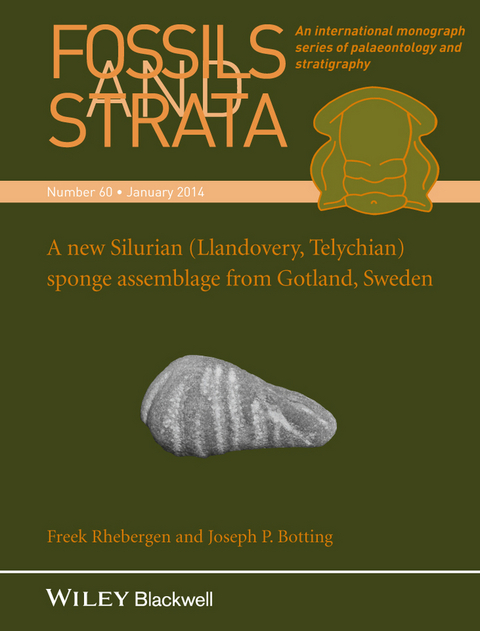
A New Silurian (Llandovery, Telychian) Sponge Assemblage from Gotland, Sweden (eBook)
John Wiley & Sons (Verlag)
978-1-118-90664-4 (ISBN)
Freek Rhebergen and Joseph Botting are the authors of A New Silurian (Llandovery, Telychian) Sponge Assemblage from Gotland, Sweden, published by Wiley.
A new Silurian (Llandovery, Telychian) sponge assemblage from Gotland, Sweden
FREEK RHEBERGEN AND JOSEPH P. BOTTING
LETHAIA
Rhebergen F. & Botting J. P. 2014: A new Silurian (Llandovery, Telychian) sponge assemblage from Gotland, Sweden. Fossils and Strata, Vol. 60, pp. 1–87.
A diverse sponge fauna is reported from the Late Llandovery (Telychian) of Gotland (Sweden) and is the first Silurian assemblage known from Baltica. The fossils have been collected from pebble accumulations along a restricted section of the western coast, but originate from the unexposed ‘Red Layer’, a poorly known formation underlying the Lower Visby Formation. The age of the assemblage has been determined through co-occurring acritarchs. The assemblage comprises 29 species in 20 genera, 18 species of which have not previously been recorded from Baltica, together with several taxa in open nomenclature. Isolated hexactinellid spicules are common, and these sponges are also represented by rare, partially articulated skeletons. The fauna includes three new genera and six new species: Multistella leipnitzae n. sp., Post-perissocoelia gnisvardensis n. gen. et n. sp., Lindstroemispongia cylindrata n. gen. et n. sp., Haplistion toftanum n. sp., Opetionella incompta n. sp. and Urphaenomenospongia euplectelloides n. gen. et n. sp. The endemic Caryoconus gothlandicus (Schlüter, 1884) comprises ca. 50 per cent of the assemblage. Early Palaeozoic Rhizomorina are here recorded from Baltica for the first time. The Anthaspidellidae and Rhizomorina show strong similarities with species from younger Silurian strata in Arctic Canada. The named non-lithistid taxa show advanced skeletal architecture more characteristic of Mesozoic sponges. The palaeobiogeography of these faunas suggests that lithistid sponges were strongly affected by the end-Ordovician extinctions, but a variety of Llandoverian taxa recovered to become very widespread and combined with endemic faunas developing within each region. Non-lithistid taxa, in contrast, appear to have undergone important evolutionary development during the Late Ordovician – Early Silurian interval, with at least some modern groups possibly originating in relatively inshore habitats at this time. Gotland, Hexactinellida, Lower Silurian, Orchocladina, palaeobiogeography, palaeoecology, Porifera, Rhizomorina.
Freek Rhebergen [freek.rhebergen@planet.nl], and Joseph P. Botting [acutipuerilis@yahoo.co.uk], Slenerbrink 178 7812 HJ Emmen, the Netherlands; State Key Laboratory of Palaeobiology and Stratigraphy, Nanjing Institute of Geology and Palaeontology, 39 East Beijing Road, Nanjing, 210008, China; manuscript received on 16/03/2012; manuscript accepted on 10/10/2013.
‘The field being comparatively new and exceedingly difficult, we expect our work to prove faulty in some respects; yet, whatever errors we may have fallen into, we will find consolation in the conviction that we have done the best we could under the circumstances.’
(Ulrich 1890, p. 257)
Introduction
Lower Silurian sponges are globally rare, and Silurian lithistid-dominated faunas are best known from Arctic Canada. A diverse assemblage of silicified sponges, including orchocladines, rhizomorines, stromatoporoids, hexactinellids and non-lithistid demosponges, has been collected from scree accumulations in a restricted area along the western coast of the Island of Gotland, Sweden (Fig. 1, topographical map). The Silurian age (Llandoverian, Telychian) of the fauna has been determined through associated acritarchs, brachiopods and tabulates. The assemblage is important in several respects, especially as Early Silurian sponges are globally rare (Muir et al. in press), and this assemblage fills one of the many gaps in our knowledge. This is the first known assemblage of Silurian sponges from Baltica and, aside from isolated spicules, includes the first rhizoclonid sponges recorded from the region. The assemblage is very distinct from, and far more diverse than, the assemblage of erratic sponges of Ordovician age that also occurs among the same pebble accumulations on Gotland. These assemblages are compared in detail in a subsequent chapter.
Silurian sponge faunas are generally scarce worldwide, being limited both in species and numbers of specimens when compared with Ordovician assemblages. Rigby & Chatterton (1989), in their description of a Silurian sponge fauna from Baillie-Hamilton and Cornwallis Islands, Arctic Canada, gave an overview of Silurian sponges known from the literature up to that time, and this is revised and extended by Muir et al. (in press). Rigby & Chatterton (1989) summarized about fifty publications, most of them concerning sponges from North America. The only European sponges were those discussed by Rauff (1894); these include two hexactinellids from the UK: Oncosella Rauff (1894) and Amphispongia Salter (1861), and Ordovician demosponges from northern Europe. Rauff considered Aulocopium, Astylospongia, Hindia and Caryospongia to be of ‘Silurian age’. However, this reflects a widespread stratigraphic confusion, because in older (mainly German) European literature, the Ordovician System was named ‘(Lower-) Silurian’ long after the Ordovician had been erected (Lindström 1888a; Rauff 1893, 1894, 1895; Stolley 1900, 1929). As a consequence, even in recent literature (Finks 2003), Ordovician sponges from Baltica, including Gotland, have erroneously been conceived as of ‘Silurian’ age.
Fig. 1. Map of Gotland (Sweden). About 98 per cent of the collected Telychian sponge specimens have been collected from the Gnisvärd/Blahäll area.
Palaeozoic sponges from the Swedish mainland are exceptionally rare. Wiman (1907) recorded two erratic specimens, but recent re-investigation in 2004 by FR has shown that Wiman’s identification of the specimens as sponges is questionable. The only other record is of three unpublished specimens of Hindia sphaeroidalis from the Ordovician Bodalimestone in the Siljan-area (Sweden), which were recognized by FR in the Leipnitz Collection (Uelzen, Germany) and in the collections of the Swedish Museum of Natural History. There are no reports of sponges from Öland, from either bedrock or erratics (Christina Franzén, personal communication 2004). The occurrence of thousands of sponge specimens on Gotland is therefore remarkable.
Sponges from Gotland have been poorly recorded, compared with the numerous papers on erratic sponges collected in Germany and the Netherlands. Lindström (1885, 1888b) listed erratic sponges from Gotland, assigning some of them to his Zone b and Zone c, and relating these to ‘the Red Layers’. Rauff (1894) apparently visited the collections of the Swedish Museum of Natural History, as he described and figured a number of specimens. However, there is no indication that he considered any of those sponges to be of ‘Upper Silurian’ age. Rhebergen & van Kempen (2002) summarized a discussion between Lindström, Schmidt (1891) and Stolley (Stolley 1900, 1929) on the age and lithostratigraphical origin of the sponges. Lindström probably intended to describe at least part of the sponge assemblage, because he had drawings made by Lilljeval, but did not complete the work (Rhebergen 2007). Schlüter (1884) reported on a remarkable sponge specimen, Astylospongia gothlandica, which has been figured by Rauff (1894) as an aberrant form of the Ordovician species Caryspongia diadema. Retrospectively, this specimen appears to have been the first specimen of the Silurian assemblage to be figured, and it is now designated as the holotype of Caryoconus gothlandicus (Schlüter, 1884).
Van Kempen (1983) described another aberrant erratic specimen from Gnisvärd (Gotland) and followed Rauff’s determination. Additional specimens of identical or similar aberrant forms, collected by Mrs. Heilwig Leipnitz, Uelzen (Germany), led to further investigation of the collections of the Swedish Museum of Natural History (Rhebergen & von Hacht 2000). Rhebergen & van Kempen (2002) established the genus Caryoconus, by then dated as Early Silurian (Llandovery to Wenlock), as discussed below. Rhebergen (2005) also described some sponge taxa from Silurian strata exposed on Gotland, varying in age from the Lower Visby Formation (Llandovery) to the Eke Formation (Ludlow).
Although the Silurian stratigraphy of Gotland has been documented in detail in numerous publications, such as by Laufeld & Jeppsson (1976), Jaanusson et al. (1979), Flodén (1980), Calner et al. (2004), Jeppsson et al. (2004) and Jeppsson et al. (2006), there is little information available regarding strata below the Lower Visby Formation, which is the oldest formation exposed. Sponges are either not referred to in these works or are mentioned only incidentally, as in works by Manten (1971) and Laufeld & Jeppsson (1976).
Institutional abbreviations
The following abbreviations denote the repositories of material referred to in the text:
IPPAS Institute of Paleobiology, Polish Academy of Sciences, Warszawa (Poland)
LMG Länsmuseet på Gotland (County Museum of Gotland), Visby (Sweden)
LCU Leipnitz Collection, Uelzen (Germany)
NRM Naturhistoriska Riksmuseet (Swedish Museum of Natural History, Department of Palaeozoology), Stockholm (Sweden)
PMU Museum of Evolution,...
| Erscheint lt. Verlag | 27.2.2014 |
|---|---|
| Reihe/Serie | Fossils and Strata Monograph Series | Fossils and Strata Monograph Series |
| Sprache | englisch |
| Themenwelt | Geisteswissenschaften ► Archäologie |
| Geschichte ► Allgemeine Geschichte ► Vor- und Frühgeschichte | |
| Naturwissenschaften ► Geowissenschaften ► Geologie | |
| Naturwissenschaften ► Geowissenschaften ► Mineralogie / Paläontologie | |
| Technik | |
| Schlagworte | Age • Arctic • Assemblage • assemblages • Baltica • Canada • Diverse • earth sciences • Eighteen • Fauna • First • Geowissenschaften • Gotland • known • Later • llandoverian • New • Paläontologie, Paläobiologie u. Geobiologie • Paläontologie, Paläobiologie u. Geobiologie • Paleontology, Paleobiology & Geobiology • silurian • species • sponge • Sponge fauna • strong similarities • Three • Worldwide |
| ISBN-10 | 1-118-90664-0 / 1118906640 |
| ISBN-13 | 978-1-118-90664-4 / 9781118906644 |
| Informationen gemäß Produktsicherheitsverordnung (GPSR) | |
| Haben Sie eine Frage zum Produkt? |
 EPUB (Adobe DRM)
Kopierschutz: Adobe-DRM
Adobe-DRM ist ein Kopierschutz, der das eBook vor Mißbrauch schützen soll. Dabei wird das eBook bereits beim Download auf Ihre persönliche Adobe-ID autorisiert. Lesen können Sie das eBook dann nur auf den Geräten, welche ebenfalls auf Ihre Adobe-ID registriert sind.
Details zum Adobe-DRM
Dateiformat: EPUB (Electronic Publication)
EPUB ist ein offener Standard für eBooks und eignet sich besonders zur Darstellung von Belletristik und Sachbüchern. Der Fließtext wird dynamisch an die Display- und Schriftgröße angepasst. Auch für mobile Lesegeräte ist EPUB daher gut geeignet.
Systemvoraussetzungen:
PC/Mac: Mit einem PC oder Mac können Sie dieses eBook lesen. Sie benötigen eine
eReader: Dieses eBook kann mit (fast) allen eBook-Readern gelesen werden. Mit dem amazon-Kindle ist es aber nicht kompatibel.
Smartphone/Tablet: Egal ob Apple oder Android, dieses eBook können Sie lesen. Sie benötigen eine
Geräteliste und zusätzliche Hinweise
Buying eBooks from abroad
For tax law reasons we can sell eBooks just within Germany and Switzerland. Regrettably we cannot fulfill eBook-orders from other countries.
aus dem Bereich