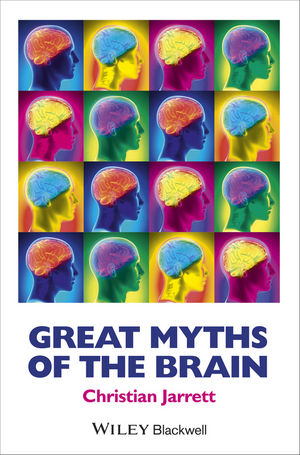
Great Myths of the Brain (eBook)
John Wiley & Sons (Verlag)
978-1-118-31270-4 (ISBN)
Great Myths of the Brain introduces readers to the field of neuroscience by examining popular myths about the human brain.
- Explores commonly-held myths of the brain through the lens of scientific research, backing up claims with studies and other evidence from the literature
- Looks at enduring myths such as “Do we only use 10% of our brain?”, “Pregnant women lose their mind”, “Right-brained people are more creative” and many more.
- Delves into myths relating to specific brain disorders, including epilepsy, autism, dementia, and others
- Written engagingly and accessibly for students and lay readers alike, providing a unique introduction to the study of the brain
- Teaches readers how to spot neuro hype and neuro-nonsense claims in the media
Christian Jarrett has a PhD in Cognitive Neuroscience from the University of Manchester. He is editor of the British Psychological Society’s Research Digest; author of the Brain Watch blog for WIRED; a blogger for Psychology Today; and columnist for 99U, the New York-based creativity think tank. Dr. Jarrett is also the author of The Rough Guide to Psychology (2011) and editor of 30 Second Psychology (Icon Books)
Great Myths of the Brain introduces readers to the field of neuroscience by examining popular myths about the human brain. Explores commonly-held myths of the brain through the lens of scientific research, backing up claims with studies and other evidence from the literature Looks at enduring myths such as Do we only use 10% of our brain? , Pregnant women lose their mind , Right-brained people are more creative and many more. Delves into myths relating to specific brain disorders, including epilepsy, autism, dementia, and others Written engagingly and accessibly for students and lay readers alike, providing a unique introduction to the study of the brain Teaches readers how to spot neuro hype and neuro-nonsense claims in the media
Christian Jarrett has a PhD in Cognitive Neuroscience from the University of Manchester. He is editor of the British Psychological Society's Research Digest; author of the Brain Watch blog for WIRED; a blogger for Psychology Today; and columnist for 99U, the New York-based creativity think tank. Dr. Jarrett is also the author of The Rough Guide to Psychology (2011) and editor of 30 Second Psychology (Icon Books)
Acknowledgments xii
Introduction 1
1 Defunct Myths 15
#1 Thought Resides in the Heart 15
#2 The Brain Pumps Animal Spirits Round the Body 18
#3 Brain Cells Join Together Forming a Huge Nerve Net 21
#4 Mental Function Resides in the Brain's Hollows 22
2 Myth-Based Brain Practices 25
#5 Drilling a Hole in the Skull Releases Evil Spirits 25
#6 Personality Can Be Read in the Bumps on the Skull 28
#7 Mental Illness Can Be Cured by Disconnecting the Frontal
Lobes 30
3 Mythical Case Studies 37
#8 Brain Injury Turned Neuroscience's Most Famous Case
into an Impulsive Brute 37
#9 The Faculty of Language Production Is Distributed Through the
Brain 40
#10 Memory Is Distributed Throughout the Entire Cortex 45
4 The Immortal Myths 51
#11 We Only Use Ten Percent of Our Brains 51
#12 Right-Brained People Are More Creative 55
#13 The Female Brain Is More Balanced (and Other Gender-Based
Brain Myths) 65
#14 Adults Can't Grow New Brain Cells 74
#15 There's a God Spot in the Brain (and Other
Lesser-Spotted Myths) 80
#16 Pregnant Women Lose Their Minds 87
#17 We All Need Eight Hours of Continuous Sleep (and Other Dozy
Sleep Myths) 92
#18 The Brain Is a Computer 101
#19 The Mind Can Exist Outside of the Brain 106
#20 Neuroscience Is Transforming Human Self-Understanding
115
5 Myths about the Physical Structure of the Brain 135
#21 The Brain Is Well Designed 135
#22 The Bigger the Brain, the Better 140
#23 You Have a Grandmother Cell 146
#24 Glial Cells Are Little More Than Brain Glue 149
#25 Mirror Neurons Make Us Human (and Broken Mirror Neurons
Cause Autism) 154
#26 The Disembodied Brain 160
6 Technology and Food Myths 177
#27 Brain Scans Can Read Your Mind 177
#28 Neurofeedback Will Bring You Bliss and Enlightenment 192
#29 Brain Training Will Make You Smart 201
#30 Brain Food Will Make You Even Smarter 209
#31 Google Will Make You Stupid, Mad, or Both 217
7 Brain Myths Concerning Perception and Action 235
#32 The Brain Receives Information from Five Separate Senses
235
#33 The Brain Perceives the World As It Is 242
#34 The Brain's Representation of the Body Is Accurate and
Stable 249
8 Myths about Brain Disorder and Illness 258
#35 Brain Injury and Concussion Myths 258
#36 Amnesia Myths 265
#37 Coma Myths 273
#38 Epilepsy Myths 280
#39 Autism Myths 286
#40 Dementia Myths 294
#41 The Chemical Imbalance Myth of Mental Illness 300
Afterword 316
Index 318
The more we are interested in the brain and how it explains our behaviour, the more important it is that we rid ourselves of untruths and half truths. Myth buster extraordinaire, Christian Jarrett, is an engaging and knowledgeable guide who spring cleans the cobwebs of misinformation that have accumulated over recent years. You will be surprised at some favourite beliefs that turn out to be scare stories or wishful thinking. Yet, Jarrett conveys a strong optimism about fresh approaches that will result in new knowledge. All claims are well substantiated with references. It will be fun to learn from this book.--Professor Uta Frith, UCL Institute of Cognitive Neuroscience
Christian Jarrett is the ideal guide to the fascinating, bewildering and often overhyped world of the brain. He writes about the latest discoveries in neuroscience with wonderful clarity, while cleanly puncturing myths and misinformation.--Ed Yong, award-winning science writer, blogger and journalist
Great Myths of the Brain' provides and incredibly thorough and engaging dismantling of neurological myths and misconceptions that abound today. For anyone overwhelmed by copious bogus neuroscience, Christian Jarrett has generously used his own mighty brain to clear this cloud of misinformation, like a lighthouse cutting through the fog.--Dr Dean Burnett, Guardian blogger, Cardiff University
Lots of people cling to misconceptions about the brain that are just plain wrong, and sometimes even dangerous. In this persuasive and forceful book, Christian Jarett exposes many of these popular and enduring brain myths. Readers who want to embrace proper neuroscience, and arm themselves against neurononsense will enjoy this splendid book, and profit greatly from doing so.--Elizabeth F. Loftus, Distinguished Professor, University of California, Irvine
Christian Jarrett, one of the world's great communicators of psychological science, takes us on a neuroscience journey, from ancient times to the present. He exposes things we have believed that just aren't so. And he explores discoveries that surprise and delight us. Thanks to this tour de force of critical thinking, we can become wiser--by being smartly skeptical but not cynical, open but not gullible--David G. Myers, Hope College, author, Psychology, 11th Edition
A masterful catalogue of neurobollocks.--Dr Ben Goldacre, author of Bad Science and Bad Pharma
In this era of commercialized neurohype, Christian Jarrett's engaging book equips us with the skills for spotting the authentic facts lost in a sea of brain myths. With compelling arguments and compassion for the human condition, Jarrett teaches us that the truth about the brain is more complicated, but ultimately more fascinating, than fiction.--The Neurocritic, neuroscientist and blogger
Christian Jarrett has written a wonderful book that is as entertaining as it is enlightening. When it comes to brain science, a little knowledge is a dangerous thing. Jarrett has done us all a great service by peeling back the layers of hype to reveal what we really do know - and don't know - about how the brain functions.--Prof Christopher C French, Goldsmiths, University of London
Introduction
“As humans, we can identify galaxies light years away, we can study particles smaller than an atom. But we still haven't unlocked the mystery of the three pounds of matter that sits between our ears.” That was US President Barack Obama speaking in April 2013 at the launch of the multimillion dollar BRAIN Initiative. It stands for “Brain Research through Advancing Innovative Neurotechnologies” and the idea is to develop new ways to visualize the brain in action. The same year the EU announced its own €1 billion Human Brain Project to create a computer model of the brain (see p. 105).
This focus on neuroscience isn't new – back in 1990, US President George W. Bush designated the 1990s the “Decade of the Brain” with a series of public awareness publications and events. Since then interest and investment in neuroscience has only grown more intense; some have even spoken of the twenty-first century as the “Century of the Brain.”
Despite our passion for all things neuro, Obama's assessment of our current knowledge was accurate. We've made great strides in our understanding of the brain, yet huge mysteries remain. They say a little knowledge can be a dangerous thing and it is in the context of this excitement and ignorance that brain myths have thrived. By brain myths I mean stories and misconceptions about the brain and brain-related illness, some so entrenched in everyday talk that large sections of the population see them as taken-for-granted facts.
With so many misconceptions swirling around, it's increasingly difficult to tell proper neuroscience from brain mythology or what one science blogger calls neurobollocks (see neurobollocks.wordpress.com), otherwise known as neurohype, neurobunk, neurotrash, or neurononsense. Daily newspaper headlines tell us the “brain spot” for this or that emotion has been identified (see p. 80). Salesmen are capitalizing on the fashion for brain science by placing the neuro prefix in front of any activity you can think of, from neuroleadership to neuromarketing (see p. 188). Fringe therapists and self-help gurus borrow freely from neuroscience jargon, spreading a confusing mix of brain myths and self-improvement propaganda.
In 2014, a journalist and over-enthusiastic neuroscientist even attempted to explain the Iranian nuclear negotiations (occurring at that time) in terms of basic brain science.1 Writing in The Atlantic, the authors actually made some excellent points, especially in terms of historical events and people's perceptions of fairness. But they undermined their own credibility by labeling these psychological and historical insights as neuroscience, or by gratuitously referencing the brain. It's as if the authors drank brain soup before writing their article, and just as they were making an interesting historical or political point, they hiccupped out another nonsense neuro reference.
This book takes you on a tour of the most popular, enduring and dangerous of brain myths and misconceptions, from the widely accepted notion that we use just 10 percent of our brains (see p. 51), to more specific and harmful misunderstandings about brain illnesses, such as the mistaken idea that you should place an object in the mouth of a person having an epileptic fit to stop them from swallowing their tongue (see p. 284). I'll show you examples of writers, filmmakers, and charlatans spreading brain myths in newspaper headlines and the latest movies. I'll investigate the myths' origins and do my best to use the latest scientific consensus to explain the truth about how the brain really works.
The Urgent Need for Neuro Myth-Busting
When Sanne Dekker at the Vrije Universiteit in Amsterdam and her colleagues surveyed hundreds of British and Dutch teachers recently about common brain myths pertaining to education, their results were alarming. The teachers endorsed around half of 15 neuromyths embedded among 32 statements about the brain.2 What's more, these weren't just any teachers. They were teachers recruited to the survey because they had a particular interest in using neuroscience to improve teaching.
Among the myths the teachers endorsed were the idea that there are left-brain and right-brain learners (see p. 55) and that physical coordination exercises can improve the integration of function between the brain hemispheres. Worryingly, myths related to quack brain-based teaching programs (see p. 207) were especially likely to be endorsed by the teachers. Most disconcerting of all, greater general knowledge about the brain was associated with stronger belief in educational neuromyths – another indication that a little brain knowledge can be a dangerous thing.
If the people educating the next generation are seduced by brain myths, it's a sure sign that we need to do more to improve the public's understanding of the difference between neurobunk and real neuroscience. Still further reason to tackle brain myths head on comes from research showing that presenting people, including psychology students, with correct brain information is not enough – many still endorse the 10 percent myth and others. Instead what's needed is a “refutational approach” that first details brain myths and then debunks them, which is the format I'll follow through much of this book.
Patricia Kowalski and Annette Taylor at the University of San Diego compared the two teaching approaches in a 2009 study with 65 undergraduate psychology students.3 They found that directly refuting brain and psychology myths, compared with simply presenting accurate facts, significantly improved the students' performance on a test of psychology facts and fiction at the end of the semester. Post-semester performance for all students had improved by 34.3 percent, compared with 53.7 for those taught by the refutational approach.
Yet another reason it's important we get myth-busting is the media's treatment of neuroscience. When Cliodhna O'Connor at UCL's Division of Psychology and Language Sciences, and her colleagues analyzed UK press coverage of brain research from 2000 to 2010, they found that newspapers frequently misappropriated new neuroscience findings to bolster their own agenda, often perpetuating brain myths in the process (we'll see through examples later in this book that the US press is guilty of spreading neuromyths too).4
From analyzing thousands of news articles about the brain, O'Connor found a frequent habit was for journalists to use a fresh neuroscience finding as the basis for generating new brain myths – dubious self-improvement or parenting advice, say, or an alarmist health warning. Another theme was using neuroscience to bolster group differences, for example, by referring to “the female brain” or “the gay brain,” as if all people fitting that identity all have the same kind of brain (see p. 65 for the truth about gender brain differences). “[Neuroscience] research was being applied out of context to create dramatic headlines, push thinly disguised ideological arguments, or support particular policy agendas,” O'Connor and her colleagues concluded.
About This Book
This introductory section ends with a primer on basic brain anatomy, techniques, and terminology. Chapter 1 then kicks off the myth-busting by providing some historical context, including showing how our understanding of the brain has evolved since Ancient times, and detailing outdated myths that are no longer widely believed, but which linger in our proverbs and sayings. This includes the centuries' long belief that the mind and emotions are located in the heart – an idea betrayed through contemporary phrases like “heart break” and “learn by heart.” Chapter 2 continues the historical theme, looking at brain techniques that have entered psychiatric or neurological folklore, such as the brutal frontal lobotomy. Chapter 3 examines the lives and brains of some of neurosciences mythical figures – including the nineteenth century rail worker Phineas Gage, who survived an iron rod passing straight through his brain, and Henry Molaison, the amnesiac who was examined by an estimated 100 psychologists and neuroscientists.
Chapter 4 moves on to the classic brain myths that refuse to die away. Many of these will likely be familiar to you – in fact, maybe you thought they were true. This includes the idea that right-brained people are more creative; that we use just 10 percent of our brains; that women lose their minds when they are pregnant; and that neuroscience is changing human self-understanding. We'll see that there is a grain of truth to many of these myths, but that the reality is more nuanced, and often more fascinating, than the myths suggest.
Chapter 5 deals with myths about the physical structure of the brain, including the idea that bigger means better. And we'll look at mythology surrounding certain types of brain cells – the suggestion that mirror neurons are what makes us human and that you have in your brain a cell that responds only to the thought of your grandmother.
Next we turn to technology-related myths about the brain. These relate to the kind of topical claims that make frequent appearances in the press, including the ubiquitous...
| Erscheint lt. Verlag | 2.9.2014 |
|---|---|
| Reihe/Serie | Great Myths in Psychology |
| Great Myths in Psychology | Great Myths of Psychology |
| Sprache | englisch |
| Themenwelt | Geisteswissenschaften ► Psychologie ► Allgemeine Psychologie |
| Geisteswissenschaften ► Psychologie ► Biopsychologie / Neurowissenschaften | |
| Geisteswissenschaften ► Psychologie ► Verhaltenstherapie | |
| Schlagworte | Biowissenschaften • Cognitive Neuropsychology & Cognitive Neuroscience • Kognitive Neuropsychologie u. Neurowissenschaft • Life Sciences • Neuropsychologie • Neuroscience • Neuroscience, brain, human brain, brain myths, cognitive neuroscience, cognition, anthropology, medicine, psychology, psychiatry • Neurowissenschaften • Psychologie • Psychology |
| ISBN-10 | 1-118-31270-8 / 1118312708 |
| ISBN-13 | 978-1-118-31270-4 / 9781118312704 |
| Informationen gemäß Produktsicherheitsverordnung (GPSR) | |
| Haben Sie eine Frage zum Produkt? |
 EPUB (Adobe DRM)
Kopierschutz: Adobe-DRM
Adobe-DRM ist ein Kopierschutz, der das eBook vor Mißbrauch schützen soll. Dabei wird das eBook bereits beim Download auf Ihre persönliche Adobe-ID autorisiert. Lesen können Sie das eBook dann nur auf den Geräten, welche ebenfalls auf Ihre Adobe-ID registriert sind.
Details zum Adobe-DRM
Dateiformat: EPUB (Electronic Publication)
EPUB ist ein offener Standard für eBooks und eignet sich besonders zur Darstellung von Belletristik und Sachbüchern. Der Fließtext wird dynamisch an die Display- und Schriftgröße angepasst. Auch für mobile Lesegeräte ist EPUB daher gut geeignet.
Systemvoraussetzungen:
PC/Mac: Mit einem PC oder Mac können Sie dieses eBook lesen. Sie benötigen eine
eReader: Dieses eBook kann mit (fast) allen eBook-Readern gelesen werden. Mit dem amazon-Kindle ist es aber nicht kompatibel.
Smartphone/Tablet: Egal ob Apple oder Android, dieses eBook können Sie lesen. Sie benötigen eine
Geräteliste und zusätzliche Hinweise
Buying eBooks from abroad
For tax law reasons we can sell eBooks just within Germany and Switzerland. Regrettably we cannot fulfill eBook-orders from other countries.
aus dem Bereich