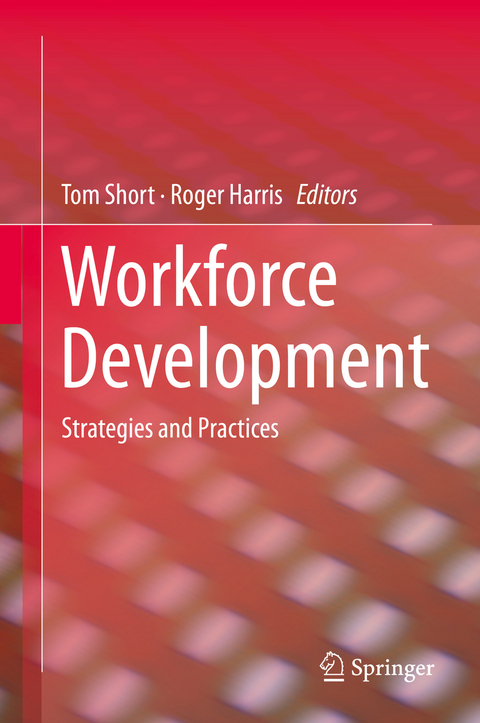
Workforce Development (eBook)
XX, 370 Seiten
Springer Singapore (Verlag)
978-981-287-068-1 (ISBN)
This book is the second in a series of two volumes that reviews a broad range of strategies and practices undertaken as workplace development activities in a post-global financial crisis period when organisational volatility and survival were foremost in the minds of leaders. Drawing mainly from a wide range of major research projects conducted Australia and with some contributions from international authors, this second book is a compilation of contemporary themes and applications that were developed from individual research projects. During the global financial crisis, the Australian economy out-performed many other developed countries, but it was not immune from international pressures such as global competition, market fluctuations and an increasingly mobile workforce. These issues are reflected in many of the chapters and the combined work will inform readers about the major workforce development challenges facing public and private sector organisations. The book blends relevant literature with rich empirical evidence gathered from large and small organisations and includes application tools developed by researchers who are experts in their field. This book will be of scholarly interest to a broad audience of academics, industry leaders, human resource practitioners and students in adult education, business, psychology and social science disciplines. Moreover, the book will be of interest to education and training professionals, management consultants, and more generally, people who follow the evolution of work and its impact on contemporary society.
Tom Short is a Research Fellow at the University of South Australia where his activities include leading workforce development research projects within the CRC for Rail Innovation. His academic and work experiences span areas such as human resource management, workforce development, leadership and adult education - in senior management, consulting, education and research roles. He has published widely on these topics in books, journals, national and international conference proceedings, professional publications and currently serves on the editorial board of three international journals. Tom is a Chartered Fellow of the Chartered Institute of Personnel and Development and was formerly Director of the Performance Improvement Centre, a HRD consulting and training business unit situated within the University of Auckland, Faculty of Education, specialising in the professional development of workplace educators, trainers, assessors and teachers of adults.
Roger Harris is a Professor in the School of Education, University of South Australia. He has had extensive experience in VET research, with a focus on national training reform, workforce development and adult learning. He has presented at national and international conferences and published widely, including books on competency-based education (Macmillan 1995), on and off-job training (NCVER 1998) and rethinking work and learning (Springer 2009), as well co-writing 18 research monographs published by the National Centre for Vocational Education Research. Recently, Roger was Director of the three-year Australian research consortium, Supporting VET providers in building capability for the future. He has been a member of the South Australian Training and Skills Commission and a Research Fellow for three months at the Institute for Adult Learning in the Singapore Workforce Development Agency. Currently he serves on the Academic Boards of two private higher education providers and as Program Leader of the Workforce Development Program within the CRC for Rail Innovation. He has been Editor of the Australian Journal of Adult Learning and is now Co-Editor of the International Journal of Training Research.
This book is the second in a series of two volumes that reviews a broad range of strategies and practices undertaken as workplace development activities in a post-global financial crisis period when organisational volatility and survival were foremost in the minds of leaders. Drawing mainly from a wide range of major research projects conducted Australia and with some contributions from international authors, this second book is a compilation of contemporary themes and applications that were developed from individual research projects. During the global financial crisis, the Australian economy out-performed many other developed countries, but it was not immune from international pressures such as global competition, market fluctuations and an increasingly mobile workforce. These issues are reflected in many of the chapters and the combined work will inform readers about the major workforce development challenges facing public and private sector organisations. The book blends relevant literature with rich empirical evidence gathered from large and small organisations and includes application tools developed by researchers who are experts in their field. This book will be of scholarly interest to a broad audience of academics, industry leaders, human resource practitioners and students in adult education, business, psychology and social science disciplines. Moreover, the book will be of interest to education and training professionals, management consultants, and more generally, people who follow the evolution of work and its impact on contemporary society.?
Tom Short is a Research Fellow at the University of South Australia where his activities include leading workforce development research projects within the CRC for Rail Innovation. His academic and work experiences span areas such as human resource management, workforce development, leadership and adult education – in senior management, consulting, education and research roles. He has published widely on these topics in books, journals, national and international conference proceedings, professional publications and currently serves on the editorial board of three international journals. Tom is a Chartered Fellow of the Chartered Institute of Personnel and Development and was formerly Director of the Performance Improvement Centre, a HRD consulting and training business unit situated within the University of Auckland, Faculty of Education, specialising in the professional development of workplace educators, trainers, assessors and teachers of adults.Roger Harris is a Professor in the School of Education, University of South Australia. He has had extensive experience in VET research, with a focus on national training reform, workforce development and adult learning. He has presented at national and international conferences and published widely, including books on competency-based education (Macmillan 1995), on and off-job training (NCVER 1998) and rethinking work and learning (Springer 2009), as well co-writing 18 research monographs published by the National Centre for Vocational Education Research. Recently, Roger was Director of the three-year Australian research consortium, Supporting VET providers in building capability for the future. He has been a member of the South Australian Training and Skills Commission and a Research Fellow for three months at the Institute for Adult Learning in the Singapore Workforce Development Agency. Currently he serves on the Academic Boards of two private higher education providers and as Program Leader of the Workforce Development Program within the CRC for Rail Innovation. He has been Editor of the Australian Journal of Adult Learning and is now Co-Editor of the International Journal of Training Research.
1 Workforce Development: Moving from Perspectives to Practices Tom Short and Roger HarrisPart I Sustainability, Growth and Diversity2 Global Shifts in Migration Policy and their Implications for Skills Formation, Nations, Communities and Corporations Peter Kell3 What do Young Australian Engineers Want? Strategies to Attract this Talent to Less Glamorous Industries Michelle Wallace, Neroli Sheldon, Roslyn Cameron and Ian Lings4 Enhancing Career Pathways Neroli Sheldon and Michelle Wallace5 Developing a ‘Win-Win’ Scenario: Understanding How Older Workers’ Learning Can Be Enhanced Within Organisations Brian Findsen6 Workplace Equity and Diversity: Towards Recognising a Plurality of Knowledge and SkillsKatie Maher Part II Building Capability and Capacity7 Formal Workplace Mentoring: A Strategy for Engagement Tom Short 8 Education, Technologies and the Training CurriculumLesley Jolly, Gregory Tibbits, Lydia Kavanagh and Liza O’Moore 9 Leading Multiple Generations in the Australian Rail Workplace Tom Short and Roger Harris10 How to Identify and Teach Abstract Skills: A Case Study of Personal Practice Lisa Davies11 What Makes e-Learning Work? Kieren Jamieson, Sukanlaya Sawang and Cameron NewtonPart III Developing Leadership, Talent and Innovation12 Building Leadership Capability: What it Means for Rail Organisations Tom Short, Tom Stehlik and Janene Piip13 Workplace Coaching: Context and Challenge Roslyn Cameron14 Identifying Leadership Talent Janene Piip, Roger Harris15 A Moment in Time and Place: Can Highly Contextualised Training Meet National Training Frameworks?Jill Hadley16 Innovation, Change and the Intrapreneurial MindsetJohn Thompson, Jarna Heinonen and Jonathon M. ScottPart IV – Harmonising Across Boundaries and Borders: Case Studies17 Recruitment of Skilled Employees and Workforce Development in Germany: Practices, Challenges and Strategies for the FutureThomas Deissinger and Kathrin Breuing18 To Engage or not to Engage: What Can the National VET System Offer Enterprises?Michele Simons and Roger Harris19 Creating A Common Approach to Safety Management through Structured Training Development Tamara Banks, Herbert C. Biggs and Nathan Dovan20 Conclusion: Workforce Development – More than the Sum of Its Parts?Roger Harris and Tom Short
| Erscheint lt. Verlag | 2.7.2014 |
|---|---|
| Zusatzinfo | XX, 370 p. 22 illus., 13 illus. in color. |
| Verlagsort | Singapore |
| Sprache | englisch |
| Themenwelt | Geisteswissenschaften |
| Sozialwissenschaften ► Pädagogik ► Berufspädagogik | |
| Sozialwissenschaften ► Pädagogik ► Erwachsenenbildung | |
| Sozialwissenschaften ► Politik / Verwaltung | |
| Schlagworte | Abstract Skills recognition • Adult and Continuing Education • Australian rail industry • Building Leadership Culture • Career Pathways • Competition for global talent • Culturally Diverse Group Skills • Educational Simulation • Education Technologies • Engagement Strategies • Enhancing Workers’ Learning • e-Technologies • Formal Workplace Mentoring • Highly Contextualised Training • Human Resource Management • Industry skills • Intrapreneurial Mindset • Leadership identification • National Training Frameworks • National Vocational Curricula • Organisational leadership • Peter Kell • post-secondary education • professional development • Professional development practice • Professional development strategy • professional education • Professional education practice • Professional education strategy • Project Management • Rail education • Roger Harris • Safety Incident Investigation • Skilled Migration • Tom Short • Unified Industry Standard • vocational education • workforce development • Workforce development practice • Workforce development strategy • workplace mentoring |
| ISBN-10 | 981-287-068-7 / 9812870687 |
| ISBN-13 | 978-981-287-068-1 / 9789812870681 |
| Informationen gemäß Produktsicherheitsverordnung (GPSR) | |
| Haben Sie eine Frage zum Produkt? |
 PDF (Wasserzeichen)
DRM: Digitales Wasserzeichen
Dieses eBook enthält ein digitales Wasserzeichen und ist damit für Sie personalisiert. Bei einer missbräuchlichen Weitergabe des eBooks an Dritte ist eine Rückverfolgung an die Quelle möglich.
Dateiformat: PDF (Portable Document Format)
Mit einem festen Seitenlayout eignet sich die PDF besonders für Fachbücher mit Spalten, Tabellen und Abbildungen. Eine PDF kann auf fast allen Geräten angezeigt werden, ist aber für kleine Displays (Smartphone, eReader) nur eingeschränkt geeignet.
Systemvoraussetzungen:
PC/Mac: Mit einem PC oder Mac können Sie dieses eBook lesen. Sie benötigen dafür einen PDF-Viewer - z.B. den Adobe Reader oder Adobe Digital Editions.
eReader: Dieses eBook kann mit (fast) allen eBook-Readern gelesen werden. Mit dem amazon-Kindle ist es aber nicht kompatibel.
Smartphone/Tablet: Egal ob Apple oder Android, dieses eBook können Sie lesen. Sie benötigen dafür einen PDF-Viewer - z.B. die kostenlose Adobe Digital Editions-App.
Buying eBooks from abroad
For tax law reasons we can sell eBooks just within Germany and Switzerland. Regrettably we cannot fulfill eBook-orders from other countries.
aus dem Bereich