


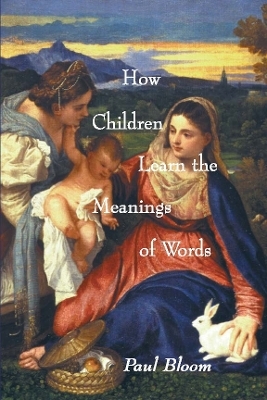
How Children Learn the Meanings of Words
Seiten
2000
MIT Press (Verlag)
978-0-262-02469-3 (ISBN)
MIT Press (Verlag)
978-0-262-02469-3 (ISBN)
- Keine Verlagsinformationen verfügbar
- Artikel merken
This text suggests that children learn words through sophisticated cognitive abilities that exist for other purposes. Topics included are the effects of language on spatial reasoning, the origin of essentialist beliefs, and the young child's understanding of representational art.
How do children learn that the word "dog" refers not to all four-legged animals, and not just to Ralph, but to all members of a particular species? How do they learn the meanings of verbs like "think," adjectives like "good," and words for abstract entities such as "mortgage" and "story"? The acquisition of word meaning is one of the fundamental issues in the study of mind.
According to Paul Bloom, children learn words through sophisticated cognitive abilities that exist for other purposes. These include the ability to infer others' intentions, the ability to acquire concepts, an appreciation of syntactic structure, and certain general learning and memory abilities. Although other researchers have associated word learning with some of these capacities, Bloom is the first to show how a complete explanation requires all of them. The acquisition of even simple nouns requires rich conceptual, social, and linguistic capacities interacting in complex ways.
This book requires no background in psychology or linguistics and is written in a clear, engaging style. Topics include the effects of language on spatial reasoning, the origin of essentialist beliefs, and the young child's understanding of representational art. The book should appeal to general readers interested in language and cognition as well as to researchers in the field.
How do children learn that the word "dog" refers not to all four-legged animals, and not just to Ralph, but to all members of a particular species? How do they learn the meanings of verbs like "think," adjectives like "good," and words for abstract entities such as "mortgage" and "story"? The acquisition of word meaning is one of the fundamental issues in the study of mind.
According to Paul Bloom, children learn words through sophisticated cognitive abilities that exist for other purposes. These include the ability to infer others' intentions, the ability to acquire concepts, an appreciation of syntactic structure, and certain general learning and memory abilities. Although other researchers have associated word learning with some of these capacities, Bloom is the first to show how a complete explanation requires all of them. The acquisition of even simple nouns requires rich conceptual, social, and linguistic capacities interacting in complex ways.
This book requires no background in psychology or linguistics and is written in a clear, engaging style. Topics include the effects of language on spatial reasoning, the origin of essentialist beliefs, and the young child's understanding of representational art. The book should appeal to general readers interested in language and cognition as well as to researchers in the field.
Paul Bloom is Professor of Psychology at Yale University.
| Verlagsort | Cambridge, Mass. |
|---|---|
| Sprache | englisch |
| Themenwelt | Geisteswissenschaften ► Psychologie ► Allgemeine Psychologie |
| Geisteswissenschaften ► Psychologie ► Entwicklungspsychologie | |
| Geisteswissenschaften ► Psychologie ► Verhaltenstherapie | |
| Geisteswissenschaften ► Sprach- / Literaturwissenschaft ► Sprachwissenschaft | |
| ISBN-10 | 0-262-02469-1 / 0262024691 |
| ISBN-13 | 978-0-262-02469-3 / 9780262024693 |
| Zustand | Neuware |
| Informationen gemäß Produktsicherheitsverordnung (GPSR) | |
| Haben Sie eine Frage zum Produkt? |
Mehr entdecken
aus dem Bereich

aus dem Bereich
Lernen, Emotion, Motivation, Gedächtnis
Buch | Softcover (2025)
Beltz (Verlag)
CHF 39,20
Wahrnehmung, Aufmerksamkeit, Denken, Sprache
Buch | Softcover (2025)
Julius Beltz (Verlag)
CHF 39,20


