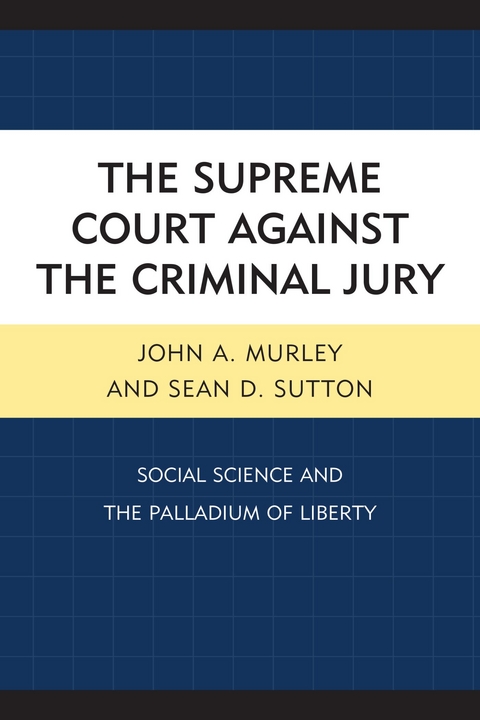
Supreme Court against the Criminal Jury (eBook)
156 Seiten
Lexington Books (Verlag)
978-0-7391-3623-2 (ISBN)
The Supreme Court against the Criminal Jury: Social Science and the Palladium of Liberty is an analysis of the United States Supreme Court decisions in what has come to be called the "e;jury-size"e; and "e;jury-decision rule"e; cases. In Williams v. Florida (1970) and Ballew v. Georgia (1978), a majority of the Supreme Court looked to history, empirical studies, and functional analysis to support its claim that there was "e;no discernible difference"e; between the verdicts of juries of six and juries of twelve. In the process the Court also decided that the number twelve was an historical accident and that the twelve-member jury was not an essential ingredient of trial by jury. Two years later, the Court, following essentially the same line of reasoning used in Williams, decided in the companion cases Apodaca v. Oregon (1972) and Johnson v. Louisiana (1972) that defendants were as well served with juries that reached verdicts by a majority vote of 11-1,10-2 and 9-3 as they were with unanimous jury verdicts. In these cases the Supreme Court rejected the centuries old common law view that the unanimous jury verdict was an essential element of trial by jury. With these four decisions, the criminal jury as it had been known for more than six hundred years under the common law and the Constitution was in principle abandoned. We critique these decisions from the perspective of unreliable jury studies and the impact of these decision on jury nullification.
John A. Murley is emeritus professor and former chair of the Department of Political Science at the Rochester Institute of Technology.Sean D. Sutton is chair of the Department of Political Science at the Rochester Institute of Technology.
Chapter 3: “No Discernible Difference”: On the Court’s Use of Social ScienceChapter 4: Auxiliary Precautions: Unanimous Jury Verdicts v. Majority Jury VerdictsChapter 5: Majority Verdict and Jury Nullification
| Erscheint lt. Verlag | 12.6.2014 |
|---|---|
| Sprache | englisch |
| Themenwelt | Geisteswissenschaften ► Geschichte ► Regional- / Ländergeschichte |
| Geschichte ► Teilgebiete der Geschichte ► Militärgeschichte | |
| Geisteswissenschaften ► Philosophie | |
| Recht / Steuern ► Allgemeines / Lexika | |
| Recht / Steuern ► EU / Internationales Recht | |
| Recht / Steuern ► Öffentliches Recht | |
| Recht / Steuern ► Rechtsgeschichte | |
| Sozialwissenschaften ► Politik / Verwaltung ► Politische Theorie | |
| Sozialwissenschaften ► Politik / Verwaltung ► Staat / Verwaltung | |
| Schlagworte | constitutional rights • Criminal Trial • Jury • Public Policy • Supreme Court • Trial by jury |
| ISBN-10 | 0-7391-3623-2 / 0739136232 |
| ISBN-13 | 978-0-7391-3623-2 / 9780739136232 |
| Informationen gemäß Produktsicherheitsverordnung (GPSR) | |
| Haben Sie eine Frage zum Produkt? |
 EPUB (Adobe DRM)
Kopierschutz: Adobe-DRM
Adobe-DRM ist ein Kopierschutz, der das eBook vor Mißbrauch schützen soll. Dabei wird das eBook bereits beim Download auf Ihre persönliche Adobe-ID autorisiert. Lesen können Sie das eBook dann nur auf den Geräten, welche ebenfalls auf Ihre Adobe-ID registriert sind.
Details zum Adobe-DRM
Dateiformat: EPUB (Electronic Publication)
EPUB ist ein offener Standard für eBooks und eignet sich besonders zur Darstellung von Belletristik und Sachbüchern. Der Fließtext wird dynamisch an die Display- und Schriftgröße angepasst. Auch für mobile Lesegeräte ist EPUB daher gut geeignet.
Systemvoraussetzungen:
PC/Mac: Mit einem PC oder Mac können Sie dieses eBook lesen. Sie benötigen eine
eReader: Dieses eBook kann mit (fast) allen eBook-Readern gelesen werden. Mit dem amazon-Kindle ist es aber nicht kompatibel.
Smartphone/Tablet: Egal ob Apple oder Android, dieses eBook können Sie lesen. Sie benötigen eine
Geräteliste und zusätzliche Hinweise
Buying eBooks from abroad
For tax law reasons we can sell eBooks just within Germany and Switzerland. Regrettably we cannot fulfill eBook-orders from other countries.
aus dem Bereich