
Book of Extremes (eBook)
X, 184 Seiten
Springer International Publishing (Verlag)
978-3-319-06926-5 (ISBN)
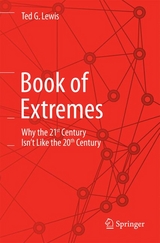
What makes the 21st century different from the 20th century? This century is the century of extremes -- political, economic, social, and global black-swan events happening with increasing frequency and severity. Book of Extremes is a tour of the current reality as seen through the lens of complexity theory - the only theory capable of explaining why the Arab Spring happened and why it will happen again; why social networks in the virtual world behave like flashmobs in the physical world; why financial bubbles blow up in our faces and will grow and burst again; why the rich get richer and will continue to get richer regardless of governmental policies; why the future of economic wealth and national power lies in comparative advantage and global trade; why natural disasters will continue to get bigger and happen more frequently; and why the Internet - invented by the US -- is headed for a global monopoly controlled by a non-US corporation. It is also about the extreme innovations and heroic innovators yet to be discovered and recognized over the next 100 years.Complexity theory combines the predictable with the unpredictable. It assumes a nonlinear world of long-tailed distributions instead of the classical linear world of normal distributions. In the complex 21st century, almost nothing is linear or normal. Instead, the world is highly connected, conditional, nonlinear, fractal, and punctuated. Life in the 21st century is a long-tailed random walk - Levy walks -- through extreme events of unprecedented impact. It is an exciting time to be alive.
Ted G. Lewis is an author, speaker, and consultant with expertise in applied complexity theory, homeland security, infrastructure systems, and early-stage startup strategies. He has served in both government, industry and academe over a long career, including, Executive Director and Professor of Computer Science, Center for Homeland Defense and Security, Naval Postgraduate School, Monterey, CA. 93943, Naval Postgraduate School, Monterey, CA., Senior Vice President of Eastman Kodak, President and CEO of DaimlerChrysler Research and Technology, North America, Inc. and Professor of Computer Science at Oregon State University, Corvallis, OR. In addition, he has served as the Editor-in-Chief of a number of periodicals: IEEE Computer Magazine, IEEE Software Magazine, as a member of the IEEE Computer Society Board of Governors and is currently Advisory Board Member of ACM Ubiquity and Cosmos + Taxis Journal (The Sociology of Hayek). He has published more than 30 books, most recently including Book of Extremes: The Complexity of Everyday Things, Bak's Sand Pile: Strategies for a Catastrophic World, Network Science: Theory and Practice and Critical Infrastructure Protection in Homeland Security: Defending a Networked Nation. Lewis has authored or co-authored numerous scholarly articles in cross-disciplinary journals such as Cognitive Systems Research, Homeland Security Affairs Journal, Journal of Risk Finance, Journal of Information Warfare and IEEE Parallel & Distributed Technology. Lewis resides with his wife and dog, in Monterey, California.
Ted G. Lewis is an author, speaker, and consultant with expertise in applied complexity theory, homeland security, infrastructure systems, and early-stage startup strategies. He has served in both government, industry and academe over a long career, including, Executive Director and Professor of Computer Science, Center for Homeland Defense and Security, Naval Postgraduate School, Monterey, CA. 93943, Naval Postgraduate School, Monterey, CA., Senior Vice President of Eastman Kodak, President and CEO of DaimlerChrysler Research and Technology, North America, Inc. and Professor of Computer Science at Oregon State University, Corvallis, OR. In addition, he has served as the Editor-in-Chief of a number of periodicals: IEEE Computer Magazine, IEEE Software Magazine, as a member of the IEEE Computer Society Board of Governors and is currently Advisory Board Member of ACM Ubiquity and Cosmos + Taxis Journal (The Sociology of Hayek). He has published more than 30 books, most recently including Book of Extremes: The Complexity of Everyday Things, Bak's Sand Pile: Strategies for a Catastrophic World, Network Science: Theory and Practice and Critical Infrastructure Protection in Homeland Security: Defending a Networked Nation. Lewis has authored or co-authored numerous scholarly articles in cross-disciplinary journals such as Cognitive Systems Research, Homeland Security Affairs Journal, Journal of Risk Finance, Journal of Information Warfare and IEEE Parallel & Distributed Technology. Lewis resides with his wife and dog, in Monterey, California.
Waves.- Flashes.- Sparks.- Booms.- Bubbles.- Shocks.- Xtremes.- Bombs.- Leaps.- Transitions.
| Erscheint lt. Verlag | 10.5.2014 |
|---|---|
| Zusatzinfo | X, 184 p. 53 illus., 15 illus. in color. |
| Verlagsort | Cham |
| Sprache | englisch |
| Themenwelt | Geisteswissenschaften ► Geschichte |
| Informatik ► Theorie / Studium ► Künstliche Intelligenz / Robotik | |
| Naturwissenschaften ► Physik / Astronomie | |
| Technik | |
| Schlagworte | Black Swan Events • Black Swan Theory • Chaos Theory History • Complexity • Complexity theory • Nonlinearity Social Science • Randomness Theory |
| ISBN-10 | 3-319-06926-8 / 3319069268 |
| ISBN-13 | 978-3-319-06926-5 / 9783319069265 |
| Informationen gemäß Produktsicherheitsverordnung (GPSR) | |
| Haben Sie eine Frage zum Produkt? |
 PDF (Wasserzeichen)
DRM: Digitales Wasserzeichen
Dieses eBook enthält ein digitales Wasserzeichen und ist damit für Sie personalisiert. Bei einer missbräuchlichen Weitergabe des eBooks an Dritte ist eine Rückverfolgung an die Quelle möglich.
Dateiformat: PDF (Portable Document Format)
Mit einem festen Seitenlayout eignet sich die PDF besonders für Fachbücher mit Spalten, Tabellen und Abbildungen. Eine PDF kann auf fast allen Geräten angezeigt werden, ist aber für kleine Displays (Smartphone, eReader) nur eingeschränkt geeignet.
Systemvoraussetzungen:
PC/Mac: Mit einem PC oder Mac können Sie dieses eBook lesen. Sie benötigen dafür einen PDF-Viewer - z.B. den Adobe Reader oder Adobe Digital Editions.
eReader: Dieses eBook kann mit (fast) allen eBook-Readern gelesen werden. Mit dem amazon-Kindle ist es aber nicht kompatibel.
Smartphone/Tablet: Egal ob Apple oder Android, dieses eBook können Sie lesen. Sie benötigen dafür einen PDF-Viewer - z.B. die kostenlose Adobe Digital Editions-App.
Buying eBooks from abroad
For tax law reasons we can sell eBooks just within Germany and Switzerland. Regrettably we cannot fulfill eBook-orders from other countries.
aus dem Bereich