Zum Hauptinhalt springen
Nicht aus der Schweiz? Besuchen Sie lehmanns.de
Functional Models of Cognition -

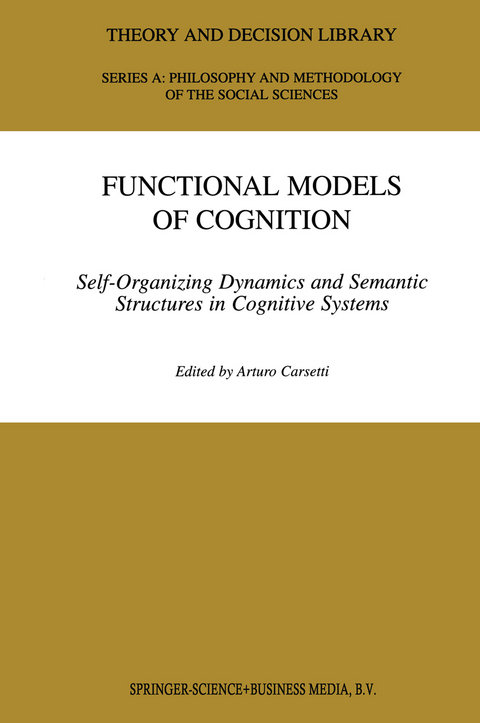
Functional Models of Cognition

Self-Organizing Dynamics and Semantic Structures in Cognitive Systems

A. Carsetti (Herausgeber)

Buch | Hardcover
312 Seiten
1999 | 2000 ed.
Kluwer Academic Publishers (Verlag)
9780792360728 (ISBN)
CHF 224,65 inkl. MwSt
Our ontology as well as our grammar are, as Quine affirms, ineliminable parts of our conceptual contribution to our theory of the world. It seems impossible to think of enti­ ties, individuals and events without specifying and constructing, in advance, a specific language that must be used in order to speak about these same entities. We really know only insofar as we regiment our system of the world in a consistent and adequate way. At the level of proper nouns and existence functions we have, for instance, a standard form of a regimented language whose complementary apparatus consists of predicates, variables, quantifiers and truth functions. If, for instance, the discoveries in the field of Quantum Mechanics should oblige us, in the future, to abandon the traditional logic of truth functions, the very notion of existence, as established until now, will be chal­ lenged. These considerations, as developed by Quine, introduce us to a conceptual perspective like the "internal realist" perspective advocated by Putnam whose principal aim is, for cer­ tain aspects, to link the philosophical approaches developed respectively by Quine and Wittgenstein. Actually, Putnam conservatively extends the approach to the problem of ref­ erence outlined by Quine: in his opinion, to talk of "facts" without specifying the language to be used is to talk of nothing.

Acknowledgements. Introduction; A. Carsetti. Part I: Models of Cognition. Functional Realism; F.M. Wuketits. Complexity and Cognition; D. Parisi. From Visual Perception to Decision Making: A Synergetic Approach; H. Haken. Connectionist Psychology and the Synergetics of Cognition; E. Pessa. Self-Organization in Perception. The Case of Motion; R. Luccio. Part II: Self-Organization, Complexity and Truth. Expressiveness and Complexity of Formal Systems; G. Ausiello, L. Cabibbo. Imposing Polynomial Time Complexity in Functional Programming; C. Böhm. Self-Organizing Networks: Weak, Strong and Intentional, the Role of Their Underdetermination; H. Atlan. Self-Organization: Epistemological and Methodological Aspects of the Unity of Reality; J. Götschl. How Science Approaches the World: Risky Truths vs. Misleading Certitudes; F.T. Arecchi. On Self-Reference and Self-Description; K. Svozil. Part III: Methods of Formal Analysis in the Cognitive Sciences. Self-Organization and Computability; M. Koppel, H. Atlan. The Difference Between Clocks and Turing Machines; G. Longo. Sheaf Mereology and Space Cognition; J. Petitot. Linguistic Structures, Cognitive Functions and Algebraic Semantics; A. Carsetti. Name Index. Subject Index.

Erscheint lt. Verlag 30.11.1999
Reihe/Serie Theory and Decision Library A ; 27
Zusatzinfo II, 312 p.
Sprache englisch
Maße 156 x 234 mm
Themenwelt Geisteswissenschaften Psychologie Allgemeine Psychologie
Geisteswissenschaften Psychologie Verhaltenstherapie
ISBN-13 9780792360728 / 9780792360728
Zustand Neuware
Informationen gemäß Produktsicherheitsverordnung (GPSR)
Haben Sie eine Frage zum Produkt?
Mehr entdecken
aus dem Bereich
Lernen, Emotion, Motivation, Gedächtnis

von Gernot Horstmann; Gesine Dreisbach

Buch | Softcover (2025)
Beltz (Verlag)
CHF 39,20
Das Trainer-Manual

von Martin Bohus; Ruben Vonderlin

Buch | Softcover (2025)
Schattauer (Verlag)
CHF 96,55
Wahrnehmung, Aufmerksamkeit, Denken, Sprache

von Miriam Spering; Thomas Schmidt

Buch | Softcover (2025)
Julius Beltz (Verlag)
CHF 39,20