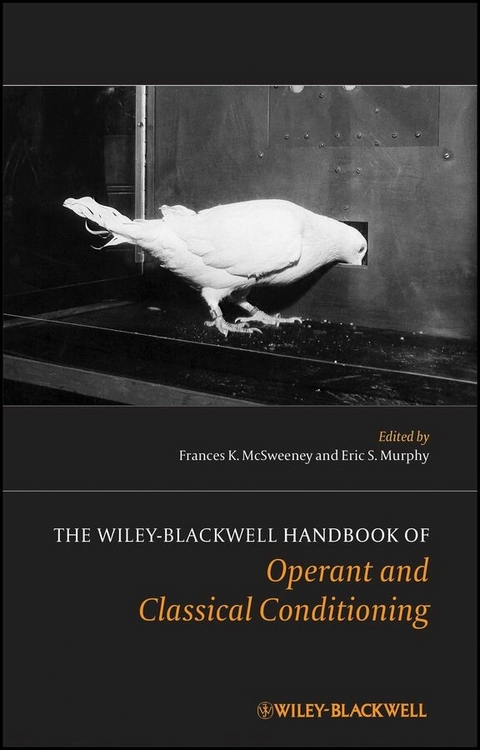
This combined survey of operant and classical conditioning provides professional and academic readers with an up-to-date, inclusive account of a core field of psychology research, with in-depth coverage of the basic theory, its applications, and current topics including behavioral economics.
- Provides comprehensive coverage of operant and classical conditioning, relevant fundamental theory, and applications including the latest techniques
- Features chapters by leading researchers, professionals, and academicians
- Reviews a range of core literature on conditioning
- Covers cutting-edge topics such as behavioral economics
Frances K. McSweeney is Regents Professor and Vice Provost for Faculty Affairs at Washington State University, USA. Cited as one of the most prolific contributors to behaviour analysis journals, she holds both Masters and Ph.D. degrees from Harvard University. The former Chair of WSU's Department of Psychology and of the Association for Behavior Analysis International (ABAI). Professor McSweeney is a fellow of ABAI, of the American Psychological Association (Divisions 3 and 25), and of the Association for Psychological Science. Her recent research focuses on short-term changes in reinforcer effectiveness.
Eric S. Murphy is Associate Professor in the Department of Psychology at the University of Alaska Anchorage, USA, and holds a doctorate in experimental psychology from Washington State University. He has published research in the Journal of the Experimental Analysis of Behavior and Journal of Applied Behavior Analysis, and in 2010 received UAA's Faculty Exemplar Award for enhancing undergraduate research opportunities. A specialist teacher and researcher in behavior analysis, Dr Murphy is currently leading a study of the variables regulating reinforcer effectiveness.
This combined survey of operant and classical conditioning provides professional and academic readers with an up-to-date, inclusive account of a core field of psychology research, with in-depth coverage of the basic theory, its applications, and current topics including behavioral economics. Provides comprehensive coverage of operant and classical conditioning, relevant fundamental theory, and applications including the latest techniques Features chapters by leading researchers, professionals, and academicians Reviews a range of core literature on conditioning Covers cutting-edge topics such as behavioral economics
Frances K. McSweeney is Regents Professor and Vice Provost for Faculty Affairs at Washington State University, USA. Cited as one of the most prolific contributors to behaviour analysis journals, she holds both Masters and Ph.D. degrees from Harvard University. The former Chair of WSU's Department of Psychology and of the Association for Behavior Analysis International (ABAI). Professor McSweeney is a fellow of ABAI, of the American Psychological Association (Divisions 3 and 25), and of the Association for Psychological Science. Her recent research focuses on short-term changes in reinforcer effectiveness. Eric S. Murphy is Associate Professor in the Department of Psychology at the University of Alaska Anchorage, USA, and holds a doctorate in experimental psychology from Washington State University. He has published research in the Journal of the Experimental Analysis of Behavior and Journal of Applied Behavior Analysis, and in 2010 received UAA's Faculty Exemplar Award for enhancing undergraduate research opportunities. A specialist teacher and researcher in behavior analysis, Dr Murphy is currently leading a study of the variables regulating reinforcer effectiveness.
Title page 2
Copyright page 3
Contributors 5
Preface 24
Part I: Basic Classical Conditioning 26
1: Principles of Pavlovian Conditioning: Description, Content, Function 27
Overview 28
Hull's Choices 30
Contingency 38
Relative Contingency: Cue Competition Phenomena 39
Conditional Contingency 43
Time 47
From Prediction to Performance 48
Summary and Conclusion 53
Acknowledgments 53
References 53
2: Building a Theory of Pavlovian Conditioning From the Inside Out 64
Conclusions 91
References 92
3: A Contemporary Behavioral Perspective on Extinction 105
Mechanisms of Extinction 106
Context and Relapse Effects after Extinction 111
Preventing Lapse and Relapse after Extinction 122
Conclusion 127
Acknowledgments 128
References 128
4: Prologue to “Habituation: A History” 146
References 147
Habituation: A History 149
Introduction 149
Dedication 166
Note 167
References 167
Part II: Applied Classical Conditioning 174
5: Conditioned Taste Aversion Learning: Relationship to Nausea and Conditioned Disgust 175
The Garcia Effect 175
Nature of the US: Nausea? 178
Nature of the CR: Not all CTA is Accompanied by Conditioned Disgust 180
Neurobiological Manipulation of Nausea: Effect on Conditioned Disgust and CTA 184
Nature of the CS: Contextually Elicited Conditioned Disgust Reactions-A Model of Anticipatory Nausea 190
Conditioned Taste Aversion Learning as a Preclinical Model of Nausea 192
References 194
6: Pavlovian Fear Conditioning: Function, Cause, and Treatment 209
Fear Conditioning Basics 209
Relevance to Anxiety Disorders: More than a Model 210
Laboratory Measures of Conditional Fear 214
CS-US Relationships that Promote Cued and Contextual Fear Conditioning 216
Biological Mechanisms of Fear Learning 219
The Dynamic Origins of Memory Systems (DOMS) 228
Translational Significance 231
Conclusions 233
References 233
7: Behavioral Conditioning of Immune Responses: An Overview and Consideration of Clinical Applications 248
Introduction 248
Overview of the Immune System 249
Conditioning of the Immune System 255
Conditioned Immunopharmacologic Effects and Stress 258
The Use of Antigen as a UCS 260
Therapeutic Effects of Behaviorally Conditioned Immunomodulation 265
Conclusion 272
Dedication 272
References 273
Part III: Basic Operant Conditioning 282
8: Basic Principles of Operant Conditioning 283
A Brief History 283
Conceptual Foundations of Behavior Analysis 284
Reinforcement and Punishment 288
Shaping 291
Schedules of Reinforcement 292
Variables Influencing Reinforcer Effectiveness 297
Extinction 302
Stimulus Control 304
Chaining and Conditioned Reinforcement 309
Social Learning 312
Conclusion 315
Notes 316
References 316
9: Choice 328
Introduction 328
Concurrent Schedules 329
Concurrent-Chain Schedules 340
Discrete-trial and Other Choice Procedures 349
Conclusions 356
References 357
10: Conditioned Reinforcement 368
Introduction 368
Defining Characteristics of Conditioned Reinforcement 369
Studying Conditioned Reinforcement 371
Determinants of Conditioned Value 383
Alternative Views: Challenges to Conditioned Reinforcement 388
Applications of Conditioned Reinforcement 397
Future Directions 399
Summary 399
Author Note 400
Notes 400
References 401
Additional Reading 409
11: Behavioral Momentum and Resistance to Change 410
Behavioral Momentum Theory: An Overview 411
Challenges to Behavioral Momentum Theory 426
Extensions of Behavioral Momentum Theory 434
Separating Baseline Accuracy and Resistance to Change 441
Conclusions 443
Acknowledgments 444
References 445
12: Behavioral Economics and the Analysis of Consumption and Choice 451
Value of Reinforcers 452
Factors That Alter Demand and Choice 462
The Behavioral Economics of Addiction and Treatment 471
From Science to Public Policy 478
Conclusions 486
Notes 487
References 488
13: Delay and Probability Discounting 497
The Discounting Framework 498
Discounting of Delayed Rewards 507
Discounting of Probabilistic Rewards 511
Comparison of Delay and Probability Discounting 513
Why is There a Magnitude Effect? 517
Delayed and Probabilistic Losses 519
Discounting in Nonhuman Animals 521
Impulsivity or Impulsivities? 526
Future Directions 528
Conclusions 530
Acknowledgments 532
References 532
14: Characteristics, Theories, and Implications of Dynamic Changes in Reinforcer Effectiveness 547
Empirical Characteristics 549
Quantitative Descriptions 559
Potential Theoretical Explanations 560
Implications for Conditioning 568
Implications Beyond Conditioning 576
Summary 580
References 580
15: Verbal Behavior 595
Definition of Verbal Behavior 596
The Physical Substrate of Vocal Behavior 598
Analytical Units of Verbal Behavior 599
The Structural Complexity of Verbal Behavior: The Puzzle of Lawful Novelty 607
The Additivity of Stimulus Control 609
Automatic Shaping 614
Conclusion 622
References 624
16: Animal Cognition 632
Timing 634
Numerical Estimation 643
Spatial Cognition 648
How Are Locations in Space Encoded? 652
Conclusions 658
Acknowledgment 659
References 659
17: Instrumental and Classical Conditioning: Intersections, Interactions and Stimulus Control 666
Two-Process Learning Theory 668
The Instrumentally-Derived Appetitive Incentive-Motivational Function 673
The Instrumentally-Derived Aversive Incentive-Motivational Function 680
Transfer-of-Control Research: Overview and Discussion 683
The Discriminative-Response Function 686
Responsive-Discriminative-by-Incentive-Motivational-Process Combination Matrix 690
Environmentally Induced Increases in Drug Seeking: An Animal Learning Model of Drug Abuse and Loss of Control 695
Extending Discriminative-Response/Incentive-Motivational Combination Model to Stimulus-Generalization Peak Shift 700
Incentive Processes and a Biological-Constraint-on-Learning: Selective Associations 704
Reconciling Different Test Outcomes by Behaviorally Indistinguishable Groups: A Composite-Stimulus Control Analysis 706
Summary and Conclusion 710
Notes 712
References 712
Part IV: Applied Operant Conditioning 721
18: Modern Animal Training: A Transformative Technology 722
Introduction 722
Conventional Animal Training 723
The Development of Modern Training 725
Domestic Animals and the General Public 731
Tools and Procedures 734
TAGteach: An Application for People 754
The Question of Awareness 756
Looking Forward 758
Acknowledgments 760
Notes 760
References 761
Recommended Reading 765
19: Autism and Behavior Analysis: History and Current Status 766
Antecedents to Applied Behavior Analytic Approach to Autism 766
Jean Marc Gaspard Itard's Proto-behavioral Treatment of Victor 767
Leo Kanner's First Clinical Description of Autism 768
What is Autism? 768
Early Behavioral Treatment of Autism 770
Løvaas's 1987 Landmark Study 777
Growth of Autism Research 781
Comprehensive Early Intensive Behavioral Intervention 783
Outcome of Early Intensive Behavioral Intervention 787
Developing More Advanced Skills 790
Challenging Behavior in Autism Revisited 792
Early Behavioral Intervention and Brain Development 794
Why “Cure” and “Recovery” Are Misnomers 795
Prognosis 796
Note 796
References 797
20: Parenting 808
Child Behavior and Development 808
Relationship Between Parent and Child Behavior 812
Functional Analysis Technology 815
Parent-Training Programs 820
Barriers to Successful Parent Training 830
Conclusion 832
References 833
21: Behavior Analysis in Education 846
Foundations in Basic and Applied Science 846
Foundational Behavioral Units 848
Behavioral Systems and Models 850
Superior Instruction by Design 856
Evidence of Effectiveness 860
Translating Research into Practice 862
Behavior Analysis' Impact in Education 864
A Science of Implementation 865
A Nonlinear Systems Approach 866
Behavioral Education in the Digital Age 867
Note 869
References 869
22: Operant Conditioning in Developmental Disabilities 892
Operant Conditioning to Reduce Behavioral Excesses 893
Operant Conditioning to Improve Skill Deficiencies 904
Conclusions 912
Notes 913
References 913
23: Precision Teaching: The Legacy of Ogden Lindsley 929
What Is Precision Teaching? 929
The Standard Celeration Chart 930
Outcomes of Fluent Performance 934
Celeration and Agility 937
Quantitative Analyses with Chart Data 943
Current Practice Procedures 944
Who Has Used PT? 945
A Brief History of the Development of Precision Teaching 946
PT's Relation to Instructivist Educational Philosophy 950
Research Supporting Precision Teaching and Remaining Questions 952
Where to Learn More 959
Afterword 960
Acknowledgment 961
Notes 961
References 962
24: Behavioral Pharmacology: A Brief Overview 972
Historical Underpinnings of Behavioral Pharmacology 974
Law of Effect 974
Pavlovian Conditioning 975
Operant Psychology of B. F. Skinner 977
Development of Antipsychotic Drugs 978
Modern Behavioral Pharmacology 980
What Do Behavioral Pharmacologists Do? 982
Transitivity of Behavioral Observations 984
Clinical Application 988
Conclusion 989
References 990
25: Contingency Management Treatments for Substance-Use Disorders and Healthy Behaviors 995
Historical Background of Contingency Management 996
Voucher-Based Contingency Management 997
Prize-Based Contingency Management 1000
Fundamental Elements and Parameters of CM 1002
Applying CM Toward the Modification of Other Behaviors 1007
Conclusion 1014
References 1014
26: Organizational Behavior Management: Past, Present, and Future 1024
Overview of Chapter 1024
An Annotated History of OBM and its Historical Roots 1026
OBM Practices and Research 1035
OBM and Human Resources Management 1041
Behavior Systems Management 1053
Note 1055
References 1055
27: Clinical Behavior Analysis 1063
Initial Successful Applications of Behavioral Principles 1064
The Application of Familiar Behavioral Principles 1067
The Challenge of Applying Principles In Clinical Settings 1076
Functional Analytic Psychotherapy 1086
Cognitions, Relational Frame Theory and Acceptance and Commitment Therapy 1090
Summary 1094
References 1094
28: Aging 1102
Basic Conditioning Research on Aging 1104
Applied Conditioning Literature on Aging 1111
Summary and Conclusions 1120
References 1123
Index 1132
End User License Agreement 1184
| Erscheint lt. Verlag | 23.5.2014 |
|---|---|
| Sprache | englisch |
| Themenwelt | Geisteswissenschaften ► Psychologie ► Allgemeine Psychologie |
| Geisteswissenschaften ► Psychologie ► Pädagogische Psychologie | |
| Geisteswissenschaften ► Psychologie ► Sozialpsychologie | |
| Schlagworte | Geschichte u. Philosophie der Psychologie • History & Philosophy of Psychology • Psychologie • Psychology • Skinner, Pavlov, behavior analysis, applied behavior analysis, applied psychology, experimental psychology • Social Psychology • Sozialpsychologie |
| ISBN-13 | 9781118468173 / 9781118468173 |
| Informationen gemäß Produktsicherheitsverordnung (GPSR) | |
| Haben Sie eine Frage zum Produkt? |
 EPUB (Adobe DRM)
Kopierschutz: Adobe-DRM
Adobe-DRM ist ein Kopierschutz, der das eBook vor Mißbrauch schützen soll. Dabei wird das eBook bereits beim Download auf Ihre persönliche Adobe-ID autorisiert. Lesen können Sie das eBook dann nur auf den Geräten, welche ebenfalls auf Ihre Adobe-ID registriert sind.
Details zum Adobe-DRM
Dateiformat: EPUB (Electronic Publication)
EPUB ist ein offener Standard für eBooks und eignet sich besonders zur Darstellung von Belletristik und Sachbüchern. Der Fließtext wird dynamisch an die Display- und Schriftgröße angepasst. Auch für mobile Lesegeräte ist EPUB daher gut geeignet.
Systemvoraussetzungen:
PC/Mac: Mit einem PC oder Mac können Sie dieses eBook lesen. Sie benötigen eine
eReader: Dieses eBook kann mit (fast) allen eBook-Readern gelesen werden. Mit dem amazon-Kindle ist es aber nicht kompatibel.
Smartphone/Tablet: Egal ob Apple oder Android, dieses eBook können Sie lesen. Sie benötigen eine
Geräteliste und zusätzliche Hinweise
Buying eBooks from abroad
For tax law reasons we can sell eBooks just within Germany and Switzerland. Regrettably we cannot fulfill eBook-orders from other countries.
aus dem Bereich