


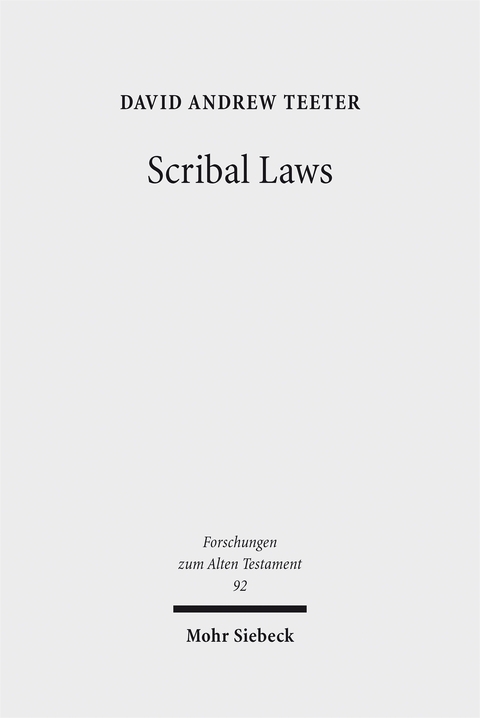
Scribal Laws
Exegetical Variation in the Textual Transmission of Biblical Law in the Late Second Temple Period
Seiten
Auf der Grundlage einer eingehenden Analyse der vorhandenen Texte und Versionen untersucht David Andrew Teeter die Art und Weise und den Hintergrund der absichtlichen Änderungen im Text der biblischen Gesetze während des späten Zeitalters des Zweiten Tempels.
On the basis of a detailed analysis of extant texts and versions, David Andrew Teeter examines the nature and background of deliberate scribal changes in the text of biblical law during the late Second Temple period. What were the "laws" governing this mode of scribal production and how are the "laws" produced thereby to be understood? What are the underlying causes of textual difference, and what are the effects of the resulting plurality upon the character of interpretive scriptural encounter? What do the attested textual differences reveal about the social history of the biblical text, and how does this relate to halakhic diversity within Judaism of the period? The author undertakes to answer these questions in a methodologically rigorous way, offering a sustained examination of the nature of exegetical textual variants and their place within the multi-faceted interpretive encounter with scripture in the late Second Temple period.
On the basis of a detailed analysis of extant texts and versions, David Andrew Teeter examines the nature and background of deliberate scribal changes in the text of biblical law during the late Second Temple period. What were the "laws" governing this mode of scribal production and how are the "laws" produced thereby to be understood? What are the underlying causes of textual difference, and what are the effects of the resulting plurality upon the character of interpretive scriptural encounter? What do the attested textual differences reveal about the social history of the biblical text, and how does this relate to halakhic diversity within Judaism of the period? The author undertakes to answer these questions in a methodologically rigorous way, offering a sustained examination of the nature of exegetical textual variants and their place within the multi-faceted interpretive encounter with scripture in the late Second Temple period.
Born 1976; 2002 MA (University of Wisconsin-Madison); 2008 PhD (University of Notre Dame); 2010-11 Alexander von Humboldt Research Fellow and Hugo Greßmann Fellow at the Theological Faculty of the Humboldt-Universität zu Berlin; currently Associate Professor of Hebrew Bible/Old Testament at Harvard Divinity School.
| Erscheint lt. Verlag | 26.8.2014 |
|---|---|
| Reihe/Serie | Forschungen zum Alten Testament |
| Verlagsort | Tübingen |
| Sprache | englisch |
| Maße | 162 x 239 mm |
| Gewicht | 715 g |
| Themenwelt | Religion / Theologie ► Christentum ► Bibelausgaben / Bibelkommentare |
| Geisteswissenschaften ► Religion / Theologie ► Judentum | |
| Geisteswissenschaften ► Sprach- / Literaturwissenschaft ► Literaturwissenschaft | |
| Schlagworte | Abraham • Abraham Geiger • Bibel-Textkritik • Criticism • DES • Frankel • Geiger • Gesetz (Theologie) • Halakhah • hermeneutics • History • History of Interpretation • Interpretation • Jerusalemer Tempel (Periode Zweiter Tempel) • Judentums • of • Pentateuch • Qumran • Samaritan • Samaritan Pentateuch • Septuagint • Targum • Textual • Textual criticism • Wissenschaft • Wissenschaft des Judentums • Zechariah • Zechariah Frankel |
| ISBN-10 | 3-16-153249-X / 316153249X |
| ISBN-13 | 978-3-16-153249-8 / 9783161532498 |
| Zustand | Neuware |
| Informationen gemäß Produktsicherheitsverordnung (GPSR) | |
| Haben Sie eine Frage zum Produkt? |
Mehr entdecken
aus dem Bereich


aus dem Bereich
Buch | Softcover (2021)
De Gruyter (Verlag)
CHF 44,90


