


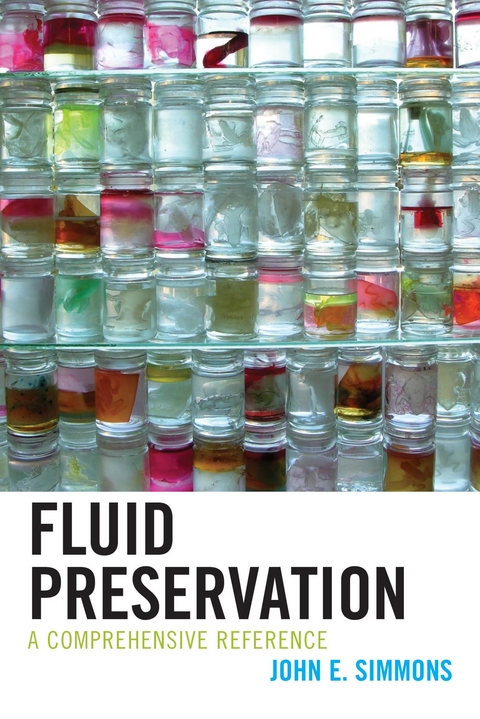
Fluid Preservation (eBook)
420 Seiten
Rowman & Littlefield Publishers (Verlag)
978-1-4422-2966-2 (ISBN)
Fluid preservation refers to specimens and objects that are preserved in fluids, most commonly alcohol and formaldehyde, but also glycerin, mineral oil, acids, glycols, and a host of other chemicals that protect the specimen from deterioration. Some of the oldest natural history specimens in the world are preserved in fluid. Despite the fact that fluid preservation has been practiced for more than 350 years, this is the only handbook that summarize all that is known about this complex and often confusing topic. Fluid Preservation: A Comprehensive Reference covers the history and techniques of fluid preservation and how to care for fluid preserved specimens in collections. More than 900 references on fluid preservation were reviewed for this project.An historical survey of preservative recipes provides for guidance for museums with older collections (many fluid preservatives contain hazardous chemicals). Current standards and best practices for collection care and management are presented.Current and controversial topics (e.g., the preservation of DNA, alternatives to alcohol and formaldehyde) are discussed and fully referenced.Health and safety issues involved with caring for fluid preserved collections are discussed.The final chapter addresses fluid preserved specimens as cultural products and their use in art, literature, film, and song.Although most fluid-preserved specimens are found in natural history and medical museums, it is not at all uncommon to find them in art museums, history museums, and science centers. In addition to animals, plants, and anatomical specimens, fluid preserved collections include some minerals and fossils and many other objects. Fluid Preservation is an essential reference for: Natural history curatorsNatural history collections managers ConservatorsMedical and anatomical museum collections managers and curatorsArt and history museum staff who have fluid preserved specimens and objects in their care (e.g., works by Damien Hirst)Private collectorsResearchers using museum collections as sources of DNA, isotopes, etc.Health and safety professionalsExhibit planners and designersMuseum facilities planners and managersPeople interested in the history of sciencePeople interested in the history of natural history museumsMuseum studies students
John Simmons holds a B.A. in systematic ecology and an M.A. in Historical Administration and Museum Studies. In 1986, he completed the Collections Care Pilot Training Program (funded by the Bay Foundation) to become one of 30 people in the country to receive specialized training in conservation and collections care. He has spent a total of 30 years as collections manager in two of the largest collections of fluid preserved specimens in the United States (the California Academy of Sciences and the Biodiversity Research Center at the University of Kansas). He has published extensively on collections care topics and conducted seminars, workshops, and training programs in the US, Latin America, Asia, the Middle East, and Europe on the care of natural history collections (his previous publications include the AAM standard reference on collections management policies).
IntroductionAcknowledgementsPart I. Fluid Preservation Techniques and CollectionsChapter 1. History of Fluid PreservationChapter 2. FixationChapter 3. Preservation Chapter 4. Effects of Fixatives and Preservatives on SpecimensChapter 5. Managing Fluid Preserved CollectionsRehydration of Fluid Preserved SpecimensChapter 6. Fluid Preserved Collections as Cultural PatrimonyPart II. Literature in this FieldChapter 7. Literature Cited.Chapter 8. Literature Reviewed but Not Cited Part III. Reference TablesAppendixIndex About the Author
| Erscheint lt. Verlag | 15.5.2014 |
|---|---|
| Sprache | englisch |
| Themenwelt | Kunst / Musik / Theater |
| Geisteswissenschaften ► Geschichte ► Hilfswissenschaften | |
| Sozialwissenschaften ► Kommunikation / Medien ► Buchhandel / Bibliothekswesen | |
| Wirtschaft ► Betriebswirtschaft / Management ► Unternehmensführung / Management | |
| Schlagworte | conservation • fluid care • fluid safety • Preservation |
| ISBN-10 | 1-4422-2966-7 / 1442229667 |
| ISBN-13 | 978-1-4422-2966-2 / 9781442229662 |
| Informationen gemäß Produktsicherheitsverordnung (GPSR) | |
| Haben Sie eine Frage zum Produkt? |
 EPUB (Adobe DRM)
Kopierschutz: Adobe-DRM
Adobe-DRM ist ein Kopierschutz, der das eBook vor Mißbrauch schützen soll. Dabei wird das eBook bereits beim Download auf Ihre persönliche Adobe-ID autorisiert. Lesen können Sie das eBook dann nur auf den Geräten, welche ebenfalls auf Ihre Adobe-ID registriert sind.
Details zum Adobe-DRM
Dateiformat: EPUB (Electronic Publication)
EPUB ist ein offener Standard für eBooks und eignet sich besonders zur Darstellung von Belletristik und Sachbüchern. Der Fließtext wird dynamisch an die Display- und Schriftgröße angepasst. Auch für mobile Lesegeräte ist EPUB daher gut geeignet.
Systemvoraussetzungen:
PC/Mac: Mit einem PC oder Mac können Sie dieses eBook lesen. Sie benötigen eine
eReader: Dieses eBook kann mit (fast) allen eBook-Readern gelesen werden. Mit dem amazon-Kindle ist es aber nicht kompatibel.
Smartphone/Tablet: Egal ob Apple oder Android, dieses eBook können Sie lesen. Sie benötigen eine
Geräteliste und zusätzliche Hinweise
Buying eBooks from abroad
For tax law reasons we can sell eBooks just within Germany and Switzerland. Regrettably we cannot fulfill eBook-orders from other countries.


