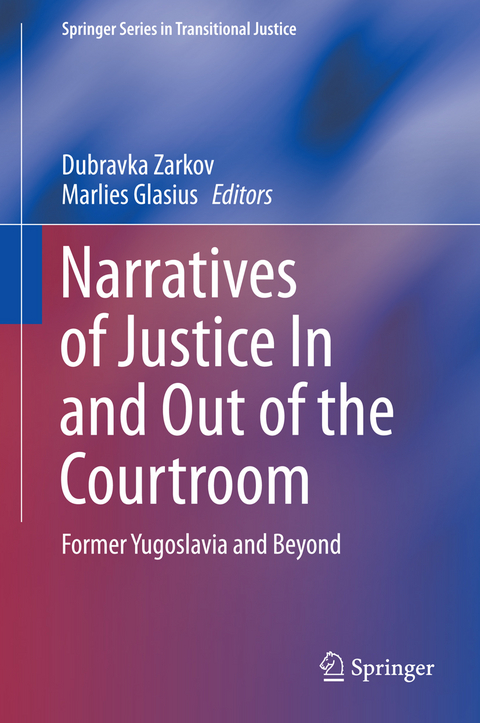
Narratives of Justice In and Out of the Courtroom (eBook)
XVII, 188 Seiten
Springer International Publishing (Verlag)
978-3-319-04057-8 (ISBN)
This volume considers the dynamic relations between the contemporary practices of international criminal tribunals and the ways in which competing histories, politics and discourses are re-imagined and re-constructed in the former Yugoslavia and beyond. There are two innovative aspects of the book - one is the focus on narratives of justice and their production, another is in its comparative perspective. While legal scholars have tended to analyze transitional justice and the international war tribunals in terms of their success or failure in establishing the facts of war crimes, this volume goes beyond mere facts and investigates how the courts create a symbolic space within which competing narratives of crimes, perpetrators and victims are produced, circulated and contested. It analyzes how international criminal law and the courts gather, and in turn produce, knowledge about societies in war, their histories and identities, and their relations to the wider world.
Moreover, the volume situates narratives of transitional justice in former Yugoslavia both within specific national spaces - such as Serbia, and Bosnia - and beyond the Yugoslav. In this way it also considers experiences from other countries and other times (post-World War II) to offer a sounding board for re-thinking the meanings of transitional justice and institutions within former Yugoslavia. Included in the volume's coverage is a look at the Rwandan tribunals, the trials of Charles Taylor, Radovan Karadzic, the Srebrenica genocide, and other war crimes and criminals in the Yugoslav. Finally, it frames all of those narratives and experiences within the global dynamics of legal, social and geo-political transformations, making it an excellent resource for social science researchers, human rights activists, those interested in the former Yugoslavia and international relations, and legal scholars.
Dubravka Zarkov is an associate professor of Gender, Conflict and Development at the International Institute of Social Studies/EUR, The Hague. She teaches on feminist epistemology, conflict theories and media representations of war and violence. Her main fields of interest are gender, sexuality and ethnicity in the context of war and violence, and their media representations. In 2012 Zarkov was a recipient of NIAS fellowship. She published The Body of War: Media, Ethnicity and Gender in the Break-up of Yugoslavia (2007, Duke University Press) about media representations of war in former Yugoslavia, and Gender, Conflict, Development (2008, Zubaan) about global dimensions of contemporary wars. In 2002 Zarkov co-edited with Cynthia Cockburn a book about Dutch peacekeeping in Bosnia, The Postwar Moment: Militaries, Masculinities and International Peacekeeping (Lawrence and Wishart).
Marlies Glasius is a Professor in International Relations at the Department of Politics, University of Amsterdam and holder of the Special Chair, Citizen Involvement in Conflict and Post-Conflict Zones, Free University Amsterdam. She was previously the managing editor of the Global Civil Society Yearbook, coordinator of the Study Group on European Security, and a lecturer in Global Politics at the London School of Economics and Political Science (LSE). She published research on international criminal courts, including The International Criminal Court: A Global Civil Society Achievement (2006) and a number of journal articles and book chapters on the relations between international criminal courts and their socio-political contexts. In 2012 Glasius was a recipient of NIAS fellowship
Dubravka Zarkov is an associate professor of Gender, Conflict and Development at the International Institute of Social Studies/EUR, The Hague. She teaches on feminist epistemology, conflict theories and media representations of war and violence. Her main fields of interest are gender, sexuality and ethnicity in the context of war and violence, and their media representations. In 2012 Zarkov was a recipient of NIAS fellowship. She published The Body of War: Media, Ethnicity and Gender in the Break-up of Yugoslavia (2007, Duke University Press) about media representations of war in former Yugoslavia, and Gender, Conflict, Development (2008, Zubaan) about global dimensions of contemporary wars. In 2002 Zarkov co-edited with Cynthia Cockburn a book about Dutch peacekeeping in Bosnia, The Postwar Moment: Militaries, Masculinities and International Peacekeeping (Lawrence and Wishart).Marlies Glasius is a Professor in International Relations at the Department of Politics, University of Amsterdam and holder of the Special Chair, Citizen Involvement in Conflict and Post-Conflict Zones, Free University Amsterdam. She was previously the managing editor of the Global Civil Society Yearbook, coordinator of the Study Group on European Security, and a lecturer in Global Politics at the London School of Economics and Political Science (LSE). She published research on international criminal courts, including The International Criminal Court: A Global Civil Society Achievement (2006) and a number of journal articles and book chapters on the relations between international criminal courts and their socio-political contexts. In 2012 Glasius was a recipient of NIAS fellowship
Dubravka Zarkov and Marlies GlasiusIntroduction Part One. Narratives of Law and Justice in the International Courtrooms Chapter 1 Dubravka Zarkov ‘Locals’ and ‘Internationals’ in Discourses and Practices of International Justice Chapter 2 Doris Buss Expert Witnesses and the International War Crimes Trials. Making Sense of Large-Scale Violence in Rwanda Chapter 3 Marlies Glasius Terror, Terrorizing, Terrorism. Instilling Fear as a Crime in the Cases of Radovan Karadzic and Charles Taylor Chapter 4 Predrag DojcinovicThe Shifting Status of Grand Narratives in War Crimes Trials and International Law. History and Politics in the Courtroom Part Two: Dealing with Justice after Yugoslav Wars Chapter 5 Vladimir Petrovic A Crack in the Wall of Denial. The Scorpions Video in and out of the Serbian Courtrooms Chapter 6 Eric Gordy Tracing Dialogue on the Legacy of War Crimes in Serbia Chapter 7 Erna Rijsdijk ‘Forever Connected’. State Narratives and the Dutch Memory of Srebrenica Chapter 8 Jasmina Husanović Resisting the Culture of Trauma in Bosnia and Herzegovina. Emancipatory Lessons for/in Cultural and Knowledge Production Chapter 9 Frederiek De Vlaming and Kate ClarkWar Reparations in Bosnia and Herzegovina. Individual Stories and Collective Interests
| Erscheint lt. Verlag | 14.4.2014 |
|---|---|
| Reihe/Serie | Springer Series in Transitional Justice | Springer Series in Transitional Justice |
| Zusatzinfo | XVII, 188 p. 6 illus. in color. |
| Verlagsort | Cham |
| Sprache | englisch |
| Themenwelt | Geisteswissenschaften ► Psychologie |
| Recht / Steuern ► EU / Internationales Recht | |
| Sozialwissenschaften ► Politik / Verwaltung | |
| Schlagworte | identity creation in human rights courts • narratives of guilt and responsibility • practices of international criminal tribunals • production of narratives in the former Yugoslavia • reconstruction of history after trauma • transitional justice in the former Yugoslavia |
| ISBN-10 | 3-319-04057-X / 331904057X |
| ISBN-13 | 978-3-319-04057-8 / 9783319040578 |
| Informationen gemäß Produktsicherheitsverordnung (GPSR) | |
| Haben Sie eine Frage zum Produkt? |
 PDF (Wasserzeichen)
DRM: Digitales Wasserzeichen
Dieses eBook enthält ein digitales Wasserzeichen und ist damit für Sie personalisiert. Bei einer missbräuchlichen Weitergabe des eBooks an Dritte ist eine Rückverfolgung an die Quelle möglich.
Dateiformat: PDF (Portable Document Format)
Mit einem festen Seitenlayout eignet sich die PDF besonders für Fachbücher mit Spalten, Tabellen und Abbildungen. Eine PDF kann auf fast allen Geräten angezeigt werden, ist aber für kleine Displays (Smartphone, eReader) nur eingeschränkt geeignet.
Systemvoraussetzungen:
PC/Mac: Mit einem PC oder Mac können Sie dieses eBook lesen. Sie benötigen dafür einen PDF-Viewer - z.B. den Adobe Reader oder Adobe Digital Editions.
eReader: Dieses eBook kann mit (fast) allen eBook-Readern gelesen werden. Mit dem amazon-Kindle ist es aber nicht kompatibel.
Smartphone/Tablet: Egal ob Apple oder Android, dieses eBook können Sie lesen. Sie benötigen dafür einen PDF-Viewer - z.B. die kostenlose Adobe Digital Editions-App.
Buying eBooks from abroad
For tax law reasons we can sell eBooks just within Germany and Switzerland. Regrettably we cannot fulfill eBook-orders from other countries.
aus dem Bereich