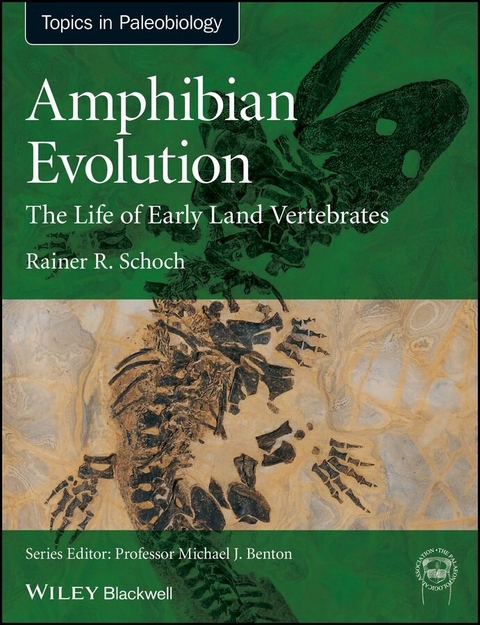
Amphibian Evolution (eBook)
John Wiley & Sons (Verlag)
978-1-118-75915-8 (ISBN)

This book focuses on the first vertebrates to conquer land and their long journey to become fully independent from the water. It traces the origin of tetrapod features and tries to explain how and why they transformed into organs that permit life on land. Although the major frame of the topic lies in the past 370 million years and necessarily deals with many fossils, it is far from restricted to paleontology. The aim is to achieve a comprehensive picture of amphibian evolution. It focuses on major questions in current paleobiology: how diverse were the early tetrapods? In which environments did they live, and how did they come to be preserved? What do we know about the soft body of extinct amphibians, and what does that tell us about the evolution of crucial organs during the transition to land? How did early amphibians develop and grow, and which were the major factors of their evolution?
The Topics in Paleobiology Series is published in collaboration with the Palaeontological Association, and is edited by Professor Mike Benton, University of Bristol.
Books in the series provide a summary of the current state of knowledge, a trusted route into the primary literature, and will act as pointers for future directions for research. As well as volumes on individual groups, the series will also deal with topics that have a cross-cutting relevance, such as the evolution of significant ecosystems, particular key times and events in the history of life, climate change, and the application of a new techniques such as molecular palaeontology.
The books are written by leading international experts and will be pitched at a level suitable for advanced undergraduates, postgraduates, and researchers in both the paleontological and biological sciences.
Rainer Schoch, born 1970 in Ludwigshafen, Germany. He graduated at the University of Tübingen, undertook field work in Argentina and the USA, and worked as a curator and assistant professor at Humboldt University Berlin. Since 2003 he has been the curator of amphibians and reptiles at the Natural History Museum of Stuttgart, Germany.
This book focuses on the first vertebrates to conquer land and their long journey to become fully independent from the water. It traces the origin of tetrapod features and tries to explain how and why they transformed into organs that permit life on land. Although the major frame of the topic lies in the past 370 million years and necessarily deals with many fossils, it is far from restricted to paleontology. The aim is to achieve a comprehensive picture of amphibian evolution. It focuses on major questions in current paleobiology: how diverse were the early tetrapods? In which environments did they live, and how did they come to be preserved? What do we know about the soft body of extinct amphibians, and what does that tell us about the evolution of crucial organs during the transition to land? How did early amphibians develop and grow, and which were the major factors of their evolution?The Topics in Paleobiology Series is published in collaboration with the Palaeontological Association, and is edited by Professor Mike Benton, University of Bristol. Books in the series provide a summary of the current state of knowledge, a trusted route into the primary literature, and will act as pointers for future directions for research. As well as volumes on individual groups, the series will also deal with topics that have a cross-cutting relevance, such as the evolution of significant ecosystems, particular key times and events in the history of life, climate change, and the application of a new techniques such as molecular palaeontology. The books are written by leading international experts and will be pitched at a level suitable for advanced undergraduates, postgraduates, and researchers in both the paleontological and biological sciences.
Rainer Schoch, born 1970 in Ludwigshafen, Germany. He graduated at the University of Tübingen, undertook field work in Argentina and the USA, and worked as a curator and assistant professor at Humboldt University Berlin. Since 2003 he has been the curator of amphibians and reptiles at the Natural History Museum of Stuttgart, Germany.
Amphibian Evolution: The Life of Early Land Vertebrates 5
Copyright 6
Contents 7
Preface 10
Acknowledgments 12
1 Introduction 15
1.1 Changing paradigms in amphibian evolution 17
1.2 Paleobiology: data, methods, and time scales 19
1.3 Concepts and metaphors: how scientists “figure out” problems 21
1.4 Characters and phylogenies 22
1.5 What’s in a name? 22
References 25
2 The Amphibian World: Now and Then 27
2.1 Tetrapoda 28
2.1.1 The tetrapod skeleton 28
2.1.2 Tetrapod characters 37
2.1.3 Stem-tetrapods (Tetrapodomorpha) 39
2.1.4 Carboniferous tetrapods or tetrapodomorphs? 45
2.2 The amniote stem-group 46
2.2.1 Anthracosauria 47
2.2.2 Seymouriamorpha 51
2.2.3 Chroniosuchia 52
2.2.4 Lepospondyli 54
2.2.4.1 Lepospondyl characters 56
2.2.4.2 Microsauria 56
2.2.4.3 Lysorophia 58
2.2.4.4 Nectridea 58
2.2.4.5 Aïstopoda 59
2.2.4.6 Adelospondyli 60
2.2.4.7 Acherontiscidae 60
2.2.5 Gephyrostegida 60
2.2.6 Amniota 61
2.2.6.1 Stem-amniotes and early crown amniotes 62
2.3 The lissamphibian stem-group (Temnospondyli) 62
2.3.1 Edopoidea 65
2.3.2 Dendrerpeton and Balanerpeton 67
2.3.3 Dvinosauria 68
2.3.4 Dissorophoidea and Zatracheidae 68
2.3.5 Eryopoidea 70
2.3.6 Stereospondyli 71
2.4 Albanerpetontidae 72
2.5 Lissamphibia 73
2.5.1 Lissamphibian characters 75
2.5.2 Batrachia 76
2.5.2.1 Anura (frogs and toads) 76
2.5.2.2 Caudata (salamanders) 81
2.5.2.3 Gymnophiona (caecilians) 82
References 84
3 Amphibian Life Through Time 95
3.1 Aquatic predators prepare for land 97
3.2 Hot springs, scorpions, and little creepers 97
3.3 Life in the tropical coal forest 99
3.4 Neotenes explore unfavorable waters 103
3.5 Lowlands, uplands, and a cave 104
3.6 Hide and protect: extreme life in the hothouse 108
3.7 Predators in deltas, lakes, and brackish swamps 111
3.8 Stereospondyls in refugia, lissamphibians on the rise 111
3.9 Batrachians diversify, stereospondyls disappear 114
3.10 Lissamphibians expand into diverse habitats 115
References 116
4 The Amphibian Soft Body 120
4.1 How to infer soft tissues in extinct taxa 121
4.2 Fossil evidence: soft tissue preservation 123
4.3 Head and visceral skeleton 124
4.4 Respiratory organs 127
4.5 Lateral lines, electroreception, and ears 132
References 136
5 Evolution of Functional Systems 140
5.1 How paradigms and brackets give a functional scenario 141
5.2 Feeding and breathing under water 145
5.3 Decoupling breathing and feeding 148
5.4 Hearing: exapting the spiracle and hyomandibula 150
5.5 Respiration in early tetrapods 155
5.6 The evolution of terrestrial feeding 157
5.7 Transforming fins into limbs 158
5.8 Locomotion of Paleozoic tetrapods 160
References 162
6 Development and Evolution 166
6.1 Ontogeny in modern amphibians 167
6.2 Fossil ontogenies 172
6.3 Ontogeny as a sequence: developmental trajectories 177
6.4 Histology: the skeleton as archive 181
6.5 Changing shape: allometry 185
6.6 Heterochrony: the evolution of development 188
6.7 Body plans: gene regulation and morphogenesis 193
References 198
7 Paleoecology 205
7.1 Lissamphibian ecology 206
7.2 Paleoecology: problems and perspectives 207
7.3 Paleozoic and Mesozoic amphibians 210
7.4 Amphibian evolution as a walk through trophic levels 217
References 219
8 Life History Evolution 222
8.1 Plasticity, reaction norm, and canalization 223
8.2 Reaction norms in extant amphibians 224
8.3 The biphasic life cycle in lissamphibians 225
8.4 Seymouriamorphs: biphasic life cycles without metamorphosis 227
8.5 Temnospondyls: flexible uni- and biphasic ontogenies 227
8.6 Lepospondyls: dwarfism and uniphasic life cycles 229
8.7 The evolution of metamorphosis 230
8.8 The evolution of neoteny 230
8.9 General features of life history evolution 231
References 233
9 Phylogeny 236
9.1 Phylogeny of amphibians 237
9.2 The big picture: tetrapod diversification 237
9.3 The origin of lissamphibians 238
References 245
10 Macroevolution 248
10.1 What is macroevolution? 249
10.2 Patterns of early tetrapod evolution 249
10.3 Major factors of amphibian evolution 254
10.4 Clades, space, and time 262
10.5 Diversity, disparity, and extinction 263
10.6 The evolution of terrestriality 266
References 268
Index 274
Supplementary Images 279
"Amphibian Evolution delivers a wide-ranging synthesis of viewpoints and data on early tetrapods and the ancestry of lissamphibians. This conveniently sized volume suits a higher-level undergraduate course on palaeobiology or introductory graduate class. Clearly written and illustrated, the text provides just enough historical context to give a sense of where the topics come from and where new developments seem to be heading... In summary, this is a thoroughly useful volume to have on your shelf (as well as recommending several copies for the college library)." (Acta Zoologica, July 2017)
"In summary, this is a comprehensive work that could be used as a guide to focus on specific aspects of one of the most exciting chapters of vertebrate history." (Ameghiniana, 1 April 2015)
"It provides rewarding reading, useful for students and researchers/professionals studying amphibians as well as other vertebrates. Summing Up: Highly recommended. Upper-division undergraduates and above." (Choice, 1 December 2014)
| Erscheint lt. Verlag | 19.3.2014 |
|---|---|
| Reihe/Serie | TOPA Topics in Paleobiology | TOPA Topics in Paleobiology |
| Sprache | englisch |
| Themenwelt | Geisteswissenschaften ► Archäologie |
| Geschichte ► Allgemeine Geschichte ► Vor- und Frühgeschichte | |
| Naturwissenschaften ► Biologie ► Evolution | |
| Naturwissenschaften ► Biologie ► Zoologie | |
| Naturwissenschaften ► Geowissenschaften ► Mineralogie / Paläontologie | |
| Technik | |
| Schlagworte | AIM • Amphibian • become fully • Biowissenschaften • Book • Comprehensive • earth sciences • Evolution • evolutionary biology • Evolutionsbiologie • first vertebrates • fossils • Frame • Geowissenschaften • Independent • Land • Life Sciences • Major • major questions • many • Organs • origin • Paläontologie, Paläobiologie u. Geobiologie • Paläontologie, Paläobiologie u. Geobiologie • Paleontology, Paleobiology & Geobiology • PAST • permit • Picture • restricted • Tetrapod • topic lies • Transformed • years |
| ISBN-10 | 1-118-75915-X / 111875915X |
| ISBN-13 | 978-1-118-75915-8 / 9781118759158 |
| Informationen gemäß Produktsicherheitsverordnung (GPSR) | |
| Haben Sie eine Frage zum Produkt? |
 EPUB (Adobe DRM)
Größe: 8,3 MB
Kopierschutz: Adobe-DRM
Adobe-DRM ist ein Kopierschutz, der das eBook vor Mißbrauch schützen soll. Dabei wird das eBook bereits beim Download auf Ihre persönliche Adobe-ID autorisiert. Lesen können Sie das eBook dann nur auf den Geräten, welche ebenfalls auf Ihre Adobe-ID registriert sind.
Details zum Adobe-DRM
Dateiformat: EPUB (Electronic Publication)
EPUB ist ein offener Standard für eBooks und eignet sich besonders zur Darstellung von Belletristik und Sachbüchern. Der Fließtext wird dynamisch an die Display- und Schriftgröße angepasst. Auch für mobile Lesegeräte ist EPUB daher gut geeignet.
Systemvoraussetzungen:
PC/Mac: Mit einem PC oder Mac können Sie dieses eBook lesen. Sie benötigen eine
eReader: Dieses eBook kann mit (fast) allen eBook-Readern gelesen werden. Mit dem amazon-Kindle ist es aber nicht kompatibel.
Smartphone/Tablet: Egal ob Apple oder Android, dieses eBook können Sie lesen. Sie benötigen eine
Geräteliste und zusätzliche Hinweise
Zusätzliches Feature: Online Lesen
Dieses eBook können Sie zusätzlich zum Download auch online im Webbrowser lesen.
Buying eBooks from abroad
For tax law reasons we can sell eBooks just within Germany and Switzerland. Regrettably we cannot fulfill eBook-orders from other countries.
 PDF (Adobe DRM)
Kopierschutz: Adobe-DRM
Adobe-DRM ist ein Kopierschutz, der das eBook vor Mißbrauch schützen soll. Dabei wird das eBook bereits beim Download auf Ihre persönliche Adobe-ID autorisiert. Lesen können Sie das eBook dann nur auf den Geräten, welche ebenfalls auf Ihre Adobe-ID registriert sind.
Details zum Adobe-DRM
Dateiformat: PDF (Portable Document Format)
Mit einem festen Seitenlayout eignet sich die PDF besonders für Fachbücher mit Spalten, Tabellen und Abbildungen. Eine PDF kann auf fast allen Geräten angezeigt werden, ist aber für kleine Displays (Smartphone, eReader) nur eingeschränkt geeignet.
Systemvoraussetzungen:
PC/Mac: Mit einem PC oder Mac können Sie dieses eBook lesen. Sie benötigen eine
eReader: Dieses eBook kann mit (fast) allen eBook-Readern gelesen werden. Mit dem amazon-Kindle ist es aber nicht kompatibel.
Smartphone/Tablet: Egal ob Apple oder Android, dieses eBook können Sie lesen. Sie benötigen eine
Geräteliste und zusätzliche Hinweise
Buying eBooks from abroad
For tax law reasons we can sell eBooks just within Germany and Switzerland. Regrettably we cannot fulfill eBook-orders from other countries.
aus dem Bereich