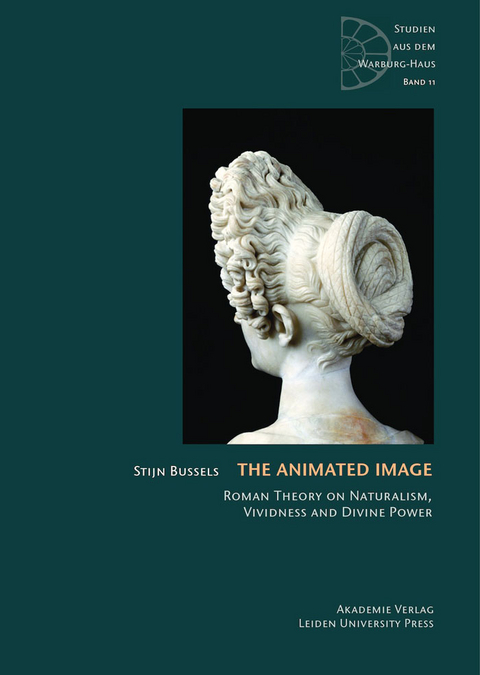
The Animated Image (eBook)
224 Seiten
De Gruyter (Verlag)
978-3-05-006261-7 (ISBN)
Many Romans wrote about the belief that an image - a sculpture or painting, as well as a verbal description or a personage on stage - is not a representation, but the image’s prototype or that an image had particular aspects of life. A first group of authors explained these believes as incorrect observation or wrong mental processing by the beholder. Other authors pointed at the excellent craftsmanship of the maker of the image. A third group looked at the supernatural involvement of its prototype, often a god. Together these discourses on the animation of images bring us to what intellectuals from all over the Roman empire saw as reprehensible or acceptable in beholding images as works of art or as cult images. Moreover, these discourses touch upon ontological and epistemological problems. The barrier between life and death was explored and also the conditions to obtain knowledge from observation.
| Erscheint lt. Verlag | 9.1.2013 |
|---|---|
| Reihe/Serie | ISSN |
| Studien aus dem Warburg-Haus | Studien aus dem Warburg-Haus |
| Zusatzinfo | 13 b/w and 3 col. ill. |
| Verlagsort | Berlin/Boston |
| Sprache | englisch |
| Themenwelt | Kunst / Musik / Theater ► Allgemeines / Lexika |
| Kunst / Musik / Theater ► Kunstgeschichte / Kunststile | |
| Kunst / Musik / Theater ► Malerei / Plastik | |
| Geisteswissenschaften ► Geschichte | |
| Schlagworte | Animation von Bildern • Römisches Reich |
| ISBN-10 | 3-05-006261-4 / 3050062614 |
| ISBN-13 | 978-3-05-006261-7 / 9783050062617 |
| Informationen gemäß Produktsicherheitsverordnung (GPSR) | |
| Haben Sie eine Frage zum Produkt? |
 PDF (Wasserzeichen)
Größe: 12,0 MB
DRM: Digitales Wasserzeichen
Dieses eBook enthält ein digitales Wasserzeichen und ist damit für Sie personalisiert. Bei einer missbräuchlichen Weitergabe des eBooks an Dritte ist eine Rückverfolgung an die Quelle möglich.
Dateiformat: PDF (Portable Document Format)
Mit einem festen Seitenlayout eignet sich die PDF besonders für Fachbücher mit Spalten, Tabellen und Abbildungen. Eine PDF kann auf fast allen Geräten angezeigt werden, ist aber für kleine Displays (Smartphone, eReader) nur eingeschränkt geeignet.
Systemvoraussetzungen:
PC/Mac: Mit einem PC oder Mac können Sie dieses eBook lesen. Sie benötigen dafür einen PDF-Viewer - z.B. den Adobe Reader oder Adobe Digital Editions.
eReader: Dieses eBook kann mit (fast) allen eBook-Readern gelesen werden. Mit dem amazon-Kindle ist es aber nicht kompatibel.
Smartphone/Tablet: Egal ob Apple oder Android, dieses eBook können Sie lesen. Sie benötigen dafür einen PDF-Viewer - z.B. die kostenlose Adobe Digital Editions-App.
Zusätzliches Feature: Online Lesen
Dieses eBook können Sie zusätzlich zum Download auch online im Webbrowser lesen.
Buying eBooks from abroad
For tax law reasons we can sell eBooks just within Germany and Switzerland. Regrettably we cannot fulfill eBook-orders from other countries.
aus dem Bereich