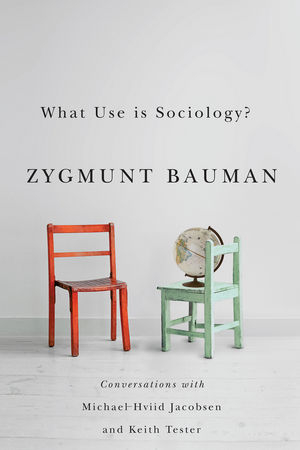
What Use is Sociology? (eBook)
In a series of conversations with Michael Hviid Jacobsen and Keith Tester, Zygmunt Bauman explains why sociology is necessary if we hope to live fully human lives. But the kind of sociology he advocates is one which sees 'use' as more than economic success and knowledge as more than the generation of facts. Bauman makes a powerful case for the practice of sociology as an ongoing dialogue with human experience, and in so doing he issues a call for us all to start questioning the common sense of our everyday lives. He also offers the clearest statement yet of the principles which inform his own work, reflecting on his life and career and on the role of sociology in our contemporary liquid-modern world.
This book stands as a testimony to Bauman's belief in the enduring relevance of sociology. But it is also a call to us all to start questioning the world in which we live and to transform ourselves from being the victims of circumstance into the makers of our own history. For that, at the end of the day, is the use of sociology.
Zygmunt Bauman is Professor Emeritus of Sociology at the University of Leeds. His many books have become international bestsellers and have been translated into more than thirty languages.
Michael Hviid Jacobsen is Professor of Sociology in the Department of Sociology and Social Work, Aalborg University, Denmark. He has published extensively on issues such as social theory, death and dying, and methodology.
Keith Tester is Professor of Sociology at the University of Hull. He has published widely in sociology and is recognised as one of the leading interpreters of the work of Zygmunt Bauman.
What's the use of sociology? The question has been asked often enough and it leaves a lingering doubt in the minds of many. At a time when there is widespread scepticism about the value of sociology and of the social sciences generally, this short book by one of the world's leading thinkers offers a passionate, engaging and important statement of the need for sociology. In a series of conversations with Michael Hviid Jacobsen and Keith Tester, Zygmunt Bauman explains why sociology is necessary if we hope to live fully human lives. But the kind of sociology he advocates is one which sees 'use' as more than economic success and knowledge as more than the generation of facts. Bauman makes a powerful case for the practice of sociology as an ongoing dialogue with human experience, and in so doing he issues a call for us all to start questioning the common sense of our everyday lives. He also offers the clearest statement yet of the principles which inform his own work, reflecting on his life and career and on the role of sociology in our contemporary liquid-modern world. This book stands as a testimony to Bauman's belief in the enduring relevance of sociology. But it is also a call to us all to start questioning the world in which we live and to transform ourselves from being the victims of circumstance into the makers of our own history. For that, at the end of the day, is the use of sociology.
Zygmunt Bauman (1925-2017) was Professor Emeritus of Sociology at the University of Leeds. His many books have become international bestsellers and have been translated into more than thirty languages. Michael Hviid Jacobsen is Professor of Sociology in the Department of Sociology and Social Work, Aalborg University, Denmark. He has published extensively on issues such as social theory, death and dying, and methodology. Keith Tester is Professor of Sociology at the University of Hull. He has published widely in sociology and is recognised as one of the leading interpreters of the work of Zygmunt Bauman.
Preface vii
Introduction 1
1 What is sociology? 7
2 Why do sociology? 35
3 How to do sociology? 67
4 What does sociology achieve? 105
"In What Use is Sociology?, Bauman peels back this hegemonic veneer, asking not what counts as sociology, but rather, what use is sociology? Via this shift, he encourages sociological practitioners to move beyond being blind followers of the latest sociologicaltrends. Instead, through self-reflexive analysis of his own work, Bauman provides a rare backstage glimpse into an engaged sociology that places people's concerns at its centre as central to its mission."
Sociology
"What Use is Sociology? is a series of intimate conversations, which mine Bauman's more than half a century of experience in the disciple--discussions which revisit truisms of the "sociological imagination" and which are littered with interesting anecdotes and asides particular to Bauman's own intellectual journey. Bauman's answers reveal the depth of his moral commitments and breadth of his critical engagement."
LSE Review of Books
"Sociology's principle purpose is to rouse people out of indifference and into action and it is this transition from inert to active knowledge that Bauman convincingly argues can bring about real change."
Morning Star
1
What is sociology?
Michael Hviid Jacobsen and Keith Tester Looking back at your own sociological trajectory, your work was initially inspired by Polish sociology in the 1950s and 1960s and after that your immediate sociological environment has been British sociology. How would you – in hindsight – say that these diverse sources of inspiration – Polish and British sociology – have inspired and shaped your own thinking?
Zygmunt Bauman ‘Looking back’, as you’ve asked me to, I can hardly spot a watershed or a violent clash of ‘sources of inspiration’. Taking off from Poland, I was already set on my sociological travels and landing in Britain did not cause anything like a significant shift in my itinerary. Separated from Poland by a linguistic barrier, ‘Polish sociology’ seemed a different universe, but please remember that the barrier was one-sided: English was then the ‘official’ language in sociology’s realm and sociologists in Poland read the same books and followed the same caprices of fashion and meanders of interests as their workmates on the other side of the Iron Curtain. Besides, British sociology in the early 1970s was not exactly in the forefront of the worldwide trends, and for a newcomer from the University of Warsaw there was not much to catch onto; indeed, the discoveries made in those years in the British Isles were, in almost every respect, old and sometimes even outdated stuff around the Vistula. Most of the excitements through which my British colleagues were to go in my presence (such as the discoveries of Gramsci, the Frankfurt School, ‘culturology’, hermeneutics, the nonentity of ‘structural functionalism’ and the greatness of structuralism, etc.) I had already gone through in the company of my Polish colleagues well before landing in Britain. To cut a long story short, my first decade in Britain might have been full of sound and fury, for quite a few reasons (and indeed it was, as I confessed to Keith Tester quite a long while ago), but however, that signified pretty little for my vision of the sociological vocation.
You have always defined sociology as a ‘conversation with human experience’. This raises two questions. First of all, what do you mean by ‘human experience’?
I mean both Erfahrungen and Erlebnisse: the two different phenomena generated at the person/world interface, which Germans distinguish and set apart yet English speakers, due to the lack of distinct names, usually blend in one notion of ‘experience’. Erfahrung is what happens to me when interacting with the world; Erlebnis is ‘what I live through’ in the course of that encounter – the joint product of my perception of the happening(s) and my effort to absorb it and render it intelligible. Erfahrung can, and does, make a bid for the status of objectivity (supra – or interpersonality), whereas Erlebnis is evidently and overtly, explicitly subjective; and so, with a modicum of simplification, we may translate these concepts into English as, respectively, objective and subjective aspects of experience; or, adding a pinch of interpretation, actor-unprocessed and actor-processed experience. The first may be presented as a report from the world external to the actor; the second, coming from the actor’s ‘inside’ and concerning private thoughts, impressions and emotions, may only be available in the form of an actor’s report. In reports of the first category we hear of interpersonally testable events called ‘facts’; the contents of the second kind of reports are not testable interpersonally – beliefs as reported by the actor are, so to speak, the ultimate (and only) ‘facts of the matter’. The epistemological status of Erfahrungen and Erlebnisse therefore differ sharply; a circumstance responsible for quite a few confusions in the practice of sociological research and above all in the interpretations of its findings. The reliability and relevance of witness-supplied evidence change with the object of the witnessing – and that applies to both partners in the ongoing ‘dialogue between sociology and human experience’.
Second, in what does this conversation consist? How does sociology engage in the conversation, and what makes sociology worth engaging with? Why should non-sociologists read it?
Like all conversations, sociology engages in conversation with lay doxa – common sense or actor’s knowledge. It involves passing messages that turn into stimuli that evoke responses which become stimuli in their turn – in principle ad infinitum. The transformation of messages into effective stimuli is mediated by reception, followed by sense-making, which involves as a rule a (selective) interpretation. In its sociological variety the conversation is aimed at the confrontation between Erfahrungen and Erlebnisse, thereby ‘relativizing’ the latter while aiming at widening, rather than narrowing and limiting the conversationalists’ spectrum of choices.
In my view, the crucial objective of such ongoing conversation is in the long run the breaking of the widespread, perhaps even nearly universal habit of ‘non-sociologists’ (otherwise known as ‘ordinary folk in their ordinary life’) of evading the ‘in order to’ category of explanation when it comes to reporting their conduct and deploying instead a ‘because of’ type of argument. Behind that habit there is a tacit presumption, occasionally articulated though mostly unreflected upon and hardly ever questioned, that ‘things are as they are’ and ‘nature is nature – full stop’, and a conviction that there is little if nothing that actors – singly, severally or collectively – can change in nature’s verdicts. What results is an inert worldview, immune to argument. It entails a truly deadly mixture of two beliefs. First, there is a belief in the indomitability of the order of things, human nature or the state of human affairs. Second, there is a belief in human weakness bordering on impotence. That duo of beliefs prompts an attitude which can be only described as ‘surrender before the battle has started’. Étienne de La Boétie famously gave that attitude the name of ‘voluntary servitude’. In his Diary of a Bad Year (Penguin, 2008), J. M. Coetzee’s character C. objects: ‘La Boétie gets it wrong’. And he proceeds to spell out what was missing in that observation of four centuries ago which is nevertheless fast gaining consequentiality in our times: ‘The alternatives are not placid servitude on the one hand and revolt against servitude on the other. There is a third way, chosen by thousands and millions of people every day. It is the way of quietism, of willed obscurity, of inner emigration’ (p.12). People go through the moves, obedient to their daily routine and resigned in advance to the impossibility of changing it, and above all convinced of the irrelevance and ineffectiveness of their own actions or their refusal to act.
Alongside the questioning of the worldview that underpins such ‘quietism’, the sociological variety of conversation aimed at the expansion of individual freedom and the collective potential of humanity pursues the task of revealing and unravelling the features of the world which, however deceptive and misleading they might be, nevertheless supply some grounds for a kind of worldview that sustains and continuously galvanizes the quietist attitudes. ‘Relativization’ aims at both sides of the Erfahrungen–Erlebnisse encounter: it is the dialectics of their interaction that could be called the conversation’s ultimate objective.
Can you perhaps give an example of this?
Allow me to return for a moment to Coetzee’s alter ego; once more, he hits a bull’s eye when he points out that the popular and deeply entrenched
figure of economic activity as a race or contest is somewhat vague in its particulars, but it would appear that, as a race, it has no finishing line and therefore no natural end. The runner’s goal is to get to the front and stay there. The question of why life must be likened to a race, or of why the national economies must race against one another rather than going for a comradely jog together, for the sake of the health, is not raised. A race, a contest: that is the way things are. By nature we belong to separate nations; by nature nations are in competition with other nations. We are as nature made us. (p. 79)
He continues: but in fact ‘there is nothing ineluctable about war. If we want war we can choose war, if we want peace we can equally well choose peace. If we want competition we can choose competition; alternatively we can take the path of comradely cooperation’ (p. 81).
Just to leave no room for doubt as to the meaning of his observation, Coetzee’s C. points out that
surely God did not make the market – God or the spirit of History. And if we human beings made it, can we not unmake it and remake it in a kindlier form? Why does the world have to be a...
| Erscheint lt. Verlag | 6.2.2014 |
|---|---|
| Sprache | englisch |
| Themenwelt | Geisteswissenschaften ► Philosophie ► Allgemeines / Lexika |
| Sozialwissenschaften ► Politik / Verwaltung | |
| Sozialwissenschaften ► Soziologie ► Allgemeine Soziologie | |
| Schlagworte | Gesellschaftstheorie • Philosophie • Philosophy • Social Philosophy • Social Theory • Sociology • Sociology, social theory, imagination, methodology • Sozialphilosophie • Soziologie |
| ISBN-13 | 9780745679884 / 9780745679884 |
| Informationen gemäß Produktsicherheitsverordnung (GPSR) | |
| Haben Sie eine Frage zum Produkt? |
 EPUB (Adobe DRM)
Kopierschutz: Adobe-DRM
Adobe-DRM ist ein Kopierschutz, der das eBook vor Mißbrauch schützen soll. Dabei wird das eBook bereits beim Download auf Ihre persönliche Adobe-ID autorisiert. Lesen können Sie das eBook dann nur auf den Geräten, welche ebenfalls auf Ihre Adobe-ID registriert sind.
Details zum Adobe-DRM
Dateiformat: EPUB (Electronic Publication)
EPUB ist ein offener Standard für eBooks und eignet sich besonders zur Darstellung von Belletristik und Sachbüchern. Der Fließtext wird dynamisch an die Display- und Schriftgröße angepasst. Auch für mobile Lesegeräte ist EPUB daher gut geeignet.
Systemvoraussetzungen:
PC/Mac: Mit einem PC oder Mac können Sie dieses eBook lesen. Sie benötigen eine
eReader: Dieses eBook kann mit (fast) allen eBook-Readern gelesen werden. Mit dem amazon-Kindle ist es aber nicht kompatibel.
Smartphone/Tablet: Egal ob Apple oder Android, dieses eBook können Sie lesen. Sie benötigen eine
Geräteliste und zusätzliche Hinweise
Buying eBooks from abroad
For tax law reasons we can sell eBooks just within Germany and Switzerland. Regrettably we cannot fulfill eBook-orders from other countries.
aus dem Bereich