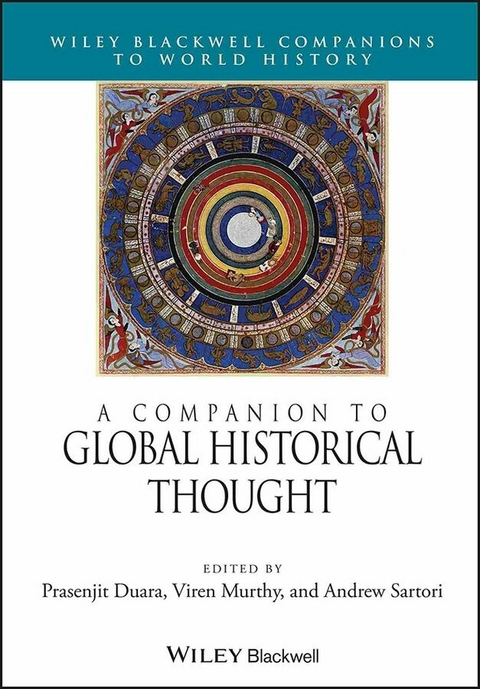
A Companion to Global Historical Thought (eBook)
John Wiley & Sons (Verlag)
978-1-118-52536-4 (ISBN)
- Provides an overview of the development of historical thinking from the earliest times to the present, across the world, through essays written by a team of leading international scholars
- Complements the Companion to Western Historical Thought, placing non-Western perspectives on historiography at the center of the discussion
- Explores the different historical traditions that have shaped the discipline, and the challenges posed by modernity and globalization
Prasenjit Duara is the Raffles Professor of Humanities and Director of the Asia Research Institute as well as Director of Research in Humanities and Social Sciences at National University of Singapore. He is the author of Culture, Power, and the State: Rural North China, 1900–1942 (1988), which won the Fairbank Prize of the American Historical Association and the Levenson Prize of the Association for Asian Studies, USA.
Viren Murthy is Assistant Professor at the University of Wisconsin-Madison, USA, where he specializes in Modern Chinese and Japanese intellectual history. He is the author of The Political Philosophy of Zhang Taiyan: The Resistance of Consciousness (2011).
Andrew Sartori is Associate Professor of History at New York University, USA. He is co-editor of Global Intellectual History (with Samuel Moyn, 2013), the author of Bengal in Global Concept History (2008), and co-editor of From the Colonial to the Postcolonial (with Dipesh Chakrabarty and Rochona Majumdar, 2007). He is also co-editor of the journal Critical Historical Studies.
A COMPANION TO GLOBAL HISTORICAL THOUGHT A Companion to Global Historical Thought provides an overview of the development of historical thinking from the earliest times to the present, directly addressing issues of historiography in a globalized context. Questions concerning the global dissemination of historical writing and the relationship between historiography and other ways of representing the past have become important not only in the academic study of history, but also in public arenas in many countries. With contributions from leading international scholars, the book considers the problem of the global in the multiplicity of traditions of narrating the past; in the global dissemination of modern historical writing; and of the global as a concept animating historical imaginations. It explores the different intellectual approaches that have shaped the discipline of history, and the challenges posed by modernity and globalization, while illustrating the shifts in thinking about time and the emergence of historical thought. Complementing A Companion to Western Historical Thought, this book places non-Western perspectives on historiography at the center of discussion, helping scholars and students alike make sense of the discipline at the start of the twenty-first century.
Prasenjit Duara is the Raffles Professor of Humanities and Director of the Asia Research Institute as well as Director of Research in Humanities and Social Sciences at National University of Singapore. He is the author of Culture, Power, and the State: Rural North China, 1900-1942 (1988), which won the Fairbank Prize of the American Historical Association and the Levenson Prize of the Association for Asian Studies, USA. Viren Murthy is Assistant Professor at the University of Wisconsin-Madison, USA, where he specializes in Modern Chinese and Japanese intellectual history. He is the author of The Political Philosophy of Zhang Taiyan: The Resistance of Consciousness (2011). Andrew Sartori is Associate Professor of History at New York University, USA. He is co-editor of Global Intellectual History (with Samuel Moyn, 2013), the author of Bengal in Global Concept History (2008), and co-editor of From the Colonial to the Postcolonial (with Dipesh Chakrabarty and Rochona Majumdar, 2007). He is also co-editor of the journal Critical Historical Studies.
Notes on Contributors viii
Introduction 1
Part I Premodern Historical Thought 19
1 History as a Way of Remembering the Past: Early India 21
Romila Thapar
2 Classical Chinese Historical Thought 34
Michael Puett
3 The Romance of the Middle Ages: Discovering the Past in Early Modern Japan 47
Thomas Keirstead
4 Buddhist Worlds 63
Ian Harris
5 Premodern Arabic/Islamic Historical Writing 78
Tarif Khalidi
6 Ottoman Historical Thought 92
Gottfried Hagen and Ethan L. Menchinger
7 "Premodern" Pasts: South Asia 107
Rosalind O'Hanlon
8 History, Exile, and Counter-History: Jewish Perspectives 122
Amnon Raz-Krakotzkin
Part II Historiographies 137
9 The Legacy of Greece and Rome 139
Freyja Cox Jensen
10 America and Global Historical Thought in the Early Modern Period 153
Karen Ordahl Kupperman
11 European Societies and their Norms in the Process of Expansion: The Iberian Cases 169
Jean-Frédéric Schaub
12 The Global in Enlightenment Historical Thought 184
Jennifer Pitts
13 Hegel, Marx, and World History 197
Andrew Sartori
14 The World of Modern Japanese Historiography: Tribulations and Transformations in Historical Approaches 213
Curtis Anderson Gayle
15 Critical Theories of Modernity 228
Viren Murthy
16 On the Compatibility of Chinese and European History: A Marxist Approach 243
Susanne Weigelin-Schwiedrzik
17 Modern Historiography in Southeast Asia: The Case of Thailand's Royal-Nationalist History 257
Thongchai Winichakul
18 Historical Thought in the Other America 269
Mauricio Tenorio-Trillo
19 Histories of History in South Asia 293
Prathama Banerjee
20 Modern Historiography - Arab World 308
Alexis Wick
21 The Burden of Peculiarity: History and Historical Thought in Africa 321
Andreas Eckert
Part III G lobal Histories and New Directions 335
22 Oceanic History 337
Michael Pearson
23 Environmental History and World History: Parallels, Intersections, and Tensions 351
Kenneth Pomeranz
24 Dependency Theory and World-Systems Analysis 369
Ravi Arvind Palat
25 Empires and Imperialism 384
Prasenjit Duara
26 Histories of Globalization(s) 399
Michael Lang
27 Comparative History and Its Critics: A Genealogy and a Possible Solution 412
George Steinmetz
28 Women, Gender, and the Global 437
Bonnie G. Smith
29 Indigenes and Settlers (Fourth World) 451
Lorenzo Veracini
30 History, Memory, Justice 466
Klaus Neumann
31 Beyond the Nation: Textbook Controversies and Contestations in a Globalizing World 482
Hanna Schissler
Index 496
"A Companion to Global Historical Thoughtbelongs on the shelf of every academic library supporting any kind of history programme. The essays are thoughtful, thought-provoking and exhaustively footnoted . . . These essays are excellent end products to enjoy or places to start the journey to study big picture history." (Reference Reviews, 1 October 2015)
Notes on Contributors
Prathama Banerjee is a historian and a fellow at the Centre for Study of Developing Societies (CSDS), Delhi. She currently works on histories of the political in modern and contemporary India. She is interested in intellectual and conceptual histories as well as in political theory and literature. She is the author of The Politics of Time: ‘Primitives’ and History-Writing in Colonial Bengal (2002). Two of her recent essays are “Thinking equality: Debates in Bengal, 1870–1940,” in Gyan Pandey, ed., Subalternity and Difference (2011), and “Chanaky/Kautilya: History, theatre, politics in 20th century Bengal,” Journal of the History of the Present, 2 (1) (2012).
Prasenjit Duara is the Raffles Professor of Humanities and Director, Asia Research Institute as well as Director of Research in Humanities and Social Sciences at National University of Singapore. He was previously Professor and Chair of the Dept of History and of the Committee on Chinese Studies at the University of Chicago. In 1988, he published Culture, Power and the State: Rural North China, 1900–1942, which won the Fairbank Prize of the AHA and the Levenson Prize of the AAS, USA.
Andreas Eckert is Professor of African history at Humboldt University. Since October 2009, he also directs the International Research Institute on “Work and Human Life Course in Global History,” funded by the German Federal Ministry of Science and Research. He has been visiting professor at Indiana University (Bloomington), Harvard University, the University of Michigan, the Maison des Sciences de l’Homme (Paris) and Fellow at the Freiburg Institute of Advanced Study (FRIAS). He has published widely on the history of Africa in the nineteenth and twentieth centuries, on the history of colonialism, and on the history of global labor.
Curtis Anderson Gayle is an Associate Professor in the Faculty of Integrated Arts and Social Sciences at Japan Women’s University, Tokyo. He has published Marxist History and Postwar Japanese Nationalism (2002) and Women’s History and Local Community in Postwar Japan (2011). He is currently working on a manuscript entitled “Re-imagining Globalization: Alternative Japanese views of the World from 1945 to Today.”
Gottfried Hagen took his doctorate from Freie Universität Berlin, and has been teaching Turkish Studies at the University of Michigan since 2000. He has published widely on Ottoman intellectual history, asking how Ottomans perceived and interpreted the world, and their place in it in time and space.
Ian Harris is Visiting Professor of Buddhist Studies, King’s College London and President of the UK Association of Buddhist Studies. He has also held positions at the Universities of Oxford, Toronto, and British Columbia, the National University of Singapore, and Dongguk University, Seoul. His most recent books are Cambodian Buddhism: History and Practice (2005), Buddhism in a Dark Age: Cambodian Monks under the Khmer Rouge (2012), and an edited volume entitled Buddhism, Power and Politics in Southeast Asia (2007).
Freyja Cox Jensen currently holds the position of Lecturer in Early Modern British History at the University of Exeter, and was previously a Junior Research Fellow at Christ Church, Oxford. She specializes in the reception of the classics in early modern Britain and Europe; her first monograph, Reading the Roman Republic in Early Modern England, was published in 2012.
Thomas Keirstead teaches Japanese history and historiography in the Department of East Asian Studies at the University of Toronto. Trained as a medievalist, he has also written on early modern and modern conceptions of the past as it appears in a variety of genres, including film, anime, and historical fiction.
Tarif Khalidi was educated at University College, Oxford, and the University of Chicago. He is currently Shaykh Zayid Professor of Arabic & Islamic Studies, American University of Beirut, and was formerly Sir Thomas Adams’s Professor of Arabic and Fellow of King’s College, Cambridge. His recent publications include: Arabic Historical Thought in the Classical Period (1994), The Muslim Jesus (2001), The Qur’an, A New Translation (2008), and Images of Muhammad (2009).
Karen Ordahl Kupperman, PhD Cantab, is Silver Professor of History Emerita at New York University. She is the author of The Jamestown Project (2007) and The Atlantic in World History (2012). Among her awards are the AHA Prize in Atlantic History and the AHA’s Beveridge Prize.
Michael Lang is an Associate Professor of History at the University of Maine, where he teaches intellectual history, historiography, and international affairs. His research focuses on modern European conceptions of global order.
Ethan L. Menchinger is a PhD candidate in Near Eastern Studies at the University of Michigan. His research and publications focus on the early modern Ottoman Empire, with special interest in historical writing, knowledge transmission, and intellectual life. He also translates.
Viren Murthy teaches transnational Asian History at the University of Wisconsin-Madison and researches Chinese and Japanese intellectual history. He is the author of The Political Philosophy of Zhang Taiyan: The Resistance of Consciousness (2011) and is currently working on a project tentatively entitled: Imagining Asia: Takeuchi Yoshimi and the Conundrums of Asian Modernity.
Klaus Neumann is a trained historian and Professor of History at the Swinburne Institute for Social Research, Swinburne University of Technology, Melbourne, Australia. He is currently working on two projects: one concerned with forced migration, and the other with historical justice. Relevant publications include, among others, Shifting Memories: The Nazi Past in the New Germany (2000).
Rosalind O’Hanlon, MA, PhD, is Professor of Indian History and Culture in the Faculty of Oriental Studies, Oxford. Her research interests lie in the social and intellectual history of early modern and colonial India. Her recent publications include Religious Cultures in Early Modern India: New Perspectives (2011, edited with David Washbrook) and numerous articles.
Ravi Arvind Palat is Professor of Sociology at the State University of New York at Binghamton and has previously taught Asian Studies at the University of Hawaii at Manoa and Sociology at the University of Auckland. He works in the broadly defined fields of historical sociology and political economy. He is the author of Capitalist Restructuring and the Pacific Rim and is currently completing a book titled Princes, Paddyfields, and Bazaars: Wet-Rice Cultivation and the Emergence of the Indian Ocean World-System, 1250–1650.
Michael Pearson is Emeritus Professor of History at the University of New South Wales, Sydney, Australia. Among his recent books are Port Cities and Intruders: The Swahili Coast, India, and Portugal in the Early Modern Era (1998, paperback edition, 2003); The Indian Ocean (2003, paperback 2008); The World of the Indian Ocean, 1500–1800: Studies in Economic, Social and Cultural History (2005); he is also co-editor, with Pamila Gupta and Isabel Hofmeyr, of Eyes Across the Water: Navigating the Indian Ocean (2010).
Jennifer Pitts is Associate Professor of Political Science at the University of Chicago and author of A Turn to Empire: The Rise of Imperial Liberalism in Britain and France (2005). Her current research explores European debates over legal relations with non-European societies during the eighteenth and nineteenth centuries.
Kenneth Pomeranz is University Professor of History at the University of Chicago, and President of the American Historical Association. His publications include The Great Divergence: China, Europe, and the Making of the Modern World Economy and The Making of a Hinterland: State, Society and Economy in Inland North China, 1853–1937.
Michael Puett is the Walter C. Klein Professor of Chinese History in the Department of East Asian Languages and Civilizations and the Chair of the Committee on the Study of Religion at Harvard University. He is the author of The Ambivalence of Creation: Debates Concerning Innovation and Artifice in Early China and To Become a God: Cosmology, Sacrifice, and Self-Divinization in Early China, as well as the co-author, with Adam Seligman, Robert Weller, and Bennett Simon, of Ritual and its Consequences: An Essay on the Limits of Sincerity.
Amnon Raz-Krakotzkin is a Professor in the Department of Jewish History at Ben-Gurion University of the Negev. Among his publications are The Censor, the Editor, and the Text: Catholic Censorship and the Shaping of the Jewish Canon in the Sixteenth Century (2007) and Exil et souveraineté: judaïsme, sionisme et pensée binationale. Preface de Carlo Ginzburg (2007).
Andrew Sartori is Associate Professor of History at NYU. He is the author of Bengal in Global Concept History, and the co-editor of Global Intellectual History and...
| Erscheint lt. Verlag | 21.1.2014 |
|---|---|
| Reihe/Serie | Blackwell Companions to World History |
| Blackwell Companions to World History | Wiley Blackwell Companions to World History |
| Sprache | englisch |
| Themenwelt | Geisteswissenschaften ► Geschichte ► Allgemeines / Lexika |
| Geisteswissenschaften ► Geschichte ► Allgemeine Geschichte | |
| Schlagworte | Geschichte • Historical Methods & Historiography • History • history of ideas • Ideengeschichte • Methoden der Geschichtsforschung u. Geschichtsschreibung • Weltgeschichte • World History |
| ISBN-10 | 1-118-52536-1 / 1118525361 |
| ISBN-13 | 978-1-118-52536-4 / 9781118525364 |
| Informationen gemäß Produktsicherheitsverordnung (GPSR) | |
| Haben Sie eine Frage zum Produkt? |
 EPUB (Adobe DRM)
Kopierschutz: Adobe-DRM
Adobe-DRM ist ein Kopierschutz, der das eBook vor Mißbrauch schützen soll. Dabei wird das eBook bereits beim Download auf Ihre persönliche Adobe-ID autorisiert. Lesen können Sie das eBook dann nur auf den Geräten, welche ebenfalls auf Ihre Adobe-ID registriert sind.
Details zum Adobe-DRM
Dateiformat: EPUB (Electronic Publication)
EPUB ist ein offener Standard für eBooks und eignet sich besonders zur Darstellung von Belletristik und Sachbüchern. Der Fließtext wird dynamisch an die Display- und Schriftgröße angepasst. Auch für mobile Lesegeräte ist EPUB daher gut geeignet.
Systemvoraussetzungen:
PC/Mac: Mit einem PC oder Mac können Sie dieses eBook lesen. Sie benötigen eine
eReader: Dieses eBook kann mit (fast) allen eBook-Readern gelesen werden. Mit dem amazon-Kindle ist es aber nicht kompatibel.
Smartphone/Tablet: Egal ob Apple oder Android, dieses eBook können Sie lesen. Sie benötigen eine
Geräteliste und zusätzliche Hinweise
Buying eBooks from abroad
For tax law reasons we can sell eBooks just within Germany and Switzerland. Regrettably we cannot fulfill eBook-orders from other countries.
aus dem Bereich