


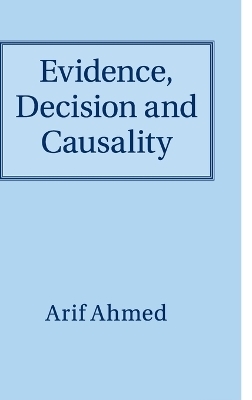
Evidence, Decision and Causality
Seiten
2014
Cambridge University Press (Verlag)
978-1-107-02089-4 (ISBN)
Cambridge University Press (Verlag)
978-1-107-02089-4 (ISBN)
Aimed at philosophers and those with an interest in rational choice. Economic theory, quantum mechanics and voting all seem to illustrate a deep puzzle about the practical role of causality. This book advances the debate, introduces many new examples and assesses the practical relevance of the philosophical discussion.
Most philosophers agree that causal knowledge is essential to decision-making: agents should choose from the available options those that probably cause the outcomes that they want. This book argues against this theory and in favour of evidential or Bayesian decision theory, which emphasises the symptomatic value of options over their causal role. It examines a variety of settings, including economic theory, quantum mechanics and philosophical thought-experiments, where causal knowledge seems to make a practical difference. The arguments make novel use of machinery from other areas of philosophical inquiry, including first-person epistemology and the free will debate. The book also illustrates the applicability of decision theory itself to questions about the direction of time and the special epistemic status of agents.
Most philosophers agree that causal knowledge is essential to decision-making: agents should choose from the available options those that probably cause the outcomes that they want. This book argues against this theory and in favour of evidential or Bayesian decision theory, which emphasises the symptomatic value of options over their causal role. It examines a variety of settings, including economic theory, quantum mechanics and philosophical thought-experiments, where causal knowledge seems to make a practical difference. The arguments make novel use of machinery from other areas of philosophical inquiry, including first-person epistemology and the free will debate. The book also illustrates the applicability of decision theory itself to questions about the direction of time and the special epistemic status of agents.
Arif Ahmed is Senior Lecturer in Philosophy at the University of Cambridge.
Introduction; 1. Savage; 2. EDT and CDT; 3. Causalist objections to CDT; 4. Realistic cases; 5. Deterministic cases; 6. Quantum-mechanical cases; 7. The standard Newcomb case; 8. 'The ultimate contingency'.
| Erscheint lt. Verlag | 7.8.2014 |
|---|---|
| Zusatzinfo | 36 Tables, black and white; 2 Line drawings, black and white |
| Verlagsort | Cambridge |
| Sprache | englisch |
| Maße | 158 x 235 mm |
| Gewicht | 520 g |
| Themenwelt | Geisteswissenschaften ► Philosophie ► Erkenntnistheorie / Wissenschaftstheorie |
| Geisteswissenschaften ► Psychologie ► Allgemeine Psychologie | |
| Geisteswissenschaften ► Psychologie ► Verhaltenstherapie | |
| Mathematik / Informatik ► Mathematik | |
| Naturwissenschaften | |
| Wirtschaft ► Betriebswirtschaft / Management ► Allgemeines / Lexika | |
| ISBN-10 | 1-107-02089-1 / 1107020891 |
| ISBN-13 | 978-1-107-02089-4 / 9781107020894 |
| Zustand | Neuware |
| Informationen gemäß Produktsicherheitsverordnung (GPSR) | |
| Haben Sie eine Frage zum Produkt? |
Mehr entdecken
aus dem Bereich


aus dem Bereich
Buch | Softcover (2023)
Reclam, Philipp (Verlag)
CHF 9,80
die Evolution des Geistes
Buch | Softcover (2025)
Suhrkamp (Verlag)
CHF 41,95


