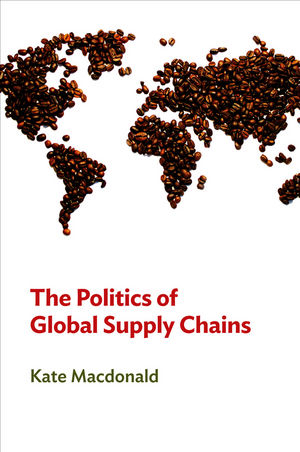
The Politics of Global Supply Chains (eBook)
John Wiley & Sons (Verlag)
978-0-7456-7973-0 (ISBN)
These emerging supply chain governance systems are shown to be multi-layered and politically contested, as transnational governance schemes interact with traditional state governance arrangements in both complementary and conflicting ways. The book’s analysis of changes to the relationship between state and non-state actors within transnational governance processes will be of particular interest to scholars and students of globalisation, global governance and regulation.
The Politics of Global Supply Chains also suggests some practical ways by which the effectiveness and accountability of supply chain governance could be strengthened, which will interest both scholars and practitioners in fields of global business regulation and corporate social responsibility. Conclusions are relevant to the business and civil society actors who participate directly in non-state governance schemes, and to state regulators whose distinctive governance capacities could play a much greater role than at present in supporting transnational, non-state governance processes.
Kate Macdonald is Lecturer in the Political and Social Sciences at the University of Melbourne.
The Politics of Global Supply Chains analyses the changing politics of power and distribution within contemporary global supply chains. Drawing on over 300 interviews with farmers, workers, activists, businesses and government officials in garment and coffee sector supply chains, the book shows how the increased involvement of non-state actors in supply chain governance is re-shaping established patterns of global political power, responsibility and accountability. These emerging supply chain governance systems are shown to be multi-layered and politically contested, as transnational governance schemes interact with traditional state governance arrangements in both complementary and conflicting ways. The book s analysis of changes to the relationship between state and non-state actors within transnational governance processes will be of particular interest to scholars and students of globalisation, global governance and regulation. The Politics of Global Supply Chains also suggests some practical ways by which the effectiveness and accountability of supply chain governance could be strengthened, which will interest both scholars and practitioners in fields of global business regulation and corporate social responsibility. Conclusions are relevant to the business and civil society actors who participate directly in non-state governance schemes, and to state regulators whose distinctive governance capacities could play a much greater role than at present in supporting transnational, non-state governance processes.
Kate Macdonald is Lecturer in the Political and Social Sciences at the University of Melbourne.
Acronyms vii
Acknowledgements xi
Introduction: The Politics of Global Supply Chains 1
1 Power and Governance in Garment Supply Chains 18
2 The Emergence of Non-State Governance: Anti-Sweatshop
Campaigns 44
3 The Private Sector Response: Codes of Conduct 71
4 Dispersed Power Within Coffee Supply Chains 87
5 The Transformative Challenge: Fair Trade as an
'Alternative' Institutional Model 103
6 Starbucks CAFÉ Practices: The 'Responsible'
Corporation Responds 129
7 Interaction Between Initiatives: Diffusing Change Beyond
'Niche' Supply Chains 147
8 Lessons and Synthesis: Power, Responsibility and Governance
Beyond the State 165
Conclusion: Ongoing Political Contests in Global Supply Chains
191
Notes 194
References 222
Index 245
"Marrying theoretical and empirical analysis seamlessly, this book
skilfully deciphers the increasingly complex world of supply chain
management and politics. It is essential reading for scholars,
activists and policy makers concerned with business regulation,
changing patterns of transnational governance and the appropriate
roles of public and private actors in crafting a more just economic
system."
Peter Utting, Deputy Director, United Nations Research Institute
for Social Development
"Global supply chains play an important role not only in the world
economy but also in global politics, and no one interested in them
can afford to ignore this landmark study. Kate Macdonald's ability
to combine rigorous and enlightening analyses of global trends with
invaluable insights into local processes and experiences, gathered
through painstaking fieldwork over several years, is truly
impressive."
Mathias Koenig-Archibugi, London School of Economics
"Macdonald brings alive the politics of supply chains, using rich
case analysis to identify - and question - key
production and regulation practices in today's global economy.
Thorough research yields helpful insights for theorists and
activists alike."
Jan Aart Scholte, University of Warwick
Introduction: The Politics of Global Supply Chains
From corporate boardrooms to the butcher's paper and whiteboards of activist workshops, the phrase ‘supply chain politics’ has become increasingly commonplace. It is now routine practice for major global companies to hire specialist staff responsible for ‘supply chain compliance’, which involves managing human rights, labour standards and other aspects of social governance in farms and factories supplying a company's manufacturing or retail operations. Meanwhile, grassroots activists working with marginalized workers use diagrams of corporate ‘supply chains’ when planning how to most effectively mobilize against transnational structures of corporate power. And consultants within the rapidly expanding industry of ‘responsible supply chain management’ organize events to consult factory workers on their employers' operations, with titles such as ‘The Supply Chain Talks Back’ (CSRAsia 2005). The objectives and experiences of such actors are far removed from each other, yet all recognize the importance of supply chain politics for understanding and transforming patterns of contemporary globalization.
What, then, are these diverse groups referring to when they vigorously debate how global supply chains should be managed? Most now share a broad understanding of a supply chain as an increasingly common arrangement through which the steps involved in producing a given product and bringing it to market are divided up and coordinated beyond the boundaries of a single firm. The term ‘global supply chain’ highlights the associated trend towards the chopping up and spreading out of stages of production not only across different organizational units, but also across different geographical sites.1
What this means in practical terms is that transnational companies in many agricultural and industrial sectors no longer rely primarily on in-house facilities to organize production of the goods they sell. Rather, they source much of their product through chains of contractual, market and network relationships across a number of countries, linking a potentially diverse range of companies, farms and other organizations (Henderson 2005; Ponte and Gibbon 2005). The functional disaggregation of the production process enables ‘lead firms’ to take advantage of the distinctive competencies, efficiencies and flexibilities offered by other firms and geographical locations at different stages of the production process. As a result, firms and countries no longer trade simply in raw materials and final products. Rather, different firms and countries specialize not just in producing different products, but in different parts of different products, each focusing variously on design, assembly, marketing, and so on.
Production processes differ in how amenable they are to this kind of disaggregation and dispersion. As a result, supply chain organization varies significantly across sectors. Nevertheless, supply chains play an important role in the production of a wide range of goods, notably in manufacturing, agriculture and horticulture sectors. Such processes have become most visible in supply chains through which everyday household consumer goods such as clothing and sportswear, tea and coffee, and popular electronic consumer goods such as Apple iPhones and iPods are produced and traded. But global supply chains also play an important role in organizing the production of less visible and politicized goods such as transport equipment, electronic components and industrial machinery.
Increasing reliance on global production in such sectors has been associated in many cases with intensified regulatory challenges as production processes extend beyond the reach of any single national regulatory system. This problem of regulatory scale is compounded by the fact that global supply chains in many sectors rely heavily on production located in developing country jurisdictions, where national regulatory capacity is often encumbered by multiple institutional and financial constraints. As global supply chains have become increasingly visible and politicized, a major preoccupation within both public and scholarly debates has been how to deal with documented deficits in the effectiveness and accountability of national governance arrangements through which economic production has traditionally been regulated. Critical attention has focused in particular on governance deficits associated with morally troubling phenomena such as the proliferation of ‘sweatshop’ labour conditions in global supply chains producing clothing, toys, and other manufactured consumer goods, and conditions of poverty among farmers producing major consumer items such as tea, coffee and cocoa.
In response to such concerns, a range of non-state governance schemes have emerged – each aspiring in varying ways to tackle problems of poor living and working conditions of those working in global supply chains. Rather than leaving the task of regulating global supply chains to the discretion of individual national governments, emerging non-state governance schemes are in a sense ‘hardwired’ into the business and market-oriented institutions of global corporate supply chains themselves. Many companies have reformed their internal organization by creating new roles and organizational units focused on compliance with designated social standards. Contracts regulating the terms of business relationships between buyers and suppliers now commonly incorporate obligations relating to labour and social conditions of production. And many businesses now participate in a range of standard-setting, auditing and capacity-building schemes involving cooperation with governments and non-government organizations (NGOs) in both buyer and supplier countries. These kinds of practices reflect an important shift away from exclusive reliance on instruments of state policy and regulation as market governance tools, toward greater reliance on governance tools internal to ‘private’ supply chain institutions.
These shifts are exemplified clearly by developments within global supply chains in the coffee and garment sectors. Supply chains in both sectors have been prominently politicized in recent years by coalitions of non-state actors promoting agendas of labour rights and trade justice. Both sectors are labour-intensive and highly globalized – coffee is the second most traded good in the world, eclipsed only by petroleum.2 And both are built around structures of production and exchange in which the transnational scope of supply chains connects some of the world's poorest workers and producers with some of the world's most affluent and powerful consumer markets and corporate entities in the global north.
Supply chains in both these sectors have also been the subject of increasing attention from highly visible non-state actors. These actors have politicized key supply chain decision-making processes through their high-profile advocacy for core labour standards in the garment sector, and their focus on issues of ‘trade justice’ in the coffee sector (Gresser and Tickell 2002; Collins 2003; Varangis et al. 2003: 21). In turn, a range of non-state governance initiatives have emerged in response. In the garment sector these include brand-based and factory-based ‘anti-sweatshop’ campaigns and corporate codes of conduct, while in the coffee sector they include the Fairtrade system, Starbucks' ‘Café Practices’ coffee sourcing programme, and the Oxfam ‘Make Trade Fair’ coffee campaign. This book's empirical analysis of the politics of global supply chains focuses on detailed studies of these two sectors.
Working with these examples as the central points of reference, the book documents the emergence of a new supply chain politics based on the direct politicization of transnational business activity. As a result of shifts in both distributions of social power within the global economy, and in ideas about responsibility for the exercise of such power, there is growing concern about a perceived problem of governance deficits in the management of these transnational social relations, for which some population segments in the global north feel increasingly responsible.
As a result, social relations within supply chains are being politicized in a highly visible way. Global supply chains are now often characterized by increasing tensions and open contests between rival systems of power and governance. These involve battles for control over supply chain relationships, and conflicts over normative principles to determine who is responsible for the social conditions of production within supply chains, and on what terms.
The Neglect of Supply Chain Politics
Despite the growing visibility and influence of such transnational political contests, the concept of supply chain politics has received little sustained attention within the discipline of international relations, or political science more broadly. This is certainly not to suggest that the broad issues examined by this book will be unfamiliar to scholars and students of international affairs. Increasing social contestation and mobilization concerning labour and social conditions of global production is widely recognized among most scholars and students of international political economy, while issues of corporate social responsibility (CSR), trade justice and international labour and social regulation have shot up the agenda of mainstream global...
| Erscheint lt. Verlag | 14.1.2014 |
|---|---|
| Sprache | englisch |
| Themenwelt | Geschichte ► Allgemeine Geschichte ► Zeitgeschichte |
| Sozialwissenschaften ► Politik / Verwaltung ► Vergleichende Politikwissenschaften | |
| Sozialwissenschaften ► Soziologie | |
| Wirtschaft ► Volkswirtschaftslehre ► Makroökonomie | |
| Wirtschaft ► Volkswirtschaftslehre ► Wirtschaftspolitik | |
| Schlagworte | Development Studies • Entwicklungsforschung • Entwicklung u. Globalisierung • Globalization & Development • Global politics • global politics, trade, coffee, garment manufacture, non-state governance, • Political Science • Politikwissenschaft • Weltpolitik |
| ISBN-10 | 0-7456-7973-0 / 0745679730 |
| ISBN-13 | 978-0-7456-7973-0 / 9780745679730 |
| Informationen gemäß Produktsicherheitsverordnung (GPSR) | |
| Haben Sie eine Frage zum Produkt? |
 EPUB (Adobe DRM)
Kopierschutz: Adobe-DRM
Adobe-DRM ist ein Kopierschutz, der das eBook vor Mißbrauch schützen soll. Dabei wird das eBook bereits beim Download auf Ihre persönliche Adobe-ID autorisiert. Lesen können Sie das eBook dann nur auf den Geräten, welche ebenfalls auf Ihre Adobe-ID registriert sind.
Details zum Adobe-DRM
Dateiformat: EPUB (Electronic Publication)
EPUB ist ein offener Standard für eBooks und eignet sich besonders zur Darstellung von Belletristik und Sachbüchern. Der Fließtext wird dynamisch an die Display- und Schriftgröße angepasst. Auch für mobile Lesegeräte ist EPUB daher gut geeignet.
Systemvoraussetzungen:
PC/Mac: Mit einem PC oder Mac können Sie dieses eBook lesen. Sie benötigen eine
eReader: Dieses eBook kann mit (fast) allen eBook-Readern gelesen werden. Mit dem amazon-Kindle ist es aber nicht kompatibel.
Smartphone/Tablet: Egal ob Apple oder Android, dieses eBook können Sie lesen. Sie benötigen eine
Geräteliste und zusätzliche Hinweise
Buying eBooks from abroad
For tax law reasons we can sell eBooks just within Germany and Switzerland. Regrettably we cannot fulfill eBook-orders from other countries.
aus dem Bereich