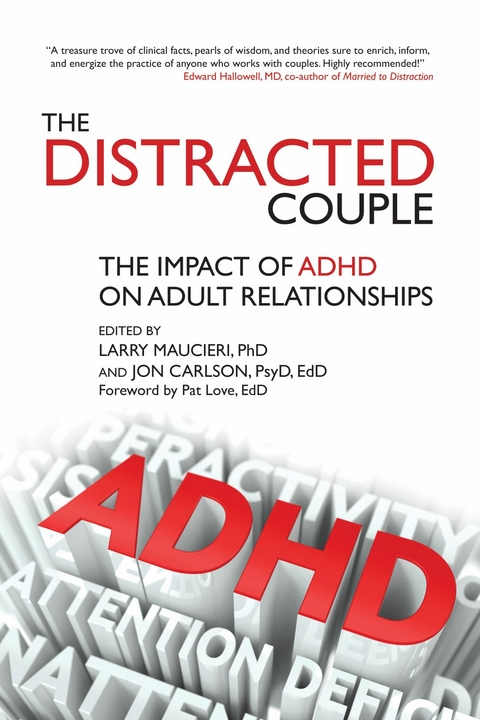
Distracted Couple (eBook)
368 Seiten
Crown House Publishing (Verlag)
978-1-84590-880-5 (ISBN)
In total, this volume addresses many of the issues that couples face when either one or both partners has ADHD and the many ways that clinicians can help them in dealing with these issues.Although historically the diagnosis and treatment of ADHD have focused on children, more recently clinicians and researchers have explored the impact of ADHD on adults. Few, however, have focused on the effects of adult ADHD on relationships and marriages, which makes this a must-read for all of those interested in and working with adults with ADHD.
Overview
This chapter describes relationships which include one ADHD partner and one non-ADHD partner, as this is the most common pairing therapists will encounter. Most of the concepts reviewed may be applied to dual ADHD couples, as one partner often functions similarly to a non-ADHD partner—taking on the role of “more organized partner” in a way that is similar to that of a non-ADHD partner.
Almost every couple’s therapist encounters clients with ADHD; however, often neither the client nor the therapist is aware of it. Current estimates suggest that over 11 million adults in the U.S. have ADHD (Barkley, Murphy, & Fischer, 2008), but this statistic hides the critical fact that about 90% of these adults are as of yet undiagnosed and therefore unaware of their condition (Weir, 2012). They frequently walk into a therapist’s office believing that poor communication skills, anger, their partner’s frustration, depression, or anxiety is the problem that needs addressing in therapy. While these presenting complaints often exist in ADHD-impacted relationships, therapists and couples who address those surface issues without attending to the underlying ADHD will significantly sub-optimize counseling. Until the ADHD is identified and adequately managed, the symptoms that were often the starting point for a large portion of the relationship’s dysfunction will continue, leading to continued difficulties.
The extent to which ADHD impacts adult relationships is made apparent in these statistics:
- As adults with ADHD age, their likelihood of divorce rises to almost double that of non-ADHD adults (Murphy & Barkley, 1996). Studies done with younger and older patients yielded information that divorce rates are higher among older couples affected by ADHD because repetitive, untreated ADHD symptoms damage relationships over time.
- Research suggests the rate of clinically diagnosable marital dysfunction for adults with ADHD is about 58%, or double that of the non-ADHD couples (Minde, Eakin, Hechtman, Ochs, Bouffard, & Greenfield, 2003).
One reason that therapists may diagnostically miss ADHD is that the condition has a significant list of common comorbidities. More than 80% of adults with ADHD will have one other diagnosable mental health issue during their lifetime (Barkley, Murphy & Fischer, 2008). Over 50% will experience two comorbid disorders, and one third will have three or more comorbid conditions (Barkley et al., 2008). The prevalence of these disorders varies by study, but Barkley et al. (2008) provides a reasonable overview of the range of estimated comorbid conditions with adult ADHD which, synopsized, includes the following:
- As many as 53% of adults with ADHD may experience depression at some point over their lifetime, with various studies showing 16—31% with major depressive disorder comorbid with ADHD at any particular time.
- 24–42% are estimated to suffer from anxiety.
- Oppositional Defiant Disorder (ODD) co-occurs in 24–35% of adults with ADHD.
- Conduct Disorder (CD) is comorbid with adults who have ADHD in an estimated 17–25% of individuals.
- It is estimated that 21–53% of adults with ADHD also present with substantial difficulties related to alcohol.
Compounding the complexity of comorbid syndromes and the general lack of awareness of the adult patient’s ADHD is that partners of adults with ADHD—and sometimes even their therapists—frequently misinterpret ADHD symptoms when they are unaware of the disorder. The misinterpretation of ADHD symptoms causes significant and unnecessary distress in the relationship, and it may be a reason why the divorce rate for these couples is so high.
A brief review of four examples of common misinterpretations involving adult ADHD are listed below to illustrate why a lack of knowledge about ADHD may be detrimental to committed relationships. These examples specifically involve one partner with ADHD and one without the disorder, or two partners with ADHD, in which one of them is significantly more impacted by the disorder than the other:
Example 1
Symptom: Distraction—whatever is in front of the ADHD partner grabs his/her attention.
Associated Characteristic Behavior: The patient pays attention to whatever is immediately in from of him/her, or happens to catch his/her eye with little discrimination as to what is important. This behavior results in the non-ADHD partner being on equal footing to all other potential distractions in the ADHD partner’s life. The non-ADHD partner is therefore paid very little attention to—essentially ignored—unless there is a compelling stimulus (e.g., yelling, anger, sexual activity) that makes him/her more prominent in the ADHD adult’s immediate attention.
Partner’s Misinterpretation: “My partner doesn’t pay attention to me; therefore he/she doesn’t love me.”
Partner’s Common Behavioral Response: Increase in intrusive behaviors to gain the attention of the ADHD partner, such as yelling, belittling, and tantrums.
Example 2
Symptom: Distraction—inability to sustain attention in the face of distracting external stimuli, particularly for things of little interest to him/her.
Associated Characteristic Behavior: The patient is able to sustain his/her focus on things that interest him/her, but not on things of lesser inherent interest or immediacy.
Partner’s Misinterpretation: “My partner is able to happily stay focused on the computer or hobby all day, but can’t pay attention to me or our mutual responsibilities for very long. I must not be important to my partner.”
Partner’s Common Behavioral Response: Feelings of anger and depression in the non-ADHD partner may lead to an increase in aggressive or intrusive behavior or, conversely, to disengagement and loss of hope.
Example 3
Symptom: Poor inhibition or poor working memory.
Associated Characteristic Behavior: The patient often interrupts his/her partner while the partner is speaking because the patient wishes to avoid forgetting the thought that he/she wishes to share.
Partner’s Misinterpretation: “My partner is rude to me and doesn’t respect me or what I have to say.”
Partner’s Common Behavioral Response: Interpretation of being ignored leads to anger and attempts to “teach” the partner with ADHD better manners, or engaging in fewer conversations with the partner with ADHD.
Example 4
Symptom: Difficulty organizing and completing tasks.
Associated Characteristic Behavior: The patient promises to do something, such as a household chore, but then often does not follow through on it.
Partner’s Misinterpretation: “My partner is not reliable or trustworthy.”
Partner’s Common Behavioral Response: The non-ADHD partner assumes the bulk of the family responsibilities, resulting in feelings of being overwhelmed and resentful. As this pattern continues, many non-ADHD partners assume a “parental” or controlling role in an effort to keep their household under control.
It is critical that both therapists and couples learn that ADHD symptoms are not an indication of lack of interest in either the relationship or partner, but simply ADHD symptoms that are as of yet untreated. Since much of the current literature suggests that ADHD is a biological condition (Ratey, 2001; Barkley, 2010), this knowledge makes the behaviors far more neutral than an interpretation that the partner is uncaring. Importantly, ADHD is one of the most treatable mental health conditions (Weir, 2012). This makes the news that ADHD underlies many of the couple’s struggles very powerful information. Finally, there is a rational explanation for them about what has been happening, and there is a way to change the future for the better through treatment of both the ADHD itself and changing the responses to the ADHD.
As a brief example, an effective therapeutic response to a non-ADHD partner’s complaint that she feels lonely and unloved because her husband never pays any attention to her would be to:
- Explain the context for the behavior (e.g., it is a behavior resulting from the ADHD symptom of “distraction” and not a reflection of his feelings).
- Create a longer-term treatment plan for this and other ADHD symptoms in the partner with the ADHD.
- Work with the non-ADHD (or other ADHD) partner to align responses to ADHD symptom behaviors with the new understanding of the situation, encouraging the non-ADHD partner to be patient and responsive to changes the ADHD partner is making.
- Create an immediate plan that allows more time for attention without other distractions, such as a date night, or committing to specific times of day when the couple might interact in a focused way.
- Start measuring progress against the goals set for steps 2, 3, and 4, adjusting the plans as necessary to make sure the...
| Erscheint lt. Verlag | 23.4.2014 |
|---|---|
| Verlagsort | London |
| Sprache | englisch |
| Themenwelt | Geisteswissenschaften ► Psychologie ► Allgemeine Psychologie |
| Medizin / Pharmazie ► Gesundheitsfachberufe | |
| Medizin / Pharmazie ► Medizinische Fachgebiete ► Psychiatrie / Psychotherapie | |
| ISBN-10 | 1-84590-880-5 / 1845908805 |
| ISBN-13 | 978-1-84590-880-5 / 9781845908805 |
| Informationen gemäß Produktsicherheitsverordnung (GPSR) | |
| Haben Sie eine Frage zum Produkt? |
 EPUB (Wasserzeichen)
DRM: Digitales Wasserzeichen
Dieses eBook enthält ein digitales Wasserzeichen und ist damit für Sie personalisiert. Bei einer missbräuchlichen Weitergabe des eBooks an Dritte ist eine Rückverfolgung an die Quelle möglich.
Dateiformat: EPUB (Electronic Publication)
EPUB ist ein offener Standard für eBooks und eignet sich besonders zur Darstellung von Belletristik und Sachbüchern. Der Fließtext wird dynamisch an die Display- und Schriftgröße angepasst. Auch für mobile Lesegeräte ist EPUB daher gut geeignet.
Systemvoraussetzungen:
PC/Mac: Mit einem PC oder Mac können Sie dieses eBook lesen. Sie benötigen dafür die kostenlose Software Adobe Digital Editions.
eReader: Dieses eBook kann mit (fast) allen eBook-Readern gelesen werden. Mit dem amazon-Kindle ist es aber nicht kompatibel.
Smartphone/Tablet: Egal ob Apple oder Android, dieses eBook können Sie lesen. Sie benötigen dafür eine kostenlose App.
Geräteliste und zusätzliche Hinweise
Buying eBooks from abroad
For tax law reasons we can sell eBooks just within Germany and Switzerland. Regrettably we cannot fulfill eBook-orders from other countries.
aus dem Bereich