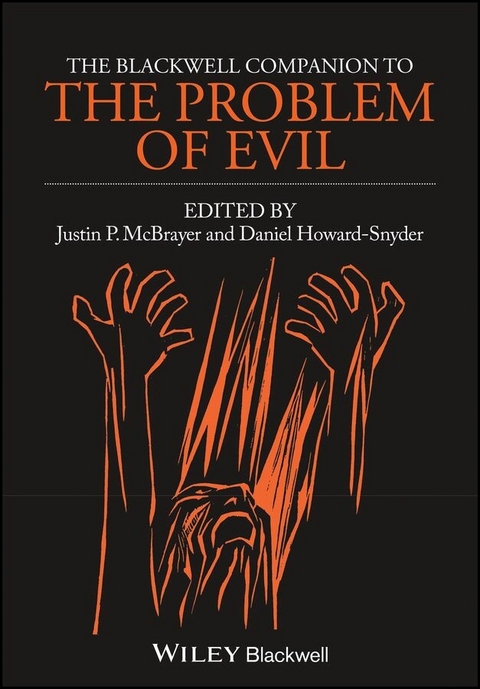
The Blackwell Companion to The Problem of Evil (eBook)
John Wiley & Sons (Verlag)
978-1-118-60797-8 (ISBN)
The Blackwell Companion to the Problem of Evil presents a collection of original essays providing both overview and insight, clarifying and evaluating the philosophical and theological 'problem of evil' in its various contexts and manifestations.
- Features all original essays that explore the various forms of the problems of evil, offering theistic responses that attempt to explain evil as well as discussion of the challenges facing such explanations
- Includes section introductions with a historical essay that traces the developments of the issues explored
- Acknowledges the fact that there are many problems of evil, some of which apply only to those who believe in concepts such as hell and some of which apply to non-theists
- Represents views from the various religious traditions, including Hindu, Jewish, Christian, and Muslim
Justin P. McBrayer is Assistant Professor of Philosophy at Fort Lewis College, Colorado. He has authored numerous papers in philosophy of religion and ethics, including 'CORNEA and Inductive Skepticism' (2009), 'Skeptical Theism' (2010), 'A Limited Defense of Moral Perception' (2010), 'Skepticism about the Argument from Divine Hiddenness' (2011), and 'Christianity, Homosexual Sex, and Sexism' (2012).
Daniel Howard-Snyder is Professor of Philosophy at Western Washington University. He is co-author of The Power of Logic (2013, 5th Ed.), and editor or co-editor of various publications including The Evidential Argument from Evil (1996), Faith, Freedom, and Rationality (1996), and Divine Hiddenness: New Essays (2002).
The Blackwell Companion to the Problem of Evil presents a collection of original essays providing both overview and insight, clarifying and evaluating the philosophical and theological problem of evil in its various contexts and manifestations. Features all original essays that explore the various forms of the problems of evil, offering theistic responses that attempt to explain evil as well as discussion of the challenges facing such explanations Includes section introductions with a historical essay that traces the developments of the issues explored Acknowledges the fact that there are many problems of evil, some of which apply only to those who believe in concepts such as hell and some of which apply to non-theists Represents views from the various religious traditions, including Hindu, Jewish, Christian, and Muslim
Justin P. McBrayer is Assistant Professor of Philosophy at Fort Lewis College, Colorado. He has authored numerous papers in philosophy of religion and ethics, including "CORNEA and Inductive Skepticism" (2009), "Skeptical Theism" (2010), "A Limited Defense of Moral Perception" (2010), "Skepticism about the Argument from Divine Hiddenness" (2011), and "Christianity, Homosexual Sex, and Sexism" (2012). Daniel Howard-Snyder is Professor of Philosophy at Western Washington University. He is co-author of The Power of Logic (2013, 5th Ed.), and editor or co-editor of various publications including The Evidential Argument from Evil (1996), Faith, Freedom, and Rationality (1996), and Divine Hiddenness: New Essays (2002).
Notes on contributors ix
Preface xi
Acknowledgments xiv
Part I Problems of Evil 1
1 A brief history of problems of evil 3
Michael W. Hickson
2 The logical problem of evil: mackie and plantinga 19
Daniel Howard-Snyder
3 A new logical problem of evil 34
J.L. Schellenberg
4 Rowe's evidential arguments from evil 49
Graham Oppy
5 Explanation and the problem of evil 67
Paul Draper and Trent Dougherty
6 A carnapian argument from evil 83
Richard Otte
7 The experience of evil and support for atheism 98
Jerome Gellman
8 The problem of animal pain and suffering 113
Robert Francescotti
9 Hell and the problem of evil 128
Andrei A. Buckareff and Allen Plug
10 The problem of apparently morally abhorrent divine commands
144
Wesley Morriston
11 God because of evil: An ad hominem argument from evil
for belief in God 160
Marilyn McCord Adams
Part II Theodicies 175
12 A brief history of theodicy 177
René van Woudenberg
13 Counterpart and appreciation theodicies 192
Justin P. McBrayer
14 Free will and soul-making theodicies 205
Daniel Speak
15 The connection-building theodicy 222
Robin Collins
16 Best possible world theodicy 236
Hud Hudson
17 Providence and theodicy 251
Thomas P. Flint
18 A christian theodicy 266
Laura W. Ekstrom
19 Toward an Indian theodicy 281
Purushottama Bilimoria
20 Earth's epistemic fruits for harmony with God: an
Islamic theodicy 296
Mohammad Ali Mobini
21 On constructing a Jewish theodicy 309
David Shatz
22 Feminism and the problem of evil 326
Beverley Clack
23 Process theism and theodicies for problems of evil 340
James A. Keller
24 Theodicy in a vale of tears 349
Evan Fales
25 Antitheodicy 363
N.N. Trakakis
Part III Skeptical Responses 377
26 A brief history of skeptical responses to evil 379
T.M. Rudavsky
27 Peter van Inwagen's defense 396
Meghan Sullivan
28 A defense without free will 411
Derk Pereboom
29 Skeptical theism, CORNEA, and common sense epistemology
426
Thomas D. Senor
30 The moral skepticism objection to skeptical theism 444
Stephen Maitzen
31 The global skepticism objection to skeptical theism 458
Ian Wilks
32 Theistic objections to skeptical theism 468
David O'Connor
33 Skeptical theism and the "too much skepticism"
objection 482
Michael C. Rea
Index 507
"This volume is an outstanding and comprehensive
collection of essays of high quality on aspects of one of the
greatest problems in intellectual history: The Problem of
Evil. The editors have covered the usual territory well, and
they have also included essays that broaden the scope of the book
considerably. Highly recommended."
--John Martin Fischer, University of California,
Riverside
"An impressive list of contributors, writing from a variety of
perspectives. The volume nicely summarizes the history of the field
and advances the discussion with some superb, groundbreaking
work."
--Thomas M. Crisp, Biola University
"The editors, Justin McBrayer and Daniel Howard-Snyder,
are to be congratulated on this stimulating, balanced and
comprehensive collection. It is a first-rate resource both for
students and for researchers."
--Peter Forrest, University of New England
"This splendid collection of essays both represents important
recent developments and breaks new ground. Theologians as well as
philosophers will appreciate this resource for what it is: the best
one available."
--Thomas H. McCall, Trinity Evangelical Divinity School
1
A Brief History of Problems of Evil
Michael W. Hickson
Introduction
If we understand “evil” broadly, as most contemporary philosophers do, to mean “all bad things” – for example, physical and mental suffering, intentional wrongdoing, error, and poverty – then it goes without saying that every Western philosopher and religious thinker has found evil problematic and has attempted, at least partially, to explain its origin and the means of overcoming or escaping it. To give an exhaustive survey of problems of evil in the West, therefore, would amount to writing a fairly complete history of 2500 years of philosophy and religion.
In what follows, therefore, I do not attempt to offer such a complete history, but rather to present several important moments of it in an attempt to track the emergence of what philosophers today call “the problem of evil.” In contemporary parlance, “the problem of evil,” despite the definite article, denotes a family of challenges to belief in a God who is supremely benevolent and powerful (van Inwagen 2006, 4–10): how can belief in such a God be justified given the vast extent and often horrendous nature of the suffering and moral depravity of human beings?
This family of problems, depending on logical presentation and authorial intent, can be considered either aporetically or atheologically (Adams and Adams 1990, 2–3). In the former case, the problems are presented as challenging human reason to think more deeply about the nature of God and his causal relation to the world (see Chapters 9 and 10). In the latter case, the problems are presented such that evil is explicitly offered as strong evidence against the very existence of God (see Chapters 4 and 5). Such atheological arguments, which are the primary focus of contemporary philosophers, have lately been referred to as “arguments from evil” in order to distinguish them from broader problems of evil that do not explicitly threaten belief in God's existence (Howard-Snyder 1996, xi–xvi). The goal of this chapter is to trace the historical origin of arguments from evil. The question I wish to answer is this: has the existence of evil always been treated by philosophers as a challenge to God's existence, or is this a more recent trend in thinking about evil?
Since authorial intent is very difficult to determine with any confidence, I focus on the presentation of the problems of evil that have been treated over the centuries, and ask whether the authors in question link evil to the denial of God's existence. The problems of evil that must be considered are those in which evil is used as the basis of an objection to an account of the origin of the universe according to which some God is the principal cause. In considering such problems, I return to the same question: is evil being used to discredit belief in the existence of God, or is evil being opposed to some other element of the causal theory?
Another Footnote to Plato
Western philosophical reflection on the problem of evil is, not surprisingly, another footnote to Plato (429–347 BC). But a footnote to which dialogue or dialogues? A single passage in the Republic has been identified as “the first distinct statement in Greek literature of the problem of evil” (Chase Greene 1944, 298): “since a god is good, he is not – as most people claim – the cause of everything that happens to human beings but of only a few things, for good things are fewer than bad ones in our lives. He alone is responsible for the good things, but we must find some other cause for the bad ones, not a god” (Plato [1018] 1997; 379c).
The problem of evil is certainly lurking in the background of this passage, where the concern is to avoid charging the gods with any involvement in evil. However, this text does not yet explicitly state or engage any problem of evil; rather, the text sets up an elegant evasion of all such problems, an evasion that will be elaborated in the sequel to the Republic, the dramatic cosmological story of the Timaeus. In both dialogues, Plato advances a dualistic account of the origin of the universe. There is not a single, supremely powerful, and perfectly good original cause that is responsible for all that exists, and that must therefore be justified in the face of so much evil in the world; instead, Plato conveniently places all the blame for evil on a second eternal cause, which can be “persuaded” by the power of the good cause only to a limited extent.
In the Timaeus, the two original causes of the universe are named “Mind” and “Necessity.” Mind acts on Necessity (by which Plato means the eternal disorderly motion of an unformed mass) “persuading it to direct most of the things that come to be toward what is best” (Plato [1250] 1997; 48a). The Demiurge, the anthropomorphic representation of Mind in the dialogue, first created because “He was good, and one who is good can never become jealous of anything. And so, being free of jealousy, he wanted everything to become as much like himself as was possible” (Plato [1236] 1997; 29e). In so far as the universe was created by the Demiurge, therefore, it is “as excellent and supreme as its nature would allow” (Plato [1236] 1997; 30b). But the Demiurge, though powerful, is not omnipotent, so disease1 and vice, both of which arise from the eternal and corruptive disorderly motion of matter, still exist. Even moral evil is blamed in Plato's Timaeus on Necessity: “[J]ust about every type of succumbing to pleasure is talked about as something reproachable, as though the evils are willfully done. But it is not right to reproach people for them, for no one is willfully evil. A man becomes evil, rather, as a result of one or another corrupt condition of his body and an uneducated upbringing” (Plato [1286] 1997; 86d–e).
Evil is not presented in the Timaeus as a possible threat to belief in the Demiurge. Nor is the Demiurge's goodness or activity in the world ever doubted on the basis of evil: “the existence of evil is not of the Demiurge's choosing; it exists in spite of the best demiurgic actions” (Mohr 1978, 575). Plato's Timaeus is certainly not, therefore, the first text to raise an argument from evil.
There are at least two separate statements of problems of evil, however, in the later Laws, in the theological 10th book of that dialogue. The origin and extent of evil becomes undeniably problematic for Plato in this work because his earlier dualism is largely set aside in this new account of the governance of the universe, summarized in this passage: “A soul or souls – and perfectly virtuous souls at that – have been shown to be the cause of all [celestial] phenomena, and whether it is by their living presence in matter that they direct all the heavens, or by some other means, we shall insist that these souls are gods” (Plato [1556] 1997; 899b). Whereas in the Timaeus, disorderly matter was coeternal with and independent of the benevolent Demiurge, in Laws X “soul is prior to matter, and … matter came later and takes second place. Soul is the master, and matter its natural subject” (Plato [1553] 1997; 896c).
The dualistic dissolution of the problem of evil still tempts Plato in Laws X, however, where an evil World Soul is posited in addition to the good World Soul: “[Is there] one soul, or more than one? I'll answer for you both: more than one. At any rate, we must not assume fewer than two: that which does good, and that which has the opposite capacity” (Plato [1553] 1997; 896e). This dualism is not exploited by Plato, however, for he believes the whole rational order of the universe points to the predominant activity of the good World Souls, who are described as “supremely good” gods who “know and see and hear everything”; who “can do anything which is within the power of mortals and immortals”; who are “supremely wise, and willing and able to superintend the world”; and who, like a good physician, look after the whole body, but also after every minor detail of it in order to keep it healthy (Plato [1558–1560] 1997; 901d–903a). Goodness is effectively unlimited and omnipotent in Laws X.
Given the supremacy of the virtuous gods in Laws X, it is unsurprising that Plato was forced to raise explicit problems of evil against this causal theory. The first he puts into the mouths of people who believe that the gods exist, but who claim that they take no notice of human affairs. In other words, the presence of evil is used as a reason to deny divine Providence. The particular evils that drive people to such “impiety” are “the good fortune of scoundrels and criminals in private and public life” and “the many ghastly acts of impiety which … are the very means by which some of these people have risen from humble beginnings to supreme power and dictatorship” (Plato [1556–1557] 1997; 899d–900a). When the problem of evil first explicitly enters Western thought, therefore, it has anti-Providential, not fully atheistic, force.
The second problem of evil in the Laws likewise challenges...
| Erscheint lt. Verlag | 14.1.2014 |
|---|---|
| Sprache | englisch |
| Themenwelt | Geisteswissenschaften ► Philosophie ► Allgemeines / Lexika |
| Geisteswissenschaften ► Philosophie ► Ethik | |
| Geisteswissenschaften ► Philosophie ► Metaphysik / Ontologie | |
| Geisteswissenschaften ► Religion / Theologie | |
| Schlagworte | apparent existence • arise • Blackwell • Central • Collection • Companion • contain • contributed • Deal • Essays • Evil • evilsome • follows • God • Good • Great • much evil • Original • perfectly • Philosophie • Philosophy • Philosophy of Religion • Powerful • Problem • Problems • Range • Religionsphilosophie • scholars • wide • World |
| ISBN-10 | 1-118-60797-X / 111860797X |
| ISBN-13 | 978-1-118-60797-8 / 9781118607978 |
| Informationen gemäß Produktsicherheitsverordnung (GPSR) | |
| Haben Sie eine Frage zum Produkt? |
 PDF (Adobe DRM)
Größe: 4,4 MB
Kopierschutz: Adobe-DRM
Adobe-DRM ist ein Kopierschutz, der das eBook vor Mißbrauch schützen soll. Dabei wird das eBook bereits beim Download auf Ihre persönliche Adobe-ID autorisiert. Lesen können Sie das eBook dann nur auf den Geräten, welche ebenfalls auf Ihre Adobe-ID registriert sind.
Details zum Adobe-DRM
Dateiformat: PDF (Portable Document Format)
Mit einem festen Seitenlayout eignet sich die PDF besonders für Fachbücher mit Spalten, Tabellen und Abbildungen. Eine PDF kann auf fast allen Geräten angezeigt werden, ist aber für kleine Displays (Smartphone, eReader) nur eingeschränkt geeignet.
Systemvoraussetzungen:
PC/Mac: Mit einem PC oder Mac können Sie dieses eBook lesen. Sie benötigen eine
eReader: Dieses eBook kann mit (fast) allen eBook-Readern gelesen werden. Mit dem amazon-Kindle ist es aber nicht kompatibel.
Smartphone/Tablet: Egal ob Apple oder Android, dieses eBook können Sie lesen. Sie benötigen eine
Geräteliste und zusätzliche Hinweise
Zusätzliches Feature: Online Lesen
Dieses eBook können Sie zusätzlich zum Download auch online im Webbrowser lesen.
Buying eBooks from abroad
For tax law reasons we can sell eBooks just within Germany and Switzerland. Regrettably we cannot fulfill eBook-orders from other countries.
 EPUB (Adobe DRM)
Kopierschutz: Adobe-DRM
Adobe-DRM ist ein Kopierschutz, der das eBook vor Mißbrauch schützen soll. Dabei wird das eBook bereits beim Download auf Ihre persönliche Adobe-ID autorisiert. Lesen können Sie das eBook dann nur auf den Geräten, welche ebenfalls auf Ihre Adobe-ID registriert sind.
Details zum Adobe-DRM
Dateiformat: EPUB (Electronic Publication)
EPUB ist ein offener Standard für eBooks und eignet sich besonders zur Darstellung von Belletristik und Sachbüchern. Der Fließtext wird dynamisch an die Display- und Schriftgröße angepasst. Auch für mobile Lesegeräte ist EPUB daher gut geeignet.
Systemvoraussetzungen:
PC/Mac: Mit einem PC oder Mac können Sie dieses eBook lesen. Sie benötigen eine
eReader: Dieses eBook kann mit (fast) allen eBook-Readern gelesen werden. Mit dem amazon-Kindle ist es aber nicht kompatibel.
Smartphone/Tablet: Egal ob Apple oder Android, dieses eBook können Sie lesen. Sie benötigen eine
Geräteliste und zusätzliche Hinweise
Buying eBooks from abroad
For tax law reasons we can sell eBooks just within Germany and Switzerland. Regrettably we cannot fulfill eBook-orders from other countries.
aus dem Bereich