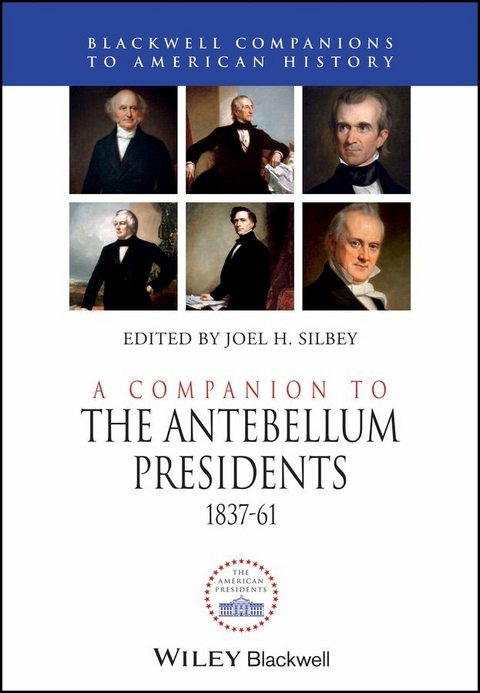
A Companion to the Antebellum Presidents presents a series of original essays exploring our historical understanding of the role and legacy of the eight U.S. presidents who served in the significant period between 1837 and the start of the Civil War in 1861.
- Explores and evaluates the evolving scholarly reception of Presidents Van Buren, Harrison, Tyler, Polk, Taylor, Fillmore, Pierce, and Buchanan, including their roles, behaviors, triumphs, and failures
- Represents the first single-volume reference to gather together the historiographic literature on the Antebellum Presidents
- Brings together original contributions from a team of eminent historians and experts on the American presidency
- Reveals insights into presidential leadership in the quarter century leading up to the American Civil War
- Offers fresh perspectives into the largely forgotten men who served during one of the most decisive quarter centuries of United States history
Joel H. Silbey is Professor of History Emeritus at Cornell University. His books include Martin Van Buren and the Emergence of American Popular Politics (2002), Storm over Texas: The Annexation Controversy and the Road to Civil War (2005), and Party Over Section: The Election of 1848 (2009).
Joel H. Silbey is Professor of History Emeritus at Cornell University. His books include Martin Van Buren and the Emergence of American Popular Politics (2002), Storm over Texas: The Annexation Controversy and the Road to Civil War (2005), and Party Over Section: The Election of 1848 (2009).
Notes on Contributors vii
Introduction 1
Joel H. Silbey
Part I General Themes 5
1. The Political World of the Antebellum Presidents 7
Joel H. Silbey
2. The Expansionist Impulse in Antebellum America 43
Michael A. Morrison
3. The Rise of Sectional Tensions: Parties, Slavery, and
Abolitionism 65
Nicole Etcheson
4. The Antebellum Presidents and Foreign Policy 89
Jay Sexton
Part II The Presidents 107
5. Martin Van Buren as Party Leader and at Andrew
Jackson's Right Hand 109
M. Philip Lucas
6. Van Buren and the Economic Collapse of the Late 1830s
131
Jonathan M. Atkins
7. "Tippecanoe and Tyler Too": William Henry
Harrison and the Rise of Popular Politics 155
William G. Shade
8. President John Tyler, Henry Clay, and the Whig Party
173
Edward P. Crapol
9. James K. Polk and the Democratic Party 195
M. J. Heale
10. Polk in Office: Domestic Politics and Policies 221
Paul H. Bergeron
11. Polk as a War President 245
John C. Pinheiro
12. Polk as a Southern Sectionalist 269
Michael Todd Landis
13. Zachary Taylor in Office: Clay, the Whig Party, and the
Sectional Crisis 291
Michael J. Birkner
14. Millard Fillmore, Whig Politician and Leader of His Party
309
Damon R. Eubank
15. President Fillmore and the Taming of Sectional Tensions
327
Elizabeth R. Varon
16. Franklin Pierce, Democratic Partisan 345
Yonatan Eyal
17. Franklin Pierce, the Kansas-Nebraska Bill, and the Political
Transformation of the Mid-1850s 367
John F. Kirn, Jr.
18. James Buchanan: The Early Political Life of the Old Public
Functionary 397
Jean H. Baker
19. James Buchanan, the Slavocracy, and the Disruption of the
Democratic Party 421
James L. Huston
20. James Buchanan and the Secession Crisis 447
John Ashworth
Index 465
"Provocative and modestly revisionist, this enlightening collection should be the first-choice volume for anyone interested in the political historiography of the antebellum presidents." (Presidential Studies Quarterly, 28 July 2015)
"Offers fresh perspectives into the largely forgotten men who served during one of the most decisive quarter centuries of United States history." (Expofairs.com, 17 December 2014)
INTRODUCTION
Joel H. Silbey
Each of the eight presidents of the United States who served between 1837 and 1861 held office only a short time: two died quite early in their term, one lost his reelection bid, and four were not renominated for a second term, one, James K. Polk, by his own choice, the others because too many of their erstwhile but now disappointed supporters decided to look elsewhere. These presidents were ordinary men, neither charismatic, nor larger than life, as many of their predecessors (Washington, Jefferson, and Jackson, for example) had been. Seven had come up through the political party system as it developed and took command of the American landscape. They had internalized its values and assumptions and were, as well, seasoned politicians and officeholders within the system. Five – Martin Van Buren, William Henry Harrison, John Tyler, Franklin Pierce, and James Buchanan – had served in the Senate, Polk had been the Speaker of the House of Representatives, Millard Fillmore had been an important Whig Party leader there, and Buchanan, Harrison, Franklin Pierce, and John Tyler served there as well. Van Buren and Buchanan had each been secretary of state, Polk governor of Tennessee. Van Buren and Tyler had also been state governors, Harrison the governor of Indiana Territory. Harrison and the other Whig president, Zachary Taylor, had made their reputation as successful generals while leading their armies in wars against native Americans and Mexicans. (Pierce had also commanded troops in the Mexican–American War.) Finally, Van Buren was acknowledged to be the most accomplished party builder and party manager of his day.
Once in office, whatever the extent of their previous experience in politics and government, none proved to be in the estimation of later scholars particularly distinguished or adept at their tasks during their tenures – only one, Polk, has appeared toward the top of historians’ list of great presidents (and his reputation has gone up and down) (Schlesinger, Sr. 1948; Schlesinger, Jr. 1997; Murray and Blessing 1994). The general public has had an even worse view of these leaders – all eight are at the bottom of its evaluation of all those who have held the office. Nevertheless, each of these presidents, whether strong or weak, was the chief executive of, and led, a nation that was undergoing massive and challenging territorial and population growth as it grew into a continental power. They were confronted by often chaotic economic and social changes and severe economic downturns as well as a range of foreign policy crises, the war against Mexico, and, most of all, the revival and growth of intense sectional tension that threatened to split the Union, all challenges, changes, and threats which would ultimately lead to the weakening of the consensus that had held the Union together.
The presidents faced much and were called upon to do much, defining, planning, convincing, cajoling, ordering, making often difficult choices for appointments to federal offices, working with Congress on legislation and other matters, dealing with and leading the cabinet, strategizing with party leaders, thinking about the federal court system, particularly the Supreme Court, trying to influence their members, and, often, negotiating with state governors as well. As they sat at the top of the nation’s executive branch none were uninvolved as they approached their responsibilities. All were serious men imbued with their party’s policy commitments and desirous of achieving its programmatic vision despite occasional disagreements. Each of them called on their political and leadership skills to deal with internal party factionalism, seemingly intractable issues, and, in the last decade before the Civil War, a political culture degenerating into dangerous sectional polarization. Bringing different degrees of vigor to the tasks before them some did passably well, others much less so. But what they did contributed, along with their administration colleagues, in some fashion to shape the way in which the United States developed in a most decisive quarter century of its history.
Whatever their low evaluation may have been, these presidents have not been ignored by later generations. The era and its presidents have always been of intense interest, bookended as these years were by the excitement of the Jacksonian age on one end and the coming of the Civil War on the other. Scholars have extensively explored the political history of their times, expending an enormous amount of energy establishing a framework for understanding the era in which the presidents operated. They have closely detailed and analyzed the events and direction of the growing nation, with much more published each year to be, in turn, digested and integrated into our understanding. General narratives covering the whole era after 1837 or significant portions of it such as Daniel Walker Howe’s impressive study of American society, thought, and politics in the early years of the period, Harry Watson’s fine analysis of the politics of the age, and David Potter’s magisterial exploration of the unfolding of the sectional crisis of the 1850s, as well as monographs focusing on particular episodes, a legislative confrontation or a skirmish over foreign policy, or the politics of the economic collapse of 1857 (Howe 2007; Potter 1976; Watson 1990/2006). Studies of both of the main political parties and their third party challengers abound as well. Finally, there are also analyses of the nature of the persistent political argument that underscored all that was occurring as well as the assumptions that lay behind the nation’s political discourse.
In all of these matters the presidents, good and bad, played important roles and are recognized as having done so. Historians have had a great deal to say about them, their function as each conceived it, and their actions. Each president has at least one study of his administration published over the last generation, most of the presidents have received recent biographic treatment as well – some more than one. There are also recent studies of several of the elections that brought them to office. All of this adds up to a daunting amount of information and analyses about a complex and compelling era and its leaders.
The basic outline of what happened between 1837 and 1861 is clear cut in the historiography as the partisan political system took hold and settled in, to be then challenged by the rise of America’s territorial expansion as a major and most divisive issue and the sectionalizing of politics that followed. But, whatever the general scholarly agreement about the era, many aspects of those years remain, not surprisingly, in dispute or not as yet settled to everyone’s satisfaction. In all that has been written, scholars have not always agreed, with subsequent investigators updating and revising what earlier scholars have written as historical currents inevitably change when new evidence, themes, and approaches become part of the narrative, and as new perspectives and interpretative frameworks develop. That is certainly the case in the many accounts about the antebellum presidents.
This volume, like others in the Companion series, focuses largely on recent scholarship to discuss the ongoing debates among historians that have challenged, changed, or deepened our understanding. Most importantly, it is our intention in this collection of essays to bring some clarity and understanding about them out of the sea of books and articles that have appeared in the past several decades, establishing what can be said as to where historians now stand as they view this portion of our past, their areas of agreement, and the nature of the differences among them, that is, what we do know and what we do not, and what remains to be understood. Sixteen of the essays are divided among each relevant presidential administration, discussing the problems the chief executive faced, how each dealt with them, and how historians subsequently assessed what they tried to do. They are preceded by four essays of general orientation, setting out the larger elements that filled the political landscape in which the presidents acted. The authors, each a specialist in the area covered, seek to trace out the pathways of recent scholarship, delineating the general themes of the era, the critical problems faced by each holder of the office, the explanations offered, and the syntheses that define the existing scholarly narrative and guide current scholarship.
The volume is aimed at a general audience as well as at scholars and students who wish to learn more about the era, inviting them to share in the understandings that have been reached about these leaders and in the recent and continuing debates that have deepened and complicated what we know and how we explain the events of this compelling and critical era and its national leaders.
REFERENCES
Howe, Daniel Walker. 2007. “What Hath God Wrought”: The Transformation of America, 1815–1848. New York: Oxford University Press.
Murray, Robert K. and Timothy Blessing. 1994. Greatness in the White House: Rating the Presidents from Washington through Reagan. University Park, PA: Penn State University Press.
Potter, David M. 1976. The Impending Crisis, 1846–1861. Completed and edited by Don E. Fehrenbacher. New York: Harper Perennial.
Schlesinger, Arthur M., Sr. 1948. “Historians Rate The U.S. Presidents,” Life Magazine, November 1, 65ff.
Schlesinger, Arthur M., Jr. 1997. “Ranking the Presidents From Washington to Clinton,” Political Science Quarterly 112: 179–190.
Watson,...
| Erscheint lt. Verlag | 6.1.2014 |
|---|---|
| Reihe/Serie | Blackwell Companions to American History |
| Blackwell Companions to American History | Wiley Blackwell Companions to American History |
| Sprache | englisch |
| Themenwelt | Geschichte ► Allgemeine Geschichte ► Neuzeit (bis 1918) |
| Geisteswissenschaften ► Geschichte ► Regional- / Ländergeschichte | |
| Schlagworte | American Politics • American presidents, Van Buren, Harrison, Tyler, Polk, Taylor, Fillmore, Pierce, Buchanan, Civil War causes, sectional turmoil, secession, historiography, presidential companions, abolition, slavery, market revolution, Union • American Social & Cultural History • American Social & Cultural History • Geschichte • History • Political Science • Politik / Amerika • Politikwissenschaft • Regional American History • Regionalgeschichte Amerikas • Sozial- u. Kulturgeschichte Amerikas • USA /Geschichte |
| ISBN-13 | 9781118609293 / 9781118609293 |
| Informationen gemäß Produktsicherheitsverordnung (GPSR) | |
| Haben Sie eine Frage zum Produkt? |
 EPUB (Adobe DRM)
Kopierschutz: Adobe-DRM
Adobe-DRM ist ein Kopierschutz, der das eBook vor Mißbrauch schützen soll. Dabei wird das eBook bereits beim Download auf Ihre persönliche Adobe-ID autorisiert. Lesen können Sie das eBook dann nur auf den Geräten, welche ebenfalls auf Ihre Adobe-ID registriert sind.
Details zum Adobe-DRM
Dateiformat: EPUB (Electronic Publication)
EPUB ist ein offener Standard für eBooks und eignet sich besonders zur Darstellung von Belletristik und Sachbüchern. Der Fließtext wird dynamisch an die Display- und Schriftgröße angepasst. Auch für mobile Lesegeräte ist EPUB daher gut geeignet.
Systemvoraussetzungen:
PC/Mac: Mit einem PC oder Mac können Sie dieses eBook lesen. Sie benötigen eine
eReader: Dieses eBook kann mit (fast) allen eBook-Readern gelesen werden. Mit dem amazon-Kindle ist es aber nicht kompatibel.
Smartphone/Tablet: Egal ob Apple oder Android, dieses eBook können Sie lesen. Sie benötigen eine
Geräteliste und zusätzliche Hinweise
Buying eBooks from abroad
For tax law reasons we can sell eBooks just within Germany and Switzerland. Regrettably we cannot fulfill eBook-orders from other countries.
aus dem Bereich