


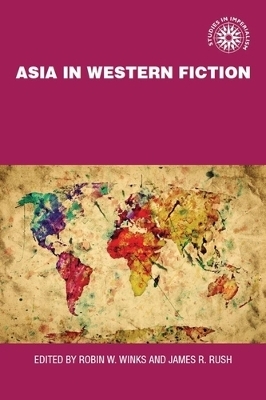
Asia in Western Fiction
Seiten
1990
Manchester University Press (Verlag)
978-0-7190-2906-6 (ISBN)
Manchester University Press (Verlag)
978-0-7190-2906-6 (ISBN)
- Titel ist leider vergriffen;
keine Neuauflage - Artikel merken
Tracing the depiction of Asia in novels and other works of Western fiction, this volume describes and analyzes the common themes, stereotypes and cliches that have contributed to Western understanding, and misunderstanding, of Asian life.
Any reader who has ever visited Asia knows that the great bulk of Western-language fiction about Asian cultures turns on stereotypes. This book, a collection of essays, explores the problem of entering Asian societies through Western fiction, since this is the major port of entry for most school children, university students and most adults. In the thirteenth century, serious attempts were made to understand Asian literature for its own sake. Hau Kioou Choaan, a typical Chinese novel, was quite different from the wild and magical pseudo-Oriental tales. European perceptions of the Muslim world are centuries old, originating in medieval Christendom's encounter with Islam in the age of the Crusades. There is explicit and sustained criticism of medieval mores and values in Scott's novels set in the Middle Ages, and this is to be true of much English-language historical fiction of the nineteenth and early twentieth centuries. Even mediocre novels take on momentary importance because of the pervasive power of India. The awesome, remote and inaccessible Himalayas inevitably became for Western writers an idealised setting for novels of magic, romance and high adventure, and for travellers' tales that read like fiction. Chinese fictions flourish in many guises. Most contemporary Hong Kong fiction reinforced corrupt mandarins, barbaric punishments and heathens. Of the novels about Japan published after 1945, two may serve to frame a discussion of Japanese behaviour as it could be observed (or imagined) by prisoners of war: Black Fountains and Three Bamboos. -- .
Any reader who has ever visited Asia knows that the great bulk of Western-language fiction about Asian cultures turns on stereotypes. This book, a collection of essays, explores the problem of entering Asian societies through Western fiction, since this is the major port of entry for most school children, university students and most adults. In the thirteenth century, serious attempts were made to understand Asian literature for its own sake. Hau Kioou Choaan, a typical Chinese novel, was quite different from the wild and magical pseudo-Oriental tales. European perceptions of the Muslim world are centuries old, originating in medieval Christendom's encounter with Islam in the age of the Crusades. There is explicit and sustained criticism of medieval mores and values in Scott's novels set in the Middle Ages, and this is to be true of much English-language historical fiction of the nineteenth and early twentieth centuries. Even mediocre novels take on momentary importance because of the pervasive power of India. The awesome, remote and inaccessible Himalayas inevitably became for Western writers an idealised setting for novels of magic, romance and high adventure, and for travellers' tales that read like fiction. Chinese fictions flourish in many guises. Most contemporary Hong Kong fiction reinforced corrupt mandarins, barbaric punishments and heathens. Of the novels about Japan published after 1945, two may serve to frame a discussion of Japanese behaviour as it could be observed (or imagined) by prisoners of war: Black Fountains and Three Bamboos. -- .
| Erscheint lt. Verlag | 8.3.1990 |
|---|---|
| Reihe/Serie | Studies in Imperialism |
| Zusatzinfo | illustrations |
| Verlagsort | Manchester |
| Sprache | englisch |
| Themenwelt | Geisteswissenschaften ► Sprach- / Literaturwissenschaft ► Anglistik / Amerikanistik |
| Geisteswissenschaften ► Sprach- / Literaturwissenschaft ► Literaturwissenschaft | |
| ISBN-10 | 0-7190-2906-6 / 0719029066 |
| ISBN-13 | 978-0-7190-2906-6 / 9780719029066 |
| Zustand | Neuware |
| Informationen gemäß Produktsicherheitsverordnung (GPSR) | |
| Haben Sie eine Frage zum Produkt? |
Mehr entdecken
aus dem Bereich


aus dem Bereich
Poetik eines sozialen Urteils
Buch | Hardcover (2023)
De Gruyter (Verlag)
CHF 83,90


