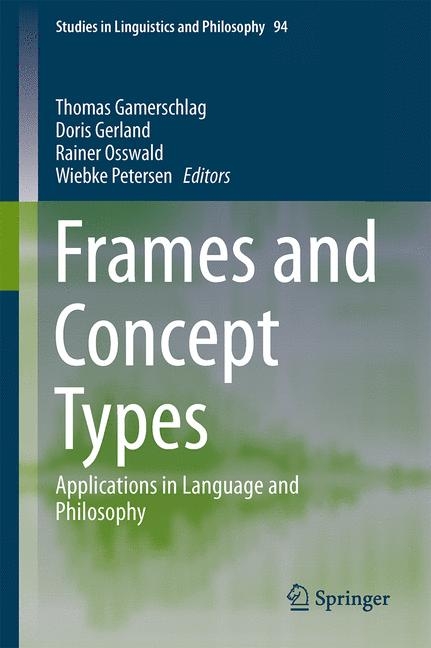
Frames and Concept Types (eBook)
X, 362 Seiten
Springer International Publishing (Verlag)
978-3-319-01541-5 (ISBN)
This volume showcases the potential richness of frame representations. The presentation includes introductory articles on the application of frames to linguistics and philosophy of science, offering readers the tools to conduct the interdisciplinary investigation of concepts that frames allow.
* Introductory articles on the application of frames to linguistics and philosophy of science
* Frame analysis of changes in scientific concepts
* Event frames and lexical decomposition
* Properties, frame attributes and adjectives
* Frames in concept composition
* Nominal concept types and determination?
'This volume deals with frame representations and their relations to concept types in linguistics and philosophy of science. It aims at reviving concepts and frames as a common model across disciplines for representing semantic and conceptual knowledge. Departing from the general assumption that frames are not just an arbitrary format of representation but essential to human cognition, a number of case studies apply frames as an analytical tool to a wide range of phenomena, from changes in scientific concepts to particular linguistic phenomena. This provides new insights into long-standing semantic issues, such as the lexical representation of verbs (as predicative frames specifying particular event descriptions or situation types and their participants), adjectives and nominals (as concept frames, which provide attributes and properties of an entity), as well as modification, complementation, possessive constructions, compounding, nominal concept types, determination, or definiteness marking.' Bert Gehrke, Pompeu, Fabra University, Barcelona, Spain
A. Introduction to Frames and Concept Types. 1. General Introduction by Thomas Gamerschlag, Doris Gerland, Rainer Osswald & Wiebke Petersen. 2. Evidence for Frames from Human Language by Sebastian Löbner. 3. From Features via Frames to Spaces: Modeling Scientific Conceptual Change without Incommensurability or Aprioricity by Frank Zenker.- B. Frame Analysis of Changes in Scientific Concepts. 4. Reconstructing Scientific Theory Change by Means of Frames by Gerhard Schurz & Ioannis Votsis. 5. Interests in Conceptual Changes: a Frame Analysis by Xiang Chen.- C. Event Frames and Lexical Decomposition. 6. FrameNet, Frame Structure, and the Syntax-Semantics Interface by Rainer Osswald & Robert D. Van Valin, Jr. 7. The Deep Lexical Semantics of Event Words by Jerry R. Hobbs & Niloofar Montazeri.- D. Properties, Frame Attributes and Adjectives. 8. Distinguishing Properties and Relations in the Denotation of Adjectives: an Empirical Investigation by Matthias Hartung & Anette Frank. 9. Why Chocolate Eggs can Taste Old but not Oval: a Frame-Theoretic Analysis of Inferential Evidentials by Wiebke Petersen & Thomas Gamerschlag.- E. Frames in Concept Composition. 10. A Frame Approach to Metonymical Processes in some Common Types of German Word Formation by Daniel Schulzek. 11. Concept Composition in Frames – Focusing on Genitive Constructions by Wiebke Petersen & Tanja Osswald. F. Nominal Concept Types and Determination. 12. Definitely Not Possessed? Possessive Suffixes with Definiteness Marking Function by Doris Gerland. 13. Definite Article Asymmetries and Concept Types: Semantic and Pragmatic Uniqueness by Albert Ortmann. 14. The Indefiniteness of Definiteness by Barbara Abbott. 15. Nominal Concept Types in German fictional Texts by Christian Horn & Nicolas Kimm
| Erscheint lt. Verlag | 26.11.2013 |
|---|---|
| Reihe/Serie | Studies in Linguistics and Philosophy | Studies in Linguistics and Philosophy |
| Zusatzinfo | X, 362 p. 95 illus., 5 illus. in color. |
| Verlagsort | Cham |
| Sprache | englisch |
| Themenwelt | Geisteswissenschaften ► Sprach- / Literaturwissenschaft ► Sprachwissenschaft |
| Schlagworte | Definite article asymmetries • Event frames and lexical decomposition • Frame analysis of changes in scientific concepts • Frame approach to metonymical processes • Frames from Human Language • Frames in concept composition • Nominal concept types in German fictional texts • Properties and relations in the denotation of adjectives • Scientific Conceptual Change • Syntax-semantics interface |
| ISBN-10 | 3-319-01541-9 / 3319015419 |
| ISBN-13 | 978-3-319-01541-5 / 9783319015415 |
| Informationen gemäß Produktsicherheitsverordnung (GPSR) | |
| Haben Sie eine Frage zum Produkt? |
 PDF (Wasserzeichen)
DRM: Digitales Wasserzeichen
Dieses eBook enthält ein digitales Wasserzeichen und ist damit für Sie personalisiert. Bei einer missbräuchlichen Weitergabe des eBooks an Dritte ist eine Rückverfolgung an die Quelle möglich.
Dateiformat: PDF (Portable Document Format)
Mit einem festen Seitenlayout eignet sich die PDF besonders für Fachbücher mit Spalten, Tabellen und Abbildungen. Eine PDF kann auf fast allen Geräten angezeigt werden, ist aber für kleine Displays (Smartphone, eReader) nur eingeschränkt geeignet.
Systemvoraussetzungen:
PC/Mac: Mit einem PC oder Mac können Sie dieses eBook lesen. Sie benötigen dafür einen PDF-Viewer - z.B. den Adobe Reader oder Adobe Digital Editions.
eReader: Dieses eBook kann mit (fast) allen eBook-Readern gelesen werden. Mit dem amazon-Kindle ist es aber nicht kompatibel.
Smartphone/Tablet: Egal ob Apple oder Android, dieses eBook können Sie lesen. Sie benötigen dafür einen PDF-Viewer - z.B. die kostenlose Adobe Digital Editions-App.
Buying eBooks from abroad
For tax law reasons we can sell eBooks just within Germany and Switzerland. Regrettably we cannot fulfill eBook-orders from other countries.
aus dem Bereich