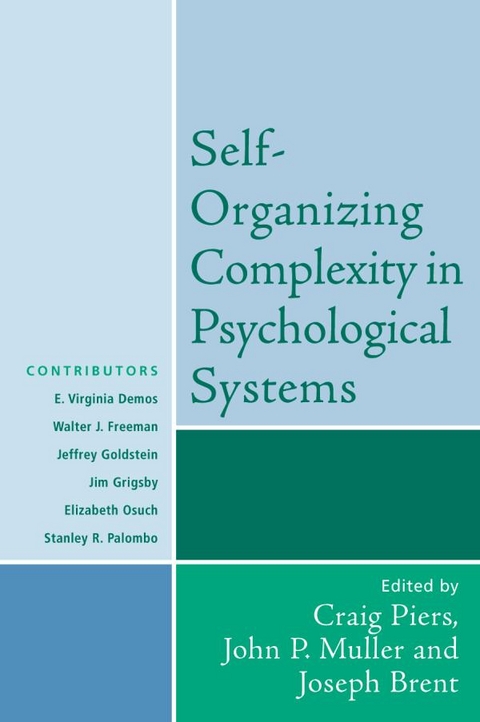
Self-Organizing Complexity in Psychological Systems (eBook)
192 Seiten
Jason Aronson, Inc. (Verlag)
978-1-4616-3065-4 (ISBN)

This volume addresses itself to the ways in which the so-called 'new sciences of complexity' can deepen and broaden neurobiological and psychological theories of mind. Complexity theory has gained increasing attention over the past 20 years across diverse areas of inquiry, including mathematics, physics, economics, biology, and the social sciences. Complexity theory concerns itself with how nonlinear dynamical systems evolve and change over time and draws on research arising from chaos theory, self-organization, artificial intelligence and cellular automata, to name a few. This emerging discipline shows many points of convergence with psychological theory and practice, emphasizing that history is irreversible and discontinuous, that small early interventions can have large and unexpected later effects, that each life trajectory is unique yet patterned, that measurement error is not random and cannot be justifiably distributed equally across experimental conditions, that a system's collective and coordinated organization is emergent and often arises from simple components in interaction, and that change is more likely to emerge under conditions of optimal turbulence.
Craig Piers, Ph.D. is a psychotherapist and clinical supervisor in the health center at Williams College and former associate director of admissions and senior staff psychologist at the Austen Riggs Center. Dr. Piers is a contributing editor of Psychoanalytic Dialogues and also serves as a reviewer for several other professional journals. John P. Muller, Ph.D. is director of training at the Austen Riggs Center. Dr. Muller is the author of numerous books, including most recently Beyond the Psychoanalytic Dyad: Developmental Semiotics in Freud, Peirce, and Lacan (Routledge, 1996). Joseph Brent, Ph.D. is a historian of ideas. He is currently president of the Semiotic Society of America and of the Charles S. Peirce Society. Dr. Brent is the author of the only full-length biography of Peirce, of which he published a revised edition in 1993.
Chapter 1 IntroductionChapter 2 Complexity theory as the parent science of psychoanalysisChapter 3 A biological theory of brain function and its relevance to psychoanalysisChapter 4 Neurodynamics, state, agency and psychological functioningChapter 5 Emergence: When a difference in degree becomes a difference in kindChapter 6 Emergence and psychological morphogenesisChapter 7 The dynamics of developmentChapter 8 The language of complexity theory
| Erscheint lt. Verlag | 18.4.2007 |
|---|---|
| Reihe/Serie | Psychological Issues |
| Co-Autor | E Virginia Demos, Walter J. Freeman, Jeffrey Goldstein, Jim Grigsby, John Muller, Stanley R. Palombo |
| Sprache | englisch |
| Themenwelt | Geisteswissenschaften ► Psychologie ► Allgemeine Psychologie |
| Geisteswissenschaften ► Psychologie ► Biopsychologie / Neurowissenschaften | |
| Geisteswissenschaften ► Psychologie ► Psychoanalyse / Tiefenpsychologie | |
| ISBN-10 | 1-4616-3065-7 / 1461630657 |
| ISBN-13 | 978-1-4616-3065-4 / 9781461630654 |
| Informationen gemäß Produktsicherheitsverordnung (GPSR) | |
| Haben Sie eine Frage zum Produkt? |
 EPUB (Adobe DRM)
Kopierschutz: Adobe-DRM
Adobe-DRM ist ein Kopierschutz, der das eBook vor Mißbrauch schützen soll. Dabei wird das eBook bereits beim Download auf Ihre persönliche Adobe-ID autorisiert. Lesen können Sie das eBook dann nur auf den Geräten, welche ebenfalls auf Ihre Adobe-ID registriert sind.
Details zum Adobe-DRM
Dateiformat: EPUB (Electronic Publication)
EPUB ist ein offener Standard für eBooks und eignet sich besonders zur Darstellung von Belletristik und Sachbüchern. Der Fließtext wird dynamisch an die Display- und Schriftgröße angepasst. Auch für mobile Lesegeräte ist EPUB daher gut geeignet.
Systemvoraussetzungen:
PC/Mac: Mit einem PC oder Mac können Sie dieses eBook lesen. Sie benötigen eine
eReader: Dieses eBook kann mit (fast) allen eBook-Readern gelesen werden. Mit dem amazon-Kindle ist es aber nicht kompatibel.
Smartphone/Tablet: Egal ob Apple oder Android, dieses eBook können Sie lesen. Sie benötigen eine
Geräteliste und zusätzliche Hinweise
Buying eBooks from abroad
For tax law reasons we can sell eBooks just within Germany and Switzerland. Regrettably we cannot fulfill eBook-orders from other countries.
aus dem Bereich