


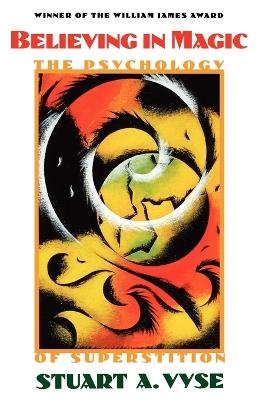
Believing in Magic
The Psychology of Superstition
Seiten
2000
Oxford University Press Inc (Verlag)
9780195136340 (ISBN)
Oxford University Press Inc (Verlag)
9780195136340 (ISBN)
- Titel erscheint in neuer Auflage
- Artikel merken
Zu diesem Artikel existiert eine Nachauflage
Examines behavioral research and shows that everyday superstitions are the natural result of several well-understood psychological processes. This book demonstrates how complex, even paradoxical, human behavior can be understood through scientific investigation. It suggests to provide alternative methods of coping with life's uncertainties.
Although we live in a technologically advanced society, superstition is as widespread as it has ever been. Far from limited to athletes and actors, superstitious beliefs are common among people of all occupations and every educational and income level. Here, Stuart Vyse investigates our proclivity towards these irrational beliefs. Superstitions, he writes, are the natural result of several well-understood psychological processes, including our human sensitivity to coincidence, a penchant for developing rituals to fill time (to battle nerves, impatience, or both), our efforts to cope with uncertainty, the need for control, and more. Vyse examines current behaviou ral research to demonstrate how complex and paradoxical human behaviour can be understood through scientific investigation, while he addresses the personality features associated with superstition and the roles of superstitious beliefs in actions.
Although superstition is a normal part of human culture, Vyse argues that we must provide alternative methods of coping with life's uncertainties by teaching decision analysis, promoting science education, and challenging ourselves to critically evaluate the sources of our beliefs.
Although we live in a technologically advanced society, superstition is as widespread as it has ever been. Far from limited to athletes and actors, superstitious beliefs are common among people of all occupations and every educational and income level. Here, Stuart Vyse investigates our proclivity towards these irrational beliefs. Superstitions, he writes, are the natural result of several well-understood psychological processes, including our human sensitivity to coincidence, a penchant for developing rituals to fill time (to battle nerves, impatience, or both), our efforts to cope with uncertainty, the need for control, and more. Vyse examines current behaviou ral research to demonstrate how complex and paradoxical human behaviour can be understood through scientific investigation, while he addresses the personality features associated with superstition and the roles of superstitious beliefs in actions.
Although superstition is a normal part of human culture, Vyse argues that we must provide alternative methods of coping with life's uncertainties by teaching decision analysis, promoting science education, and challenging ourselves to critically evaluate the sources of our beliefs.
Stuart A. Vyse is Associate Professor in the Department of Psychology at Connecticut College.
1: Believing in Magic
2: The Superstitious Person
3: Superstition and Coincidence
4: Superstitious Thinking
5: Growing Up Superstitious
6: Is Superstition Abnormal, Irrational, or Neither?
7: A Magical View of the World
Coda:
Notes:
References:
Index:
| Erscheint lt. Verlag | 1.8.2000 |
|---|---|
| Zusatzinfo | line figures and tables |
| Verlagsort | New York |
| Sprache | englisch |
| Gewicht | 224 g |
| Themenwelt | Geisteswissenschaften ► Psychologie ► Verhaltenstherapie |
| Geisteswissenschaften ► Religion / Theologie ► Weitere Religionen | |
| ISBN-13 | 9780195136340 / 9780195136340 |
| Zustand | Neuware |
| Informationen gemäß Produktsicherheitsverordnung (GPSR) | |
| Haben Sie eine Frage zum Produkt? |
Mehr entdecken
aus dem Bereich


aus dem Bereich
das Behandlungsprogramm SLEEPexpert für den klinischen Alltag
Buch | Softcover (2024)
Schattauer (Verlag)
CHF 34,95


