


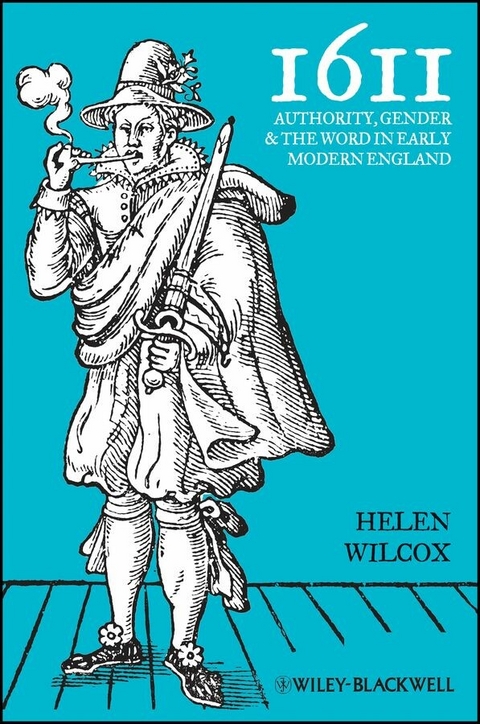
1611 (eBook)
John Wiley & Sons (Verlag)
978-1-118-32749-4 (ISBN)
- Represents an exploration of a year in the textual life of early modern England
- Juxtaposes the variety and range of texts that were published, performed, read, or heard in the same year, 1611
- Offers an account of the textual culture of the year 1611, the environment of language, and the ideas from which the Authorised Version of the English Bible emerged
Helen Wilcox is Professor of English at Bangor University, Wales, and Director of the Institute for Medieval and Early Modern Studies at the Universities of Aberystwyth and Bangor. Her most recent major publication was the highly-acclaimed annotated edition of The English Poems of George Herbert (2007).
Helen Wilcox is Professor of English at Bangor University, Wales, and Director of the Institute for Medieval and Early Modern Studies at the Universities of Aberystwyth and Bangor. Her most recent major publication was the highly-acclaimed annotated edition of The English Poems of George Herbert (2007).
Preface ix
Acknowledgements x
List of Illustrations Chronology of Selected Historical, Cultural and Textual Events in 1611
Introduction: 'The omnipotency of the word' 1
1 Jonson's Oberon and friends: masque and music in 1611 24
2 Aemilia Lanyer and the 'first fruits' of women's wit 44
3 Coryats Crudities and the 'travelling Wonder' of the age 68
4 Time, tyrants and the question of authority: The Winter's Tale and related drama 91
5 'Expresse words': Lancelot Andrewes and the sermons and devotions of 1611 112
6 The Roaring Girl on and off stage 132
7 'The new world of words': authorising translation in 1611 151
8 Donne's 'Anatomy' and the commemoration of women: 'her death hath taught us dearly' 174
9 Vengeance and virtue: The Tempest and the triumph of tragicomedy 192
Conclusion: 'This scribling age' 211
Appendix: A List of Printed Texts Published in 1611 219
Bibliography 225
Index 244
"In 1611: Authority, Gender and the Word in Early Modern
England, Helen Wilcox transports us back to the rich textual
history of a single year in Jacobean England, where she
proves to be the most amiable and knowledgeable of
guides. Side by side, elite works next to popular, the
year unfolds with all the curious excitement of an elegantly
presented almanac. Whether your preference is for The King
James Bible or Dekker and Middleton's The Roaring Girl,
Coryates Crudities or The Winter's Tale, this is a splendid
slice-of-life introduction to early modern England that will please
new readers and specialists alike."
--Jonathan F.S. Post, University of California,
Los Angeles
"Fascinating, elegant, and eminently readable, 1611 is
a treasure trove of information and critical insight. Wilcox
displays great range, writing as smartly about Shakespeare as about
Lanyer, about secular as about devotional works. She makes
juxtapositions and connections among texts that are unexpected and
illuminating."
--Achsah Guibbory, Barnard College
"Conventionally, our knowledge of texts is filtered
through canon formations, critical traditions, and political
agendas, producing predictable selectivities, but different
perspectives can be gained by the radically simple method Helen
Wilcox adopts, of assembling the texts, connections and priorities
of a key moment in the past. 1611 offers the student the
chance to share a journey of discovery of a single
year."
--Cedric Brown, Professor Emeritus, University of
Reading
1
Jonson's Oberon and friends: masque and music in 1611
Bringing in the New Year
1611 began in England with a flourish of culture in the court of King James. On New Year's Day the King, his family, his courtiers and several foreign ambassadors attended the performance of a masque in the Banqueting House of his court at Whitehall. Masques were an integral part of courtly celebrations and central to the iconography of royalty by 1611; their plots often incorporated rebellious energies shown to be overcome by peaceful authority, and their mixture of drama, music, dance and visual splendour was a symbolic display of learning, largesse and patronage. The masque to mark the beginning of 1611, Oberon, The Faery Prince, was no exception: it was the result of collaborative work by some of the greatest creative artists active in England at the time. The text, which includes dialogue, lyric verse, stage directions, scenic descriptions and learned annotation, was written by Ben Jonson; the songs were set to music by Alfonso Ferrabosco the Younger, Prince Henry's music tutor; the performance took place in costumes and on stage sets designed by Inigo Jones; its speaking parts were played by members of Shakespeare's company, the King's Men; its lively action included ballets devised by choreographers Confesse, Giles and Herne, and it concluded with courtly dances to the music of Robert Johnson. The patron and central figure of this glittering event was James's elder son, Henry, whose political coming of age had been celebrated for much of 1610 and had kept many writers, including Samuel Daniel, very busy with masques and other ceremonial ‘solemnitie’ (Daniel (1610), title page). The festivities surrounding Henry's investiture as Prince of Wales may be seen as reaching their completion with this new-year masque for 1611, reminding us immediately of the continuity of cultural history in which the start of this special year simultaneously represents the continuation and climax of other cycles of events and experiences.
The full title of the masque also evokes the recent past in textual culture. The character of Oberon played a key role in Shakespeare's A Midsummer Night's Dream, in performance since the 1590s and available in print since 1600; Oberon also featured in Robert Greene's play, The Scottish Historie of James the Fourth … Entermixed with a Pleasant Comedie, presented by Oboram, King of Fayeries, staged in 1590 and published in 1598. The subtitle of Jonson's masque, identifying Oberon as the ‘Faery Prince’, was bound to call to mind a major work of recent English poetry, Spenser's The Faerie Queene, and with it, no doubt, positive memories of the reign of Elizabeth I and the glorious triumphs of her Protestant kingdom. It is perhaps no coincidence that the poetic works of Spenser, who had died in 1599, were collected and published in a grand folio volume during 1611. Jonson's new-year masque therefore asserts, even in its title and subtitle, that there is no such thing as a clean slate on which to create new texts: the new year and its products are built on the continuing cultural memories of the preceding era.
The title page of Oberon, as printed in Jonson's own folio Workes in 1616, announces the text as ‘A Masque of Prince Henries’, indicating the young prince's sponsorship of the event, and on 1 January 1611 it was Henry himself who played the title role of the ‘Faery Prince’. This early modern dramatic, musical and visual spectacle is a fitting place to begin our study of the textual culture of 1611 – not only because it was performed on the very first day of the year and is in itself a ‘minor masterpiece’ (Butler, 188) but also because it encapsulates the typically vital interconnections in this period between language, performance, politics and the moment. The simple plot – concerning a set of rebellious satyrs awaiting the arrival of Prince Oberon in their midst – focuses on excited anticipation: the dramatic impulse is forward-looking, intent upon the appearance of this splendid emblem of virtue and authority. The masque is preoccupied with time and is imbued from the start with a sense that the moment – aptly for a new year's celebration – must be seized. The spectacle opens with a night-time scene, described by Jonson as ‘nothing … but a darke Rocke, with trees beyond it; and all wildnesse, that could be presented’ (Jonson 7 (1941), 341). The first figure on stage is a ‘Satyre’, a mythological woodland creature whose presence and physical appearance, featuring ‘cloven feet’, ‘shaggie thighs’ and ‘stubbed hornes’ (345–6), would immediately suggest uncontrolled energies and excessive revelling. Although the emphasis is on ‘play’, it is already significant that there is an urgency about the Satyr's attempt to wake his playfellows with the sound of his cornet:
Come away,
Times be short, are made for play;
The hum'rous Moone too will not stay:
What doth make you thus delay?
(341)
The ‘hum'rous’ moon ‘will not stay’: its brief pre-eminence and its shifting cycles, like the changing humours or moods of human beings, suggest the necessity of haste in the interests of pleasure. The prince whom they hope to see, Oberon, is himself the head of the fairy realm and thus a monarch of the night: even he is constrained by time. The impact of the initial nocturnal scene upon those present on New Year's Day 1611 is recorded in the extant eyewitness account of the diplomat William Trumbull. He refers to the ‘great rock’, the brilliantly craggy form at the centre of Inigo Jones's set, and specifically notes that the moon was ‘showing above through an aperture, so that its progress through the night could be observed’ (Jonson 10 (1950), 522–3). The passing of time is thus made a part of the set's visual effects and, as the action proceeds, the audience is constantly reminded of the temporal nature of the experience: ‘O, that he so long doth tarrie’, cry the impatient Chorus as they wait for Oberon, and later much is made of the cock's crow, a sign of the coming end of the night and so the exact time for the Prince to emerge – he who fills ‘every season, ev'ry place’ with his ‘grace’, and in whose face ‘Beautie dwels’ (Jonson 7 (1941), 343).
When Oberon, played by Prince Henry, is pulled forward in a chariot at this crucial moment in the masque, his arrival is hailed by a song which reminds the audience that the ultimate purpose of the masque is the glorification not of Henry but of King James. The reason given for Oberon's visit is that he is to pay his ‘annuall vowes’ to the legendary King Arthur (Jonson 7 (1941), 352) in a new-year statement of homage. This is yet another way in which the masque is explicitly shaped by the significance of time, but it is also an assertion of the hierarchical authority celebrated by the performance. In the mythology of the drama, Oberon pays his respects to ‘ARTHURS chayre’, but the words of the song explicitly point out that there is only one monarch higher than King Arthur, and that is ‘JAMES’, the ‘wonder’ of ‘tongues, of eares, of eyes’ (351). Seated on his throne in pride of place above the audience at Whitehall, James is the off-stage focus of the nocturnal masque. As Jonson's text asserts, James is the glorious sun by whose reflected light the moon and her prince can shine:
The solemne rites are well begunne;
And, though but lighted by the moone,
They show as rich, as if the sunne
Had made this night his noone.
But may none wonder, that they are so bright,
The moone now borrowes from a greater light.
(354)
Through the mirroring effect of the masque's rhetoric and movement, in which the actions on stage are intimately bound up with the relationships in and with the audience, Oberon reasserts James's position as the rightful descendant of Arthur. Indeed, Trumbull's account of the one-off performance of the masque makes it clear that James's political concerns were prominent: the ‘very large curtain’ which hung in front of the set until the performance began was ‘painted with the kingdoms of England, Scotland and Ireland, with the legend above Separata locis concordi pace figantur’, meaning ‘May what is separated in place be joined by harmonious peace’ (Jonson 10 (1950), 522). James's regal identity was firmly associated with keeping war at bay – his personal motto was the biblical phrase Beati Pacifici [blessed are the peacemakers] – and one of the major priorities of his reign was to maintain the several kingdoms of the British Isles in relatively peaceful coexistence. In an allegory of James's political concerns, the factions and orders of the fairy world who appear in the masque...
| Erscheint lt. Verlag | 18.11.2013 |
|---|---|
| Sprache | englisch |
| Themenwelt | Literatur |
| Geisteswissenschaften ► Sprach- / Literaturwissenschaft ► Anglistik / Amerikanistik | |
| Geisteswissenschaften ► Sprach- / Literaturwissenschaft ► Literaturwissenschaft | |
| Schlagworte | 17th Century English Literature • Early modern literature, early modern England, King James Bible, John Donne, Aemelia Lanyer, 17th century, literary history, cultural history, Ben Jonson, Shakespeare, The Winter's Tale, The Tempest • Englische Literatur • Englische Literatur / 17. Jhd. • English literature • Geschichte • Grossbritannien /Literatur, Literaturgeschichte • History • Literature • Literaturwissenschaft • Social & Cultural History • Sozial- u. Kulturgeschichte |
| ISBN-10 | 1-118-32749-7 / 1118327497 |
| ISBN-13 | 978-1-118-32749-4 / 9781118327494 |
| Informationen gemäß Produktsicherheitsverordnung (GPSR) | |
| Haben Sie eine Frage zum Produkt? |
 PDF (Adobe DRM)
Größe: 3,7 MB
Kopierschutz: Adobe-DRM
Adobe-DRM ist ein Kopierschutz, der das eBook vor Mißbrauch schützen soll. Dabei wird das eBook bereits beim Download auf Ihre persönliche Adobe-ID autorisiert. Lesen können Sie das eBook dann nur auf den Geräten, welche ebenfalls auf Ihre Adobe-ID registriert sind.
Details zum Adobe-DRM
Dateiformat: PDF (Portable Document Format)
Mit einem festen Seitenlayout eignet sich die PDF besonders für Fachbücher mit Spalten, Tabellen und Abbildungen. Eine PDF kann auf fast allen Geräten angezeigt werden, ist aber für kleine Displays (Smartphone, eReader) nur eingeschränkt geeignet.
Systemvoraussetzungen:
PC/Mac: Mit einem PC oder Mac können Sie dieses eBook lesen. Sie benötigen eine
eReader: Dieses eBook kann mit (fast) allen eBook-Readern gelesen werden. Mit dem amazon-Kindle ist es aber nicht kompatibel.
Smartphone/Tablet: Egal ob Apple oder Android, dieses eBook können Sie lesen. Sie benötigen eine
Geräteliste und zusätzliche Hinweise
Buying eBooks from abroad
For tax law reasons we can sell eBooks just within Germany and Switzerland. Regrettably we cannot fulfill eBook-orders from other countries.
 EPUB (Adobe DRM)
Kopierschutz: Adobe-DRM
Adobe-DRM ist ein Kopierschutz, der das eBook vor Mißbrauch schützen soll. Dabei wird das eBook bereits beim Download auf Ihre persönliche Adobe-ID autorisiert. Lesen können Sie das eBook dann nur auf den Geräten, welche ebenfalls auf Ihre Adobe-ID registriert sind.
Details zum Adobe-DRM
Dateiformat: EPUB (Electronic Publication)
EPUB ist ein offener Standard für eBooks und eignet sich besonders zur Darstellung von Belletristik und Sachbüchern. Der Fließtext wird dynamisch an die Display- und Schriftgröße angepasst. Auch für mobile Lesegeräte ist EPUB daher gut geeignet.
Systemvoraussetzungen:
PC/Mac: Mit einem PC oder Mac können Sie dieses eBook lesen. Sie benötigen eine
eReader: Dieses eBook kann mit (fast) allen eBook-Readern gelesen werden. Mit dem amazon-Kindle ist es aber nicht kompatibel.
Smartphone/Tablet: Egal ob Apple oder Android, dieses eBook können Sie lesen. Sie benötigen eine
Geräteliste und zusätzliche Hinweise
Buying eBooks from abroad
For tax law reasons we can sell eBooks just within Germany and Switzerland. Regrettably we cannot fulfill eBook-orders from other countries.
aus dem Bereich


