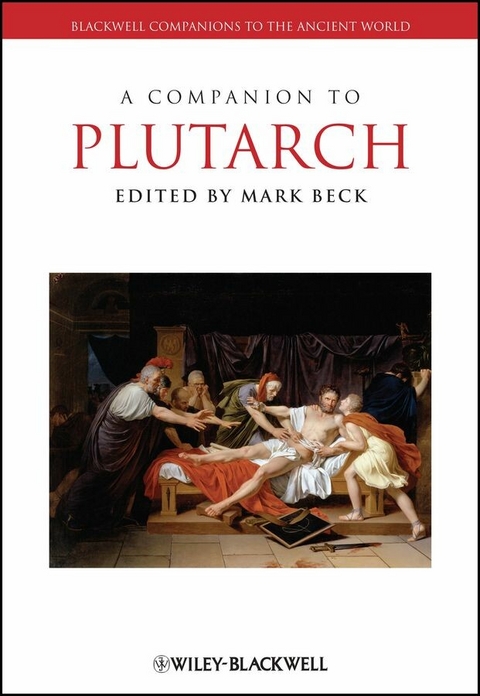
A Companion to Plutarch (eBook)
John Wiley & Sons (Verlag)
978-1-118-31623-8 (ISBN)
- Constitutes the first survey of its kind, a unified and accessible guide that offers a comprehensive discussion of all major aspects of Plutarch's oeuvre
- Provides essential background information on Plutarch's world, including his own circle of influential friends (Greek and Roman), his travels, his political activity, and his relations with Trajan and other emperors
- Offers contextualizing background, the literary and cultural details that shed light on some of the fundamental aspects of Plutarch's thought
- Surveys the ideologically crucial reception of the Greek Classical Period in Plutarch's writings
- Follows the currents of recent serious scholarship, discussing perennial interests, and delving into topics and works not formerly given serious attention
Mark Beck is Associate Professor of Classics at the University of South Carolina, where he teaches courses on Greek and Roman authors and classical civilization courses. He has published numerous articles and chapters on Plutarch and is the author of the forthcoming book, Understanding Classics: Plutarch (2012).
A Companion to Plutarch offers a broad survey of the famous historian and biographer; a coherent, comprehensive, and elegant presentation of Plutarch s thought and influence Constitutes the first survey of its kind, a unified and accessible guide that offers a comprehensive discussion of all major aspects of Plutarch s oeuvre Provides essential background information on Plutarch s world, including his own circle of influential friends (Greek and Roman), his travels, his political activity, and his relations with Trajan and other emperors Offers contextualizing background, the literary and cultural details that shed light on some of the fundamental aspects of Plutarch s thought Surveys the ideologically crucial reception of the Greek Classical Period in Plutarch s writings Follows the currents of recent serious scholarship, discussing perennial interests, and delving into topics and works not formerly given serious attention
Mark Beck is Associate Professor of Classics at the University of South Carolina, where he teaches courses on Greek and Roman authors and classical civilization courses. He has published numerous articles and chapters on Plutarch and is the author of the forthcoming book, Understanding Classics: Plutarch (2012).
Notes on Contributors x
Acknowledgments xvii
Note on the Translations and Abbreviations xviii
Introduction: Plutarch in Greece 1
Mark Beck
Part I Plutarch in Context 11
1 Plutarch and Rome 13
Philip A. Stadter
2 Plutarch and the Second Sophistic 32
Thomas A. Schmitz
3 The Role of Philosophy and Philosophers in the Imperial Period43
Michael Trapp
Part II Plutarch's Moralia 59
4 Plutarch and Platonism 61
John Dillon
5 Plutarch, Aristotle, and the Peripatetics 73
Francesco Becchi (translated by Pia Bertucci)
6 Plutarch and the Stoics 88
Jan Opsomer
7 Plutarch and Epicureanism 104
Eleni Kechagia-Ovseiko
8 Plutarch and the Skeptics 121
Mauro Bonazzi (translated by Pia Bertucci)
9 Practical Ethics 135
Lieve Van Hoof
10 Political Philosophy 149
Christopher Pelling
11 Religion and Myth 163
Rainer Hirsch-Luipold (translated by Mark Beck)
12 Poetry and Education 177
Ewen Bowie
13 Love and Marriage 191
Georgia Tsouvala
14 The Sympotic Works 207
Frieda Klotz
15 Animals in Plutarch 223
Stephen T. Newmyer
16 Plutarch the Antiquarian 235
Pascal Payen (translated by Cara Welch)
Part III Plutarch's Biographical Projects 249
17 The Lives of the Caesars 251
Aristoula Georgiadou
18 Plutarch's Galba and Otho 267
Lukas de Blois
19 The Aratus and the Artaxerxes 278
Eran Almagor
20 The Project of the Parallel Lives: Plutarch'sConception of Biography 292
Joseph Geiger
21 Kratein onomatôn: Language and Value in Plutarch304
Alexei V. Zadorojnyi
22 Compositional Methods in the Lives 321
Luc Van der Stockt
23 The Prologues 333
Timothy E. Duff
24 Morality, Characterization, and Individuality 350
Anastasios G. Nikolaidis
25 Childhood and Youth 373
Carmen Soares (translated by Camila Alvahydo)
26 Death and Other Kinds of Closure 391
Craig Cooper
27 The Synkrisis 405
David H.J. Larmour
28 The Use of Historical Sources 417
Maria Teresa Schettino (translated by Pia Bertucci)
29 Tragedy and the Hero 437
Judith Mossman
30 The Philosopher-King 449
Bernard Boulet
31 The Socratic Paradigm 463
Mark Beck
32 Fate and Fortune 479
Frances B. Titchener
33 The Perils of Ambition 488
Françoise Frazier (translated by Cara Welch)
34 Sex, Eroticism, and Politics 503
Jeffrey Beneker
35 Philanthropy, Dignity, and Euergetism 516
Geert Roskam
Part IV The Reception of Plutarch 529
36 The Reception of Plutarch from Antiquity to the ItalianRenaissance 531
Marianne Pade
37 The Renaissance in France: Amyot and Montaigne 544
Olivier Guerrier (translated by Cara Welch)
38 The Reception of Plutarch in France after the Renaissance549
Françoise Frazier (translated by Cara Welch)
39 The Reception of Plutarch in Spain 556
Aurelio Pérez Jiménez
40 Shakespeare 577
Gordon Braden
41 The Post-Renaissance Reception of Plutarch in England592
Judith Mossman
42 Plutarch and the Early American Republic 598
Carl J. Richard
Index 611
"In sum, this handsomely produced companion provides a snapshot of current research on Plutarch, while also lighting the way for new directions of inquiry about one of our most important sources on the ancient Mediterranean." (Religious Studies Review, 1 September 2015)
"As a collection of essays on Plutarch the philosopher, moralist, biographer, and human being, Beck's companion offers a well-rounded, enjoyable, and state-of-the-art introduction." (New England Classical Journal, 1 May 2015)
"This book studies him in his broader contemporary and later contexts and will be invaluable to anyone, student or specialist, investigating the culture of Plutarch's times as well, of course, as the subject himself." (Reference Reviews, 1 December 2014
"All in all, Beck's Companion to Plutarch has now become the major reference work for scholars and students of Plutarch, as well as for a wider class of readers (specialists and non-specialists alike) who want to enter the charming world of the Chaeronean philosopher." (Bryn Mawr Classical Review, 1 September 2014)
Notes on Contributors
Eran Almagor is a lecturer in the History Department at Ben Gurion University of the Negev, Israel. He was a research fellow at the Max Weber Kolleg, Erfurt (2011), the Simon Dubnow Institut, Leipzig (2009–2011), and a British Academy Visiting Fellow in Oxford (2009). His research interests cover Plutarch’s Lives and writings, Greek Imperial authors, and the image of Persia in Greek texts of the fifth and fourth centuries BCE. Among his forthcoming works is the co-edited volume Ancient Ethnography: New Approaches and the monograph Plutarch and the Persica.
Francesco Becchi is a Professor of Greek Language and Literature at Florence University, Italy. He studied ethical literature in its historical development from the Classical Age to the Imperial Age. His interests are in scientific texts of philosophy such as the Meteorologica of Aristotle, Problemata of Ps.-Aristotle, De signis and De ventis, attributed to Theophrastus, and Plutarch’s zoopsychological writings. He is also interested in the fortune of Plutarch’s Moralia through Latin translations in the age of humanism and the Renaissance and in later centuries through printed editions starting from Aldina. He has published several articles on these topics in international journals as well as critical editions, with introduction, translation, and commentary, of Plutarch’s De virtute morali (1990) and De fortuna (2010).
Mark Beck is currently Associate Professor of Classics at the University of South Carolina in Columbia, United States. He has published several articles and chapters on Plutarch.
Jeffrey Beneker is Associate Professor of Classics at the University of Wisconsin in Madison, United States. He has published The Passionate Statesman: Eros and Politics in Plutarch’s Lives (2012), in addition to several articles on Plutarch and ancient biography.
Lukas de Blois is Professor of Ancient History at the Radboud University of Nijmegen, The Netherlands. He has published books and articles on the history of the Roman Empire in the third century CE, the history of the Late Roman Republic, ancient historiography (Sallust, Tacitus, Cassius Dio), Plutarch’s works, and Greek Sicily in the fourth century BCE. He has also published, with R.J. van der Spek, Introduction to the Ancient World (2nd ed., 2008). He is a member of the editorial board of the international network Impact of Empire (Roman Empire, 200 B.C.–A.D. 476).
Mauro Bonazzi teaches History of Ancient Philosophy at the Università degli Studi di Milano, Italy. He has written on Plato, the history of Platonism in general, and on Plutarch in particular. His most recent books include Academici e Platonici. Il dibattito sullo scetticismo di Platone (2003), Platone. Fedro (2011), and (co-edited with Thomas Bénatouïl) Theoria, Praxis and the Contemplative Life after Plato and Aristotle (2012).
Bernard Boulet is currently Professor of Philosophy at Université Laval, Quebec City, Canada, where he teaches in a Great Books program. Prior to this he taught for many years at Sainte-Foy College in Quebec City. He has published books on Plato, Descartes, and Machiavelli.
Ewen Bowie was Praelector in Classics at Corpus Christi College, Oxford, UK, from 1965 to 2007, and successively University Lecturer, Reader, and Professor of Classical Languages and Literature in the University of Oxford. He is now an Emeritus Fellow of Corpus Christi College. He has published articles on early Greek elegiac, iambic, and lyric poetry; on Aristophanes; on Hellenistic poetry; and on many aspects of Greek literature and culture from the first century BCE to the third century CE, including Plutarch and the Greek novels. He recently edited (jointly with Jaś Elsner) a collection of papers on Philostratus (2009) and (jointly with Lucia Athanassaki) a collection of papers entitled Archaic and Classical Choral Song (2011) and is currently completing a commentary on Longus, Daphnis and Chloe.
Gordon Braden is Linden Kent Memorial Professor of English at the University of Virginia, United States. He is author of The Classics and English Renaissance Poetry (1978), Renaissance Tragedy and the Senecan Tradition (1985), and Petrarchan Love and the Continental Renaissance (1999), co-author with William Kerrigan of The Idea of the Renaissance (1989), and co-editor with Robert Cummings and Stuart Gillespie of The Oxford History of Literary Translation in English, vol. 2, 1550–1660 (2010).
Craig Cooper is Dean of Arts and Science at the University of Lethbridge, Alberta, Canada. He has written and published on Athenian law, Greek rhetoric, Greek historiography, and Greek biography, including Plutarch.
John Dillon graduated in Literae Humaniores from Oxford in 1963, and gained a PhD from the University of California at Berkeley in 1969. He joined the faculty of the Department of Classics at Berkeley, where he remained until 1980, serving as Chairman of the Department from 1977 to 1980. He then returned to Ireland, to assume the Regius Professorship of Greek at Trinity College Dublin, where he remained until his retirement in 2006. He is the author or editor of over thirty books in the area of Greek philosophy, in particular the history of the Platonic tradition, including The Middle Platonists (2nd ed., 1996), Alcinous: The Handbook of Platonism (trans., with commentary, 1993), Iamblichus: De Anima (ed. with John Finamore, with introduction, translation, and commentary, 2002), The Heirs of Plato: A Study of the Old Academy, 347–274 B.C. (2003), and three collections of essays, The Golden Chain: Studies in the Development of Platonism and Christianity (1991), The Great Tradition: Further Studies in the Development of Platonism and Christianity (1997), and The Platonic Heritage (2012).
Timothy E. Duff is Professor of Greek at the University of Reading, UK. He is author of Plutarch’s Lives: Exploring Virtue and Vice (1999) as well as numerous papers on Plutarch. He is editor and co-translator (with Ian Scott-Kilvert) of Plutarch: The Age of Alexander (2012).
Françoise Frazier is Professor of Greek Language and Literature at the Université de Paris Ouest Nanterre La Défense, France. She wrote her dissertation on the presentation of historical material in the Parallel Lives, has edited Plutarch’s Moralia, and has published numerous articles. She is the representative of the French section of the IPS (International Plutarch Society) and book review editor of the journal Ploutarchos.
Joseph Geiger is Shalom Horowitz Professor of Classics Emeritus at the Hebrew University of Jerusalem, Israel. He has published extensively on ancient biography, Cornelius Nepos, and Plutarch, including his monograph Cornelius Nepos and Ancient Political Biography (1985) and, most recently, a chapter on autobiographical literature during the Augustan Age in G. Marasco (ed.), Political Autobiographies and Memoirs in Antiquity (2011).
Aristoula Georgiadou is Associate Professor of Classics at the University of Patras, Greece. She is the author of Plutarch’s Pelopidas: A Historical and Philological Commentary (1997) and co-author of Plutarco. Pelopida e Marcello (1998) and Lucian’s Science Fiction Novel “True Histories”: Interpretation and Commentary (1998). Current projects include a commentary on Plutarch’s Amatorius.
Olivier Guerrier is Professor of French Literature of the Renaissance at the Université de Toulouse-Le Mirail, France. He is an honorary member of the French Institut Universitaire and president of the Société Internationale des Amis de Montaigne. He specializes in Montaigne, in the relationship between literature and other branches of knowledge, in the Renaissance and questions related to fiction in that period. His numerous publications include “Quand les poètes feignent”: “fantasie” et fiction dans les Essais de Montaigne (2002), Moralia et Œuvres morales à la Renaissance: Actes du colloque international de Toulouse (mai 2005) (2008), and Plutarque de l’Âge classique au XIXe siècle – Présences, interférences et dynamique (2012).
Rainer Hirsch-Luipold is Professor for New Testament Studies at Bern University, Switzerland, and head of the German section of the International Plutarch Society. He has worked and published on religious philosophy and philosophical religion in the Early Empire and especially on Plutarch’s religious philosophy as well as on philosophical and religious use of imagery.
Eleni Kechagia-Ovseiko studied Classics and Ancient Philosophy at the Universities of Thessaloniki, Greece (BA and Masters), and Oxford, UK (DPhil). From 2006 to 2009 she was a British Academy Postdoctoral Fellow in Classics at Oxford (Keble College). She has written articles on Plutarch, Epicureanism, and ancient biography, and has been teaching Classics and Ancient Philosophy for Oxford colleges. Her monograph, Plutarch Against Colotes: A Lesson in History of Philosophy, was published in 2011.
Frieda Klotz did a DPhil at...
| Erscheint lt. Verlag | 13.11.2013 |
|---|---|
| Reihe/Serie | Blackwell Companions to the Ancient World | Blackwell Companions to the Ancient World |
| Sprache | englisch |
| Themenwelt | Geschichte ► Allgemeine Geschichte ► Vor- und Frühgeschichte |
| Geschichte ► Allgemeine Geschichte ► Altertum / Antike | |
| Geisteswissenschaften ► Geschichte ► Regional- / Ländergeschichte | |
| Geisteswissenschaften ► Sprach- / Literaturwissenschaft ► Latein / Altgriechisch | |
| Schlagworte | Classical Greek Literature • Classical Studies • Humanistische Studien • Klassische griechische Literatur • Klassische lateinische Literatur • Latin Literature • Plutarch • Roman historian, Roman biographer, Roman historiography, Roman author, Middle Platonism, historical sources, roman sources, Hellenic Studies, scholarship, research, reference, Greek historiography, Greek author, Greek historian, Classical Greek reception, Lives of the Roman Emperors, Parallel Lives, famous Greeks and Romans |
| ISBN-10 | 1-118-31623-1 / 1118316231 |
| ISBN-13 | 978-1-118-31623-8 / 9781118316238 |
| Informationen gemäß Produktsicherheitsverordnung (GPSR) | |
| Haben Sie eine Frage zum Produkt? |
 EPUB (Adobe DRM)
Größe: 1,5 MB
Kopierschutz: Adobe-DRM
Adobe-DRM ist ein Kopierschutz, der das eBook vor Mißbrauch schützen soll. Dabei wird das eBook bereits beim Download auf Ihre persönliche Adobe-ID autorisiert. Lesen können Sie das eBook dann nur auf den Geräten, welche ebenfalls auf Ihre Adobe-ID registriert sind.
Details zum Adobe-DRM
Dateiformat: EPUB (Electronic Publication)
EPUB ist ein offener Standard für eBooks und eignet sich besonders zur Darstellung von Belletristik und Sachbüchern. Der Fließtext wird dynamisch an die Display- und Schriftgröße angepasst. Auch für mobile Lesegeräte ist EPUB daher gut geeignet.
Systemvoraussetzungen:
PC/Mac: Mit einem PC oder Mac können Sie dieses eBook lesen. Sie benötigen eine
eReader: Dieses eBook kann mit (fast) allen eBook-Readern gelesen werden. Mit dem amazon-Kindle ist es aber nicht kompatibel.
Smartphone/Tablet: Egal ob Apple oder Android, dieses eBook können Sie lesen. Sie benötigen eine
Geräteliste und zusätzliche Hinweise
Buying eBooks from abroad
For tax law reasons we can sell eBooks just within Germany and Switzerland. Regrettably we cannot fulfill eBook-orders from other countries.
 PDF (Adobe DRM)
Kopierschutz: Adobe-DRM
Adobe-DRM ist ein Kopierschutz, der das eBook vor Mißbrauch schützen soll. Dabei wird das eBook bereits beim Download auf Ihre persönliche Adobe-ID autorisiert. Lesen können Sie das eBook dann nur auf den Geräten, welche ebenfalls auf Ihre Adobe-ID registriert sind.
Details zum Adobe-DRM
Dateiformat: PDF (Portable Document Format)
Mit einem festen Seitenlayout eignet sich die PDF besonders für Fachbücher mit Spalten, Tabellen und Abbildungen. Eine PDF kann auf fast allen Geräten angezeigt werden, ist aber für kleine Displays (Smartphone, eReader) nur eingeschränkt geeignet.
Systemvoraussetzungen:
PC/Mac: Mit einem PC oder Mac können Sie dieses eBook lesen. Sie benötigen eine
eReader: Dieses eBook kann mit (fast) allen eBook-Readern gelesen werden. Mit dem amazon-Kindle ist es aber nicht kompatibel.
Smartphone/Tablet: Egal ob Apple oder Android, dieses eBook können Sie lesen. Sie benötigen eine
Geräteliste und zusätzliche Hinweise
Buying eBooks from abroad
For tax law reasons we can sell eBooks just within Germany and Switzerland. Regrettably we cannot fulfill eBook-orders from other countries.
aus dem Bereich