


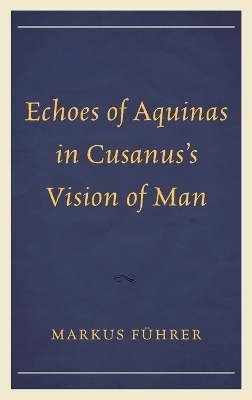
Echoes of Aquinas in Cusanus's Vision of Man
Seiten
2014
Lexington Books (Verlag)
9780739187401 (ISBN)
Lexington Books (Verlag)
9780739187401 (ISBN)
This book examines the influence of Saint Thomas Aquinas upon Nicholas of Cusa’s (Cusanus) doctrine of human nature. It explores this influence against the background of other authors associated with Cusanus’ own generation of philosophers in order to demonstrate the uniqueness of Cusanus’ use of Aquinas.
This book demonstrates the influence that the philosophical and theological anthropology of Saint Thomas Aquinas had on Nicholas of Cusa’s (Cusanus) view of human nature. While Rudolf Haubst suggested that Aquinas had, in fact, influenced several factors of Cusanus’ theology, Haubst did not explore the topic of anthropology. Since the philosophy of man is supposed to be one of the determining characteristics of the Renaissance, and because there is a prevailing opinion that Cusanus was not only a Renaissance philosopher but indeed one of the founders of Renaissance humanism, I demonstrate that his view of the place of man in the universe is remarkably similar to the view of Aquinas. A close examination of the texts of both thinkers when compared to some of the leading Renaissance writers indicates that it is not entirely true that Cusanus is Renaissance in his analysis of the human condition. Because Cusanus’ copies of some of the works of Aquinas are still intact and his marginal comments in these manuscripts indicate not only that he read Aquinas carefully, but also actually reacted to texts in Aquinas, it is possible to conduct a study of Cusanus’ use of Aquinas based directly on the text of Aquinas. It is also possible to explore similarities by studying the formulae that both writers used in expressing their respective positions. The present study appeals to students and scholars of late medieval theology and philosophy in its unique examination of the impact of Aquinas’ thought upon Cusanus.
This book demonstrates the influence that the philosophical and theological anthropology of Saint Thomas Aquinas had on Nicholas of Cusa’s (Cusanus) view of human nature. While Rudolf Haubst suggested that Aquinas had, in fact, influenced several factors of Cusanus’ theology, Haubst did not explore the topic of anthropology. Since the philosophy of man is supposed to be one of the determining characteristics of the Renaissance, and because there is a prevailing opinion that Cusanus was not only a Renaissance philosopher but indeed one of the founders of Renaissance humanism, I demonstrate that his view of the place of man in the universe is remarkably similar to the view of Aquinas. A close examination of the texts of both thinkers when compared to some of the leading Renaissance writers indicates that it is not entirely true that Cusanus is Renaissance in his analysis of the human condition. Because Cusanus’ copies of some of the works of Aquinas are still intact and his marginal comments in these manuscripts indicate not only that he read Aquinas carefully, but also actually reacted to texts in Aquinas, it is possible to conduct a study of Cusanus’ use of Aquinas based directly on the text of Aquinas. It is also possible to explore similarities by studying the formulae that both writers used in expressing their respective positions. The present study appeals to students and scholars of late medieval theology and philosophy in its unique examination of the impact of Aquinas’ thought upon Cusanus.
Markus Führer is professor of philosophy and chairman of the Department of Philosophy at Augsburg College in Minneapolis, Minnesota.
I. The Nature of Man and his Spiritual Destiny
II. The Human Individual
III. The Unity of Man’s Soul
IV. The Sensible-Corporeal Subordination of the Mind
V. Mind–Soul-Body
VI. The Rejection of Monopsychism and the Immortality of the Human Mind
VII. The Potentiality of the Human Mind as Possibility of Being and Willing All Things
VIII.Conclusions
| Sprache | englisch |
|---|---|
| Maße | 160 x 235 mm |
| Gewicht | 445 g |
| Themenwelt | Geschichte ► Allgemeine Geschichte ► Mittelalter |
| Geschichte ► Allgemeine Geschichte ► Neuzeit (bis 1918) | |
| Geisteswissenschaften ► Philosophie ► Ethik | |
| Geisteswissenschaften ► Philosophie ► Philosophie des Mittelalters | |
| Geisteswissenschaften ► Religion / Theologie | |
| ISBN-13 | 9780739187401 / 9780739187401 |
| Zustand | Neuware |
| Informationen gemäß Produktsicherheitsverordnung (GPSR) | |
| Haben Sie eine Frage zum Produkt? |
Mehr entdecken
aus dem Bereich



aus dem Bereich
Geschichte einer Augsburger Familie (1367-1650)
Buch | Softcover (2024)
Kohlhammer (Verlag)
CHF 47,60


