


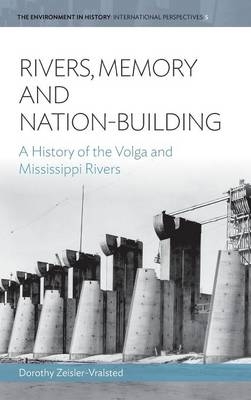
Rivers, Memory, And Nation-building
A History of the Volga and Mississippi Rivers
Seiten
2014
Berghahn Books (Verlag)
978-1-78238-431-1 (ISBN)
Berghahn Books (Verlag)
978-1-78238-431-1 (ISBN)
Rivers figure prominently in a nation's historical memory, and the Volga and Mississippi have special importance in Russian and American cultures. Beginning in the pre-modern world, both rivers served as critical trade routes connecting cultures in an extensive exchange network, while also sustaining populations through their surrounding wetlands..
Rivers figure prominently in a nation’s historical memory, and the Volga and Mississippi have special importance in Russian and American cultures. Beginning in the pre-modern world, both rivers served as critical trade routes connecting cultures in an extensive exchange network, while also sustaining populations through their surrounding wetlands and bottomlands. In modern times, “Mother Volga” and the “Father of Waters” became integral parts of national identity, contributing to a sense of Russian and American exceptionalism. Furthermore, both rivers were drafted into service as the means to modernize the nation-state through hydropower and navigation. Despite being forced into submission for modern-day hydrological regimes, the Volga and Mississippi Rivers persist in the collective memory and continue to offer solace, recreation, and sustenance. Through their histories we derive a more nuanced view of human interaction with the environment, which adds another lens to our understanding of the past.
Rivers figure prominently in a nation’s historical memory, and the Volga and Mississippi have special importance in Russian and American cultures. Beginning in the pre-modern world, both rivers served as critical trade routes connecting cultures in an extensive exchange network, while also sustaining populations through their surrounding wetlands and bottomlands. In modern times, “Mother Volga” and the “Father of Waters” became integral parts of national identity, contributing to a sense of Russian and American exceptionalism. Furthermore, both rivers were drafted into service as the means to modernize the nation-state through hydropower and navigation. Despite being forced into submission for modern-day hydrological regimes, the Volga and Mississippi Rivers persist in the collective memory and continue to offer solace, recreation, and sustenance. Through their histories we derive a more nuanced view of human interaction with the environment, which adds another lens to our understanding of the past.
Dorothy Zeisler-Vralsted is Professor of Government and International Affairs at Eastern Washington University. Her research in rivers and water resources has been published by UNESCO, Environment and History, as several book chapters, and in numerous regional journals. Prior to her academic research, she worked in the public sector in water rights and researched and consulted for water rights litigation.
List of Illustrations
Preface
Introduction
Chapter 1. The Early Years
Chapter 2. Rivers as Nation-Builders
Chapter 3. Rivers and Modernization
Chapter 4. Moscow—A Port to Five Seas
Chapter 5. Navigating the Mississippi
Epilogue
Bibliography
Index
| Reihe/Serie | Environment in History: International Perspectives |
|---|---|
| Zusatzinfo | 20 Illustrations |
| Verlagsort | Oxford |
| Sprache | englisch |
| Maße | 152 x 229 mm |
| Gewicht | 445 g |
| Themenwelt | Geschichte ► Teilgebiete der Geschichte ► Kulturgeschichte |
| ISBN-10 | 1-78238-431-6 / 1782384316 |
| ISBN-13 | 978-1-78238-431-1 / 9781782384311 |
| Zustand | Neuware |
| Informationen gemäß Produktsicherheitsverordnung (GPSR) | |
| Haben Sie eine Frage zum Produkt? |
Mehr entdecken
aus dem Bereich



aus dem Bereich
Die Revolution des Gemeinen Mannes
Buch | Softcover (2024)
C.H.Beck (Verlag)
CHF 16,80
Eine Geschichte des Geschmacks
Buch | Hardcover (2025)
C.H.Beck (Verlag)
CHF 49,95
vom Mittelalter bis zur Gegenwart
Buch | Softcover (2024)
C.H.Beck (Verlag)
CHF 16,80


