


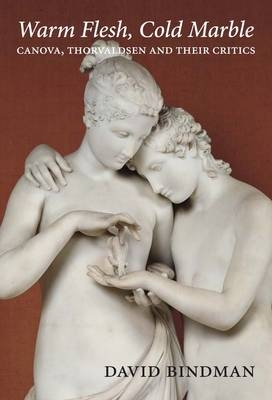
Warm Flesh, Cold Marble
Canova, Thorvaldsen, and Their Critics
Seiten
2014
Yale University Press (Verlag)
978-0-300-19789-1 (ISBN)
Yale University Press (Verlag)
978-0-300-19789-1 (ISBN)
Focusing on the aesthetic concerns of the two most important sculptors of the early 19th century, the Italian sculptor Antonio Canova (1757-1822) and his Danish rival Bertel Thorvaldsen (1770-1844), this book considers: the aesthetic autonomy of works of art, the gender of the subject, and the efficacy of marble as an imitative medium.
This brilliant book focuses on the aesthetic concerns of the two most important sculptors of the early 19th century, the great Italian sculptor Antonio Canova (1757–1822) and his illustrious Danish rival Bertel Thorvaldsen (1770–1844). Rather than comparing their artistic output, the distinguished art historian David Bindman addresses the possible impact of Kantian aesthetics on their work. Both artists had elevated reputations, and their sculptures attracted interest from philosophically minded critics. Despite the sculptors’ own apparent disdain for theory, Bindman argues that they were in dialogue with and greatly influenced by philosophical and critical debates, and made many decisions in creating their sculptures specifically in response to those debates. Warm Flesh, Cold Marble considers such intriguing topics as the aesthetic autonomy of works of art, the gender of the subject, the efficacy of marble as an imitative medium, the question of color and texture in relation to ideas and practices of antiquity, and the relationship between the whiteness of marble and ideas of race.
This brilliant book focuses on the aesthetic concerns of the two most important sculptors of the early 19th century, the great Italian sculptor Antonio Canova (1757–1822) and his illustrious Danish rival Bertel Thorvaldsen (1770–1844). Rather than comparing their artistic output, the distinguished art historian David Bindman addresses the possible impact of Kantian aesthetics on their work. Both artists had elevated reputations, and their sculptures attracted interest from philosophically minded critics. Despite the sculptors’ own apparent disdain for theory, Bindman argues that they were in dialogue with and greatly influenced by philosophical and critical debates, and made many decisions in creating their sculptures specifically in response to those debates. Warm Flesh, Cold Marble considers such intriguing topics as the aesthetic autonomy of works of art, the gender of the subject, the efficacy of marble as an imitative medium, the question of color and texture in relation to ideas and practices of antiquity, and the relationship between the whiteness of marble and ideas of race.
David Bindman is Emeritus Durning-Lawrence Professor of the History of Art, University College London, and visiting professor, history of art, Harvard University.
| Zusatzinfo | 30 color + 30 b-w illus. |
|---|---|
| Sprache | englisch |
| Maße | 152 x 229 mm |
| Gewicht | 726 g |
| Themenwelt | Kunst / Musik / Theater ► Kunstgeschichte / Kunststile |
| Kunst / Musik / Theater ► Malerei / Plastik | |
| Geisteswissenschaften ► Philosophie | |
| ISBN-10 | 0-300-19789-6 / 0300197896 |
| ISBN-13 | 978-0-300-19789-1 / 9780300197891 |
| Zustand | Neuware |
| Informationen gemäß Produktsicherheitsverordnung (GPSR) | |
| Haben Sie eine Frage zum Produkt? |
Mehr entdecken
aus dem Bereich

aus dem Bereich
kleine Kulturgeschichte einer brillanten Allianz
Buch | Softcover (2025)
Iudicium (Verlag)
CHF 33,90


