


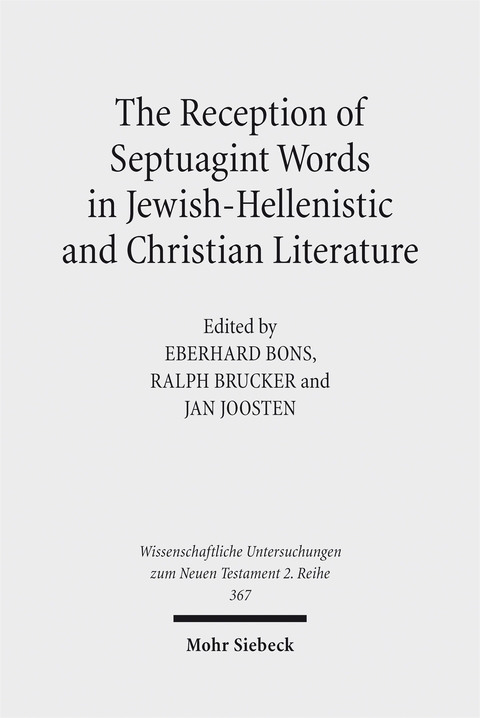
The Reception of Septuagint Words in Jewish-Hellenistic and Christian Literature
Seiten
Die Rezeption der Septuaginta im griechischsprachigen Judentum und Christentum wirft viele Fragen auf: Wie wird die unterschiedliche Bedeutung einiger Wörter in ihrer "biblischen" Verwendung im Gegensatz zu ihrer gewöhnlichen Verwendung im Griechischen von den jüdischen oder christlichen Autoren gehandhabt? In welchem Ausmaß haben die Autoren des Neuen Testaments ihre religiöse Terminologie von der Septuaginta übernommen? Die Beiträge in diesem Band verbinden die Analyse ausgewählter einzelner Wörter oder Wortgruppen mit grundsätzlichen methodischen Erwägungen.
The projected Historical and Theological Lexicon of the Septuagint will offer historical studies of Septuagint words, retracing their usage from early Greek authors, over koine Greek and the Septuagint translation itself, into Jewish-Hellenistic and early Christian literature. The latter two of these phases were the object of a workshop held in Bühl (Germany) on January 21 and 22, 2011. The reception of the Septuagint in Greek-speaking Judaism and Christianity raises many questions touching the lexicon, such as: How do Jewish or Christian authors writing in Greek handle the difference existing for some words between the "biblical" usage created in the Septuagint and the usual meaning in Greek? To what extent is it possible to affirm that New Testament authors borrowed their religious terminology from the Septuagint? Which words of the Septuagint continue in later writings with their specific meaning, and which ones go out of use? Is it possible to observe further semantic developments in the use of "biblical" words by Jewish or Christian authors writing in Greek? These and similar questions are of concern not only to the narrow fields of lexical semantics and philology. More often than not, they have important historical and theological implications. With help from some of the best specialists of Jewish-Hellenistic and early Christian texts, an effort will be made in this book to develop an adequate approach to the problems outlined. Papers will combine the analysis of selected words and word groups with considerations of method.
The projected Historical and Theological Lexicon of the Septuagint will offer historical studies of Septuagint words, retracing their usage from early Greek authors, over koine Greek and the Septuagint translation itself, into Jewish-Hellenistic and early Christian literature. The latter two of these phases were the object of a workshop held in Bühl (Germany) on January 21 and 22, 2011. The reception of the Septuagint in Greek-speaking Judaism and Christianity raises many questions touching the lexicon, such as: How do Jewish or Christian authors writing in Greek handle the difference existing for some words between the "biblical" usage created in the Septuagint and the usual meaning in Greek? To what extent is it possible to affirm that New Testament authors borrowed their religious terminology from the Septuagint? Which words of the Septuagint continue in later writings with their specific meaning, and which ones go out of use? Is it possible to observe further semantic developments in the use of "biblical" words by Jewish or Christian authors writing in Greek? These and similar questions are of concern not only to the narrow fields of lexical semantics and philology. More often than not, they have important historical and theological implications. With help from some of the best specialists of Jewish-Hellenistic and early Christian texts, an effort will be made in this book to develop an adequate approach to the problems outlined. Papers will combine the analysis of selected words and word groups with considerations of method.
Born 1961; 1996 Dr. theol., University of Hamburg; since 2010 lecturer for Old and New Testament at the Justus Liebig University Giessen; since 2011 Post-Doc Research Fellow at the University of Strasbourg.
Born in 19581988: Dr. phil., University of Mainz, Germany1993: Dr. theol., Philosophisch-Theologische Hochschule Sankt Georgen, Frankfurt am Main,Germany2000: Habilitation, University of Strasbourg2023: Professor emeritus, University of Strasbourg, and Affiliated Researcher, Fondazione per leScienze religiose, Bologna, Italy
Born 1959; Regius Professor of Hebrew, University of Oxford; Student of Christ Church.
| Erscheint lt. Verlag | 6.5.2014 |
|---|---|
| Reihe/Serie | Wissenschaftliche Untersuchungen zum Neuen Testament 2. Reihe |
| Verlagsort | Tübingen |
| Sprache | englisch |
| Maße | 157 x 232 mm |
| Gewicht | 364 g |
| Themenwelt | Geisteswissenschaften ► Religion / Theologie ► Christentum |
| Geisteswissenschaften ► Religion / Theologie ► Judentum | |
| Schlagworte | Christentum • Judentum, Literatur • New • New Testament • Old • Old Testament • Septuagint • Septuaginta • Testament |
| ISBN-13 | 9783161529535 / 9783161529535 |
| Zustand | Neuware |
| Informationen gemäß Produktsicherheitsverordnung (GPSR) | |
| Haben Sie eine Frage zum Produkt? |
Mehr entdecken
aus dem Bereich


aus dem Bereich
und was sie über die Kirche verraten
Buch | Hardcover (2024)
C.H.Beck (Verlag)
CHF 39,90


