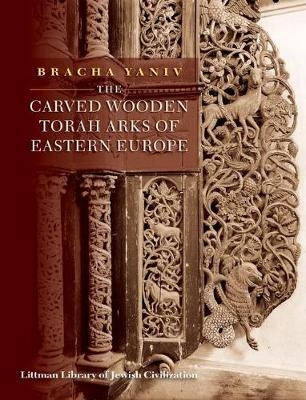
The Carved Wooden Torah Arks of Eastern Europe
The Littman Library of Jewish Civilization (Verlag)
9781906764371 (ISBN)
The carved wooden Torah arks found in eastern Europe from the seventeenth to nineteenth centuries were magnificent structures, unparalleled in their beauty and mystical significance. The work of Jewish artisans, they dominated the synagogues of numerous towns both large and small throughout the former Polish-Lithuanian Commonwealth, inspiring worshippers with their monumental scale and intricate motifs.
Virtually none of these superb pieces survived the devastation of the two world wars. Bracha Yaniv’s pioneering work therefore breathes new life into a lost genre, making it accessible to scholars and students of Jewish art, Jewish heritage, and religious art more generally. Making use of hundreds of pre-war photographs housed in local archives, she develops a vivid portrait of the history and artistic development of these arks, the scope and depth of her meticulous research successfully compensating for the absence of physical remains. In this way she has succeeded in producing a richly illustrated and comprehensive overview of a classic Jewish religious art form.
Professor Yaniv’s analysis of the historical context in which these arks emerged includes a broad survey of the traditions that characterized the local workshops of Lithuania, Belarus, and Ukraine. She also provides a detailed analysis of the motifs carved into the Torah arks and explains their mystical significance, among them representations of Temple imagery and messianic themes—and even daring visual metaphors for God. Fourteen arks are discussed in particular detail, with full supporting documentation; appendices relating to the inscriptions on the arks and to the artisans’ names will further facilitate future research. This seminal work throws new light on long-forgotten traditions of Jewish craftsmanship and religious understanding.
Bracha Yaniv is Professor Emerita of Jewish Art History at Bar-Ilan University, and founding editor of Ars Judaica: The Bar-Ilan Journal of Jewish Art. She is the author of The Carved Wooden Torah Arks of Eastern Europe (2017) and Ceremonial Synagogue Textiles from Ashkenazi, Sephardi, and Italian Communities (2019), both published by the Littman Library.
Note on Transliteration
Introduction
PART I HISTORY AND CULTURE, FUNCTION AND DESIGN
1. The Emergence of the Torah Ark from Antiquity to the Seventeenth Century
2. Historical and Cultural Background
The Polish–Lithuanian Commonwealth
The Rise of Hasidism and the Influence of Kabbalah
3. Construction and Design
Crafts, Artisans, and Workshops
The Lithuanian Workshop of Jacob ben Solomon of Raseinai
The Workshop of the Vase in a Niche
The Rococo-Style Workshop
The Belarusian Workshop
The Ukrainian Workshop
Constructing the Ark
Building
Materials and Techniques
Style and Design
PART II FORM AND CONTENT
Introduction: The Architectural Structure of the Torah Ark
4. The Kingdom of God in the Little Sanctuary
The Throne of Glory
The Eagle as a Metaphor for God
The Three Crowns
Praise of God
Perek shirah
Music in the Temple
5. The Temple
The Gateway to Heaven
The Passageway
The Inscription Avinu Malkenu
Yakhin and Boaz
The Ark of the Covenant and the Temple Appurtenances
The Kaporet and the Cherubim
The Tree of Life: Symbol of the Torah
The Seven-Branched Menorah
Introduction
The Menorah and the Showbread Table
The Menorah as a Solitary Motif
The Menorah in Zechariah’s Vision
The Menorah as a Mystical Symbol
The Temple Rituals: Avodat Hakodesh
The Sacrificial Offerings
The Priestly Blessing
Offering of the First Fruits
6. Messianic Expectations
Personal Redemption: The Leviathan and the Ox
National Redemption
Aaron’s Rod, the Manna Jar, and the Jug of Anointing Oil
The Four Species and the Shofar
PART III APPENDICES
I. Fourteen Torah Arks: Comprehensive Description, Technical Data, and Supporting Documentation
Introduction
1. Kamyanka-Buzka, Western Ukraine, c.1775
2. Vyzˇuonos, Central Lithuania, 1784
3. Zabłudów, North-East Poland, 1765
4. Druya, Northern Belarus, 1774/5
5. Zelva, Western Belarus, 1849/50
6. Lukiv, Western Ukraine, c.1781
7. Hrodna, Western Belarus, Late Eighteenth Century
8. Nowe Miasto nad Pilica˛, East-Central Poland, after 1800
9. Sˇauke˙nai, Central Lithuania, 1885/6
10. Przedbórz, Central Poland, c.1775
11. Valkininkai, South-East Lithuania, 1804
12. Ke˛pno, West-Central Poland, 1816/17
13. Vowpa, Western Belarus, 1781
14. Unidentified Ark, Ukraine, Nineteenth Century
II. Biblical Quotations and Liturgical Phrases Adorning the Arks
III. Carpenters and Woodcarvers of Arks
IV. Alphabetical List of the Arks Comprising the Visual Database for This Study
List of Illustrations
List of Institutions
Bibliography
Index
| Erscheint lt. Verlag | 1.8.2017 |
|---|---|
| Reihe/Serie | The Littman Library of Jewish Civilization |
| Zusatzinfo | 150 Illustrations |
| Verlagsort | Oxford |
| Sprache | englisch |
| Maße | 210 x 275 mm |
| Themenwelt | Kunst / Musik / Theater ► Kunstgeschichte / Kunststile |
| Kunst / Musik / Theater ► Malerei / Plastik | |
| Geisteswissenschaften ► Religion / Theologie ► Judentum | |
| Sozialwissenschaften ► Soziologie ► Spezielle Soziologien | |
| ISBN-13 | 9781906764371 / 9781906764371 |
| Zustand | Neuware |
| Informationen gemäß Produktsicherheitsverordnung (GPSR) | |
| Haben Sie eine Frage zum Produkt? |
aus dem Bereich