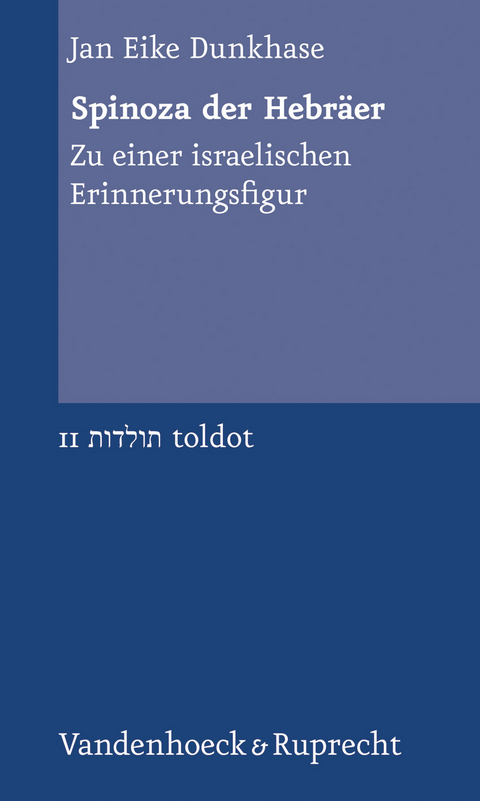
Spinoza der Hebräer
Vandenhoeck & Ruprecht (Verlag)
978-3-525-35112-3 (ISBN)
Dr. Jan Eike Dunkhase ist Wissenschaftlicher Mitarbeiter am Deutschen Literaturarchiv Marbach.
Mit einem Vorwort von Dan Diner
Jan Eike Dunkhase tells the story of how and why Spinoza became a cultural icon for secular Israelis. Drawing a line between early modern Amsterdam and contemporary Tel Aviv, extending from the seventeenth century to the present, this essay on the appropriation of Spinoza by national Jewish memory deals with thinkers as Moses Hess, historians as Heinrich Graetz, and Zionists from Eastern Europe such as Joseph Klausner, Nahum Sokolov and David Ben-Gurion. Particular attention is paid to the Hebrew translations of Spinoza’s work, which have provided the basis for creative adoptions of the philosopher’s thinking in current Israeli culture. Thus, the genealogy of “Spinoza the Hebrew” opens a new historic perspective on Israeli secularism and its conflicts.>
| Erscheint lt. Verlag | 23.10.2013 |
|---|---|
| Reihe/Serie | Toldot ; Band 011 |
| Zusatzinfo | mit 1 Abb. |
| Verlagsort | Göttingen |
| Sprache | deutsch |
| Maße | 113 x 205 mm |
| Gewicht | 194 g |
| Themenwelt | Geschichte ► Allgemeine Geschichte ► Neuzeit (bis 1918) |
| Schlagworte | 17. /Philosophie • Jahrhundert • Jahrhundert, 17. /Philosophie • Jüdische Geschichte • Jüdische Identität • Spinoza, Benedictus (Baruch) de |
| ISBN-10 | 3-525-35112-7 / 3525351127 |
| ISBN-13 | 978-3-525-35112-3 / 9783525351123 |
| Zustand | Neuware |
| Informationen gemäß Produktsicherheitsverordnung (GPSR) | |
| Haben Sie eine Frage zum Produkt? |
aus dem Bereich