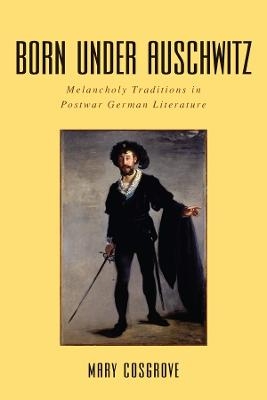
Born under Auschwitz
In German Studies the literary phenomenon of melancholy, which has a longstanding and diverse history in European letters, has typically been associated with the Early Modern and Baroque periods, Romanticism, and the crisis of modernity. This association, alongside the dominant psychoanalytical view of melancholy in German memory discourses since the 1960s, has led to its neglect as an important literary mode in postwar German literature, a situation the present book seeks to redress by identifying and analyzing epochal postwar works that use melancholy traditions to comment on German history in the aftermath of the Holocaust. It focuses on five writers - Günter Grass, Wolfgang Hildesheimer, Peter Weiss, W. G. Sebald, and Iris Hanika - who reflect on the legacy of Auschwitz as intellectuals trying to negotiate a relationship to the past based on the stigma of belonging to a perpetrator collective (Grass, Sebald, Hanika) or, broadly speaking, to the victim collective (Weiss, Hildesheimer), in order to develop a melancholy ethics of memory for the Holocaust and the Nazi past. It will appeal to scholars and students of German Studies,Comparative Literature, Cultural Studies, Cultural Memory, and Holocaust Studies.
Mary Cosgrove is Reader in German at the University of Edinburgh.
Mary Cosgrove is Professor in German at Trinity College Dublin. Her research and teaching foci include Holocaust memory and representation in literature and culture; German Jewish writing; the cultural history and theory of melancholia and boredom in European letters; and literary and narrative economics. Key publications include Born under Auschwitz: Melancholy Traditions in Postwar German Literature (Camden House, 2014); German Memory Contests: The Quest for Identity in Literature, Film, and Discourse since 1990 (Camden House, 2006; paperback 2010).
Introduction: In Defense of Melancholy
The Diseased Imagination: Perpetrator Melancholy in Günter Grass's Aus dem Tagebuch einer Schnecke and Beim Häuten der Zwiebel
The Disenchanted Mind: Victim Melancholy in Wolfgang Hildesheimer's Tynset and Masante
The Feminine Holocaust: Gender, Melancholy, and Memory in Peter Weiss's Die Ästhetik des Widerstands
From the Weltschmerz of the Postwar Penitent to Capitalism and the "Racial Century": Melancholy Diversity in W. G. Sebald's Work
Epilogue: Death of the Male Melancholy Genius: From Vergangenheitsbewältigung to Vergangenheitsbewirtschaftung in Iris Hanika's Das Eigentliche
Bibliography
Index
| Erscheint lt. Verlag | 1.4.2014 |
|---|---|
| Reihe/Serie | Studies in German Literature Linguistics and Culture |
| Verlagsort | Columbia, MD |
| Sprache | englisch |
| Maße | 152 x 229 mm |
| Gewicht | 520 g |
| Themenwelt | Geisteswissenschaften ► Geschichte |
| Geisteswissenschaften ► Sprach- / Literaturwissenschaft ► Anglistik / Amerikanistik | |
| Geisteswissenschaften ► Sprach- / Literaturwissenschaft ► Literaturwissenschaft | |
| ISBN-13 | 9781571135568 / 9781571135568 |
| Zustand | Neuware |
| Informationen gemäß Produktsicherheitsverordnung (GPSR) | |
| Haben Sie eine Frage zum Produkt? |
aus dem Bereich