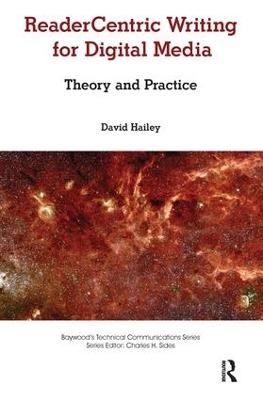
Readercentric Writing for Digital Media
Baywood Publishing Company Inc (Verlag)
978-0-89503-814-2 (ISBN)
Designed for professional writers and writing students, this text provides a rubric for writing in digital media, but more importantly, it provides a rubric and vocabulary for identifying and explaining problems in copy that already exists. The Internet has become a pastiche of cut-and-paste content, often placed by non-writers to fill space for no particular reason or by computers with no oversight from humans (e.g., Amazon.com). Because these snippets are typically on topic (but often for the wrong purpose or audience), professional writers have difficulty identifying the problems and an even harder time explaining them. Finding an effective tool for identifying and explaining problems in digital content becomes a particularly important problem as writers increasingly struggle with growing complications in complex information systems (systems that create and manage their own content with little human intervention). Being able to look at a body of copy and immediately see that it is problematic is an important skill that is lacking in a surprising number of professional writers.
Dr. David Hailey has been researching and teaching professional and technical writing at Utah State University (USU), USA since 1994 and has been researching and developing digital media since 1991, working first with bulletin board and kiosk-based hypertexts and then with html-based hypermedia. He has produced more than a dozen book-length instructional projects for organisations, including the State of Utah, DOE, NSF, US West, EPA, NEH, Sandia National Laboratories, Hitachi, and Rio Tinto, as well as USU and the University of Texas at Tyle, USA. In his largest projects, Hailey was the principal architect for USU's online Master's degree. For the first six or so years of his time at USU, Hailey developed and tested instructional modules designed to permit independent learning among engineering students, working closely with the College of Engineering and a variety of national agencies. For the past ten years, Hailey has developed and tested methods for evaluating quality of content on the Internet, first studying the parameters of usability theory, then looking for more powerful alternatives. This book results from that research, presenting those more powerful alternatives. Currently, Hailey examines methods for applying these new rubrics to texts in complex information systems.
Dedication
Introduction
SECTION I: Theory
CHAPTER 1 Why is It So Hard to Write and Evaluate Writing on the Internet?
CHAPTER 2 Anything Can Be a Text
CHAPTER 3 A Tool Called Genre
CHAPTER 4 What Does It Mean to Publish?
CHAPTER 5 Theory Behind Usability Studies
SECTION II: Application
CHAPTER 6 Proposing a New Approach to Content Evaluation
CHAPTER 7 Writing Persuasion-Centric Content
CHAPTER 8Writing Quality-Centric Content
CHAPTER 9 Writing User-Centric Content
SECTION III: Practice
CHAPTER 10 Professional Writer in an Agile Environment
CHAPTER 11 The Future—If There Be Such
Index
| Reihe/Serie | Baywood's Technical Communications |
|---|---|
| Verlagsort | Amityville |
| Sprache | englisch |
| Maße | 152 x 229 mm |
| Gewicht | 408 g |
| Themenwelt | Geisteswissenschaften ► Sprach- / Literaturwissenschaft ► Literaturwissenschaft |
| ISBN-10 | 0-89503-814-5 / 0895038145 |
| ISBN-13 | 978-0-89503-814-2 / 9780895038142 |
| Zustand | Neuware |
| Informationen gemäß Produktsicherheitsverordnung (GPSR) | |
| Haben Sie eine Frage zum Produkt? |
aus dem Bereich