


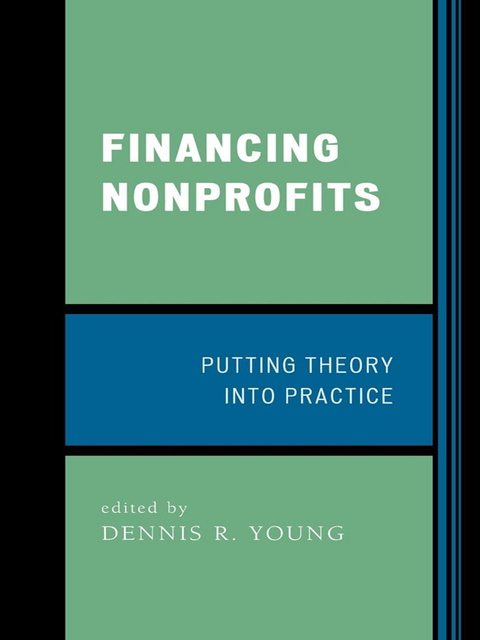
Financing Nonprofits (eBook)
454 Seiten
Altamira Press (Verlag)
978-0-7591-1412-8 (ISBN)
Nonprofits often struggle financially, overwhelmed by the need to muster a complex combination of income streams that range from grants and government funding to gifts-in-kind and volunteer labor. Financing Nonprofits draws upon a growing body of scholarship in economics and organizational theory to offer a conceptual framework for understanding this diverse mix of financing sources. By applying theory, readers can understand when a nonprofit organization should pursue particular sources of income and how it should manage its portfolio of income from different sources. Organized under the auspices of the National Center on Nonprofit Enterprise, Financing Nonprofits argues that those who would manage nonprofit organizations must first develop a conceptual framework through which they can understand the complicated and fast-paced landscape surrounding nonprofit decision-making. It offers a piece by piece analysis of the many potential components of nonprofit operating income, including a detailed study on how to accumulate the capital needed for major infrastructure projects or endowments and an examination of how to maintain a healthy investment profile once sufficient capital exists. By melding theory with practice, Young and the other contributors to Financing Nonprofits have created a volume that will serve as a practical guide to financing strategies for executive directors, CFOs, and board members of nonprofit organizations in a wide variety of fields; as a text for graduate students in nonprofit finance; and as a source of ideas for researchers to continue to probe and illuminate the many subtle issues associated with finding the right mix of resources to support the essential work of nonprofit organizations in our society.
Dennis R. Young is Bernard B. and Eugenia A. Ramsey Professor of Private Enterprise, Andrew Young School of Policy Studies at Georgia State University and president of the National Center on Nonprofit Enterprise.
Chapter 1 Preface Chapter 2 Foreword Chapter 3 I. Why Study Nonprofit Finance? Chapter 4 1. Why Study Nonprofit Finance? Chapter 5 II. Sources of Support for Operations Chapter 6 2. Individual Giving Chapter 7 3. Institutional Philanthropy Chapter 8 4. Government Funding of Nonprofit Organizations Chapter 9 5. Fee Income and Commercial Ventures Chapter 10 6. Membership Income Chapter 11 7. Investment Income Chapter 12 8. Volunteer Resources Chapter 13 III. Sources of Capital Chapter 14 9. Collaboration and Barter Chapter 15 10. Gifts-in-Kind and Other Illiquid Assets Chapter 16 11. Borrowing and Debt Chapter 17 IV. Income and Asset Portfolios, and Financial Health Chapter 18 12. Managing Endowments and Other Assets Chapter 19 13. Income Portfolios Chapter 20 14. Financial Health Chapter 21 V. Towards a Normative Theory of Nonprofit Finance Chapter 22 15. Towards a Normative Theory of Nonprofit Finance
| Erscheint lt. Verlag | 11.9.2006 |
|---|---|
| Co-Autor | Woods Bowman, Elizabeth Keating, Anne Preston, Patrick Rooney, Michael Rushton, Richard Sansing, Roxanne Spillett, Richard Steinberg, Howard Tuckman, Robert Yetman, Arthur Brooks, Joseph Cordes, Charles M. Gray, Janet Greenlee, Mark Hager, Renee Irvin, Estelle James, Kevin M. Kearns |
| Sprache | englisch |
| Themenwelt | Kunst / Musik / Theater |
| Geisteswissenschaften ► Geschichte ► Hilfswissenschaften | |
| Recht / Steuern ► Wirtschaftsrecht | |
| Sozialwissenschaften ► Kommunikation / Medien ► Buchhandel / Bibliothekswesen | |
| Sozialwissenschaften ► Politik / Verwaltung | |
| Wirtschaft ► Betriebswirtschaft / Management ► Finanzierung | |
| Wirtschaft ► Betriebswirtschaft / Management ► Planung / Organisation | |
| Wirtschaft ► Betriebswirtschaft / Management ► Unternehmensführung / Management | |
| Wirtschaft ► Volkswirtschaftslehre | |
| ISBN-10 | 0-7591-1412-9 / 0759114129 |
| ISBN-13 | 978-0-7591-1412-8 / 9780759114128 |
| Informationen gemäß Produktsicherheitsverordnung (GPSR) | |
| Haben Sie eine Frage zum Produkt? |
 EPUB (Adobe DRM)
Kopierschutz: Adobe-DRM
Adobe-DRM ist ein Kopierschutz, der das eBook vor Mißbrauch schützen soll. Dabei wird das eBook bereits beim Download auf Ihre persönliche Adobe-ID autorisiert. Lesen können Sie das eBook dann nur auf den Geräten, welche ebenfalls auf Ihre Adobe-ID registriert sind.
Details zum Adobe-DRM
Dateiformat: EPUB (Electronic Publication)
EPUB ist ein offener Standard für eBooks und eignet sich besonders zur Darstellung von Belletristik und Sachbüchern. Der Fließtext wird dynamisch an die Display- und Schriftgröße angepasst. Auch für mobile Lesegeräte ist EPUB daher gut geeignet.
Systemvoraussetzungen:
PC/Mac: Mit einem PC oder Mac können Sie dieses eBook lesen. Sie benötigen eine
eReader: Dieses eBook kann mit (fast) allen eBook-Readern gelesen werden. Mit dem amazon-Kindle ist es aber nicht kompatibel.
Smartphone/Tablet: Egal ob Apple oder Android, dieses eBook können Sie lesen. Sie benötigen eine
Geräteliste und zusätzliche Hinweise
Buying eBooks from abroad
For tax law reasons we can sell eBooks just within Germany and Switzerland. Regrettably we cannot fulfill eBook-orders from other countries.


