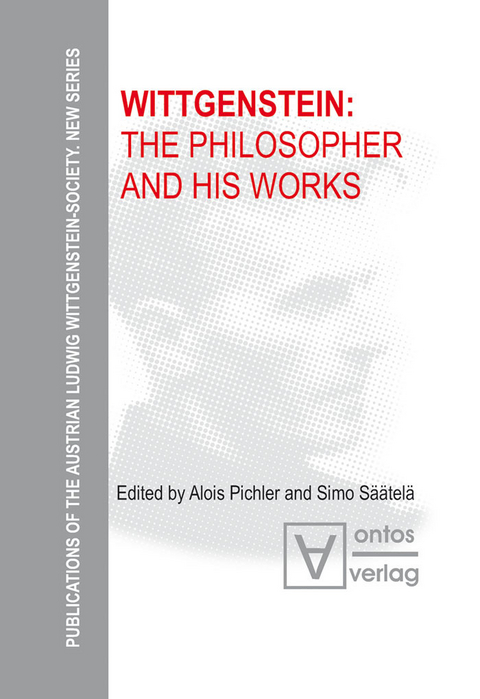
Wittgenstein: The Philosopher and his Works (eBook)
461 Seiten
Walter de Gruyter GmbH & Co.KG (Verlag)
978-3-11-032891-2 (ISBN)
This wide-ranging collection of essays contains eighteen original articles by authors representing some of the most important recent work on Wittgenstein. It deals with questions pertaining to both the interpretation and application of Wittgenstein's thought and the editing of his works. Regarding the latter, it also addresses issues concerning scholarly electronic publishing. The collection is accompanied by a comprehensive introduction which lays out the content and arguments of each contribution. Contributors: Knut Erik Tranøy, Lars Hertzberg, Georg Henrik von Wright, Marie McGinn, Cora Diamond, James Conant, David G. Stern, Eike von Savigny, P.M.S. Hacker, Hans-Johann Glock, Allan Janik, Kristóf Nyíri, Antonia Soulez, Brian McGuinness, Anthony Kenny, Joachim Schulte, Herbert Hrachovec, Cameron McEwen.
Note on the second edition 12
Acknowledgements 14
Introduction 16
Wittgenstein and therelation between lifeand philosophy 76
1. My relation to Wittgenstein 76
2. Two questions 77
3. “To stop doing philosophy” 79
4. What is it to be a philosopher? 83
Trying to keepphilosophy honest 85
1. The marginalization of Wittgenstein’s philosophy 85
2. Work on oneself 88
3. Bringing words back 89
4. A one-sided diet 93
5. The rabbit case 96
6. Pretensions are a mortgage 98
Remarks on Wittgenstein’s use of the terms “Sinn”, “sinnlos”, “unsinnig”, “wahr”, and “Gedanke” in the Tractatus 101
1. Sense and contingency 101
2. Sense and truth-value 102
3. Senseless truths? 102
4. Thoughts 103
5. “Legitimately constructed proposition” 104
6. Nonsensical Tractatus 105
Wittgenstein’s early philosophy of language and the idea of ‘the single great problem’ 110
1. A ‘single great problem’ 110
2. The significance of Frege and Russell 112
3. Russell’s theory of judgement 115
4. Frege’s conception of truth 121
5. The content of molecular propositions 125
6. Shared preconceptions 126
7. The propositions of logic 129
8. ‘Quite general propositions’ 133
9. Inference 138
Peter Winch on theTractatus and the unity of Wittgenstein’s philosophy 144
1. Winch, Malcolm and the unityof Wittgenstein’s philosophy 144
2. Opposed understandings of the Tractatus 149
3. Thinking and projecting 153
4. What’s in a name? 160
5. Winch and formalism 164
6. Another problem with Winch’s reading 169
7. The significance of Winch’s philosophical practice 173
Wittgenstein’s Later Criticism of the Tractatus 175
1. A dispute about how to read the Tractatus 175
2. The first list 185
3. The second list 190
4. The third list 202
How many Wittgensteins? 208
1. Debates in Wittgenstein scholarship 208
2. The queer grammar of talk about Wittgenstein 209
3. Who wrote the Philosophical Investigations:Nine answers in search of a philosopher 216
4. Style and context 223
Taking avowals seriously:The soul a public affair 233
1. Preliminary 233
2. Use determines meaning 234
3. First person psychological utterances 236
4. Nonverbal expressions of mental states 239
5. Research bibliography 244
Of knowledge and of knowing that someone is in pain 247
1. First person authority: the received explanation 247
2. Knowledge: the point of the concept 251
3. Knowledge: the semantic field 256
4. Methodological constraints 260
5. Some conditions of sense forthe operators ‘A knows’ and ‘I know’ 263
6. The cognitive assumption: sensations 265
7. Objections to the non-cognitive account 272
Wittgenstein and history 280
1. Wittgenstein and history 280
2. Varieties of historicism 281
3. Wittgenstein and the history of philosophy 285
4. Wittgenstein and historicism 292
5. Wittgenstein and genealogy 299
Impure reason vindicated 307
1. Rationality, Wittgenstein and philosophy of science 307
2. Rule-following and the preconditions of experience 311
3. Aristotle’s conception of practical knowledge 314
4. How practice takes care of itself: The Common Law 319
5. Leaving things as they are 320
Wittgenstein’s philosophy of pictures 325
1. Wittgenstein’s philosophy of pictures 325
2. What the printed corpus offers 328
3. Using the Nachlass: towards a re-interpretation 345
4. A philosophy of post-literacy 355
A case of early Wittgensteinian dialogism: Stances on the impossibility of “Red and green in the same place” 357
1. Dialogical style and musicality 357
2. Three (four) voices 360
3. “Our” answer to the phenomenologist 363
4. Conceptual characters, Denkstile, and the author 365
5. A faceless kind of voice – the grammatical garb of the (absent) philosopher 368
Wittgenstein: Philosophy and literature 370
1. The relation between form and content 370
2. The Tractatus 372
3. Philosophical Investigations 377
4. The form of publishing 382
A brief history of Wittgenstein editing 385
1. Wittgenstein’s will 385
2. The seventies 387
3. The eighties 389
4. The nineties 393
5. The situation today 396
What is a work by Wittgenstein? 400
1. The Wittgenstein editions 400
2. Wittgenstein’s way of working 403
3. What is a work by Wittgenstein? 405
Evaluating the Bergen Electronic Edition 408
1. The Bergen edition and Wittgenstein scholarship 408
2. Technical and other troubles 409
3. Prospects with XML 415
4. The Bergen edition and digital scholarship 419
Wittgenstein in digitalform: Perspectivesfor the future 421
1. The digital turn 421
2. Wittgenstein as test bed forelectronic humanities scholarship 423
3. Perspectives for the future 429
Bibliography andreference system 434
Authors and Abstracts 443
The editors 458
Name index 459
| Erscheint lt. Verlag | 2.5.2006 |
|---|---|
| Sprache | englisch |
| Themenwelt | Geisteswissenschaften ► Philosophie ► Allgemeines / Lexika |
| Geisteswissenschaften ► Philosophie ► Geschichte der Philosophie | |
| Geisteswissenschaften ► Philosophie ► Philosophie der Neuzeit | |
| ISBN-10 | 3-11-032891-7 / 3110328917 |
| ISBN-13 | 978-3-11-032891-2 / 9783110328912 |
| Informationen gemäß Produktsicherheitsverordnung (GPSR) | |
| Haben Sie eine Frage zum Produkt? |
 PDF (Wasserzeichen)
Größe: 1,9 MB
DRM: Digitales Wasserzeichen
Dieses eBook enthält ein digitales Wasserzeichen und ist damit für Sie personalisiert. Bei einer missbräuchlichen Weitergabe des eBooks an Dritte ist eine Rückverfolgung an die Quelle möglich.
Dateiformat: PDF (Portable Document Format)
Mit einem festen Seitenlayout eignet sich die PDF besonders für Fachbücher mit Spalten, Tabellen und Abbildungen. Eine PDF kann auf fast allen Geräten angezeigt werden, ist aber für kleine Displays (Smartphone, eReader) nur eingeschränkt geeignet.
Systemvoraussetzungen:
PC/Mac: Mit einem PC oder Mac können Sie dieses eBook lesen. Sie benötigen dafür einen PDF-Viewer - z.B. den Adobe Reader oder Adobe Digital Editions.
eReader: Dieses eBook kann mit (fast) allen eBook-Readern gelesen werden. Mit dem amazon-Kindle ist es aber nicht kompatibel.
Smartphone/Tablet: Egal ob Apple oder Android, dieses eBook können Sie lesen. Sie benötigen dafür einen PDF-Viewer - z.B. die kostenlose Adobe Digital Editions-App.
Buying eBooks from abroad
For tax law reasons we can sell eBooks just within Germany and Switzerland. Regrettably we cannot fulfill eBook-orders from other countries.
aus dem Bereich